
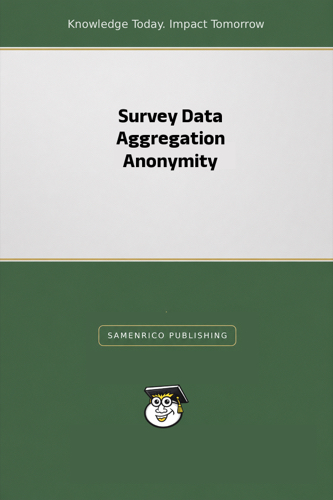
Non-FictionAI OperatorAggregation Ethics
Survey Data Aggregation Anonymity Audiobook
Aggregate survey data while preserving anonymity u
by Grenier Vina
Aggregate survey data while preserving anonymity using AI with this market research ethics guide.
Formats
Free sample
Chapter 1: The Honesty Paradox--–- Maria had just finished her annual employee engagement survey. She had spent twenty minutes carefully answering questions about her manager, her pay, and her intent to stay with the company. The survey’s header promised in bold letters: “Your responses are completely anonymous. Your manager will never see individual answers.” She trusted that promise. She wrote in the open-ended field: “My manager, David, has created a culture of fear.
I’m looking for other jobs, but please don’t tell anyone until I find one.”Three weeks later, David pulled her aside. “I hear you’re looking,” he said quietly. “I’d appreciate a heads-up next time.”Maria’s story is fictional, but the mechanism that betrayed her is not. Somewhere between her anonymous submission and the final report, a dataset was processed, aggregated, and anonymized—or so someone believed. But a quasi-identifier (her department plus her shift schedule) combined with a named entity (her manager’s first name, which she unwittingly provided in free text) was enough to collapse the illusion of anonymity.
She didn’t need to write her own name. She wrote David’s, and the system inferred the rest.This chapter reveals a foundational paradox that haunts all survey research: people lie when they believe they are being watched, but they reveal dangerous truths when they believe they are safe. The very mechanisms designed to protect respondents—anonymity pledges, confidentiality notices, data aggregation—create a false sense of security that leads people to over-share. And in the age of artificial intelligence, those over-shared truths can be re-identified with terrifying ease.The honesty paradox has three layers, each more disturbing than the last. First, surveys are systematically unreliable because respondents edit themselves.
Second, even when respondents try to be honest, they cannot overcome cognitive biases and social pressures. Third, and most counterintuitively, the promise of anonymity makes the situation worse—not because anonymity is bad, but because it is never absolute, and respondents do not know where the boundaries lie.This book is about navigating that paradox. It is about using artificial intelligence not to strip away identifiers naively—the equivalent of putting a bandage on a bullet wound—but to mathematically transform survey data so that individuals disappear into statistical noise while their aggregate truths emerge with clarity. But before we can build that future, we must understand why the present is so broken.The Archaeology…
This is the end of the free sample. Get the Audiobook to keep going. Buy now
About this book
Details
- Author
- Grenier Vina
- Publisher
- SamEnrico
- Language
- English
- Genre
- Non-Fiction, AI Operator, Aggregation Ethics
- Released
- 2026-06-09
- Pages (approx.)
- 160
- Available as
- eBook, Audiobook

Listen in the VoxFlicks app
Audiobooks and audio dramas wherever you go. Sign in with your SamEnrico account and press play.
More by Grenier Vina
 HIIT for Women Over 40Grenier Vina$11.99
 Stress Physiology MBSR CourseGrenier Vina$11.99
 Analogous Inspiration MethodGrenier Vina$11.99
 OCD Online Therapy GuideGrenier Vina$11.99
 The Secret Sauce: How a High School Dropout Built a Fast Food GiantGrenier Vina$11.99
 Silent Skies: The Rise and Fall of the U-2 Spy PlaneGrenier Vina$11.99
 Understanding Capillary Leak Syndrome With Monoclonal GammopathyGrenier Vina$17.99
 Industry R&D Without PublicationsGrenier Vina$12.99
 Engineering Master Cheap EuropeGrenier Vina$12.99
 Home Health Care WorkerGrenier Vina$11.99
 How to Start a Construction of Domestic Buildings Business (Beginners Guide)Grenier Vina$11.99
You may also like
 Hong Kong Handover 1997Dunn Johnnie$11.99
 Zumba For Postnatal Recovery CourseNeal Christian$11.99
 Zumba for BeginnersLadner Nikia$11.99
 YouTube Comment Mining GuideHumes Pandora$12.99
 Worry Box MeditationCarlin Rudy$11.99
 Workplace Stress MeditationNguyen Lynn$11.99
 Workplace Stress and Sleep RepairHawley Ivory$11.99
 Workplace Perfectionism CureDelaney Jeffry$11.99
 Workplace Injustice Anger GuideWallen Isabelle$11.99
 Work Addiction and Burnout LinkGreenwood Ester$11.99
 Women in Yoga and WellnessBeattie Galina$11.99
 Women in Stand Up ComedyChun Evangeline$11.99