
Non-FictionInformativeEducational
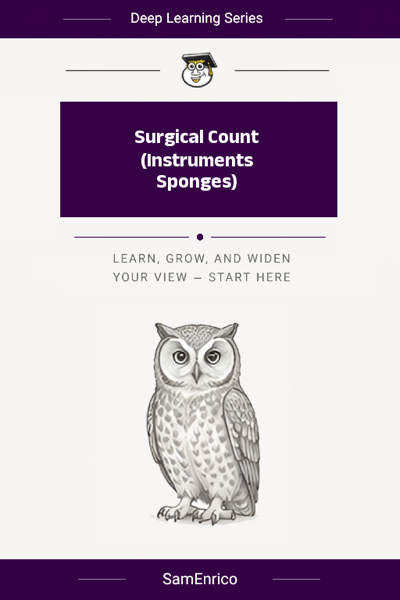
Surgical Count (Instruments Sponges) eBook
A Coursebook on Surgical Count (Instruments Sponge
by Chism Lester
A Coursebook on Surgical Count (Instruments Sponges)
Formats
Free sample
Chapter 1: The Last Sound...--The last sound a patient hears before anesthesia takes hold is often a mundane one: the clatter of an instrument tray, the beep of a monitor, the muffled voice of a nurse calling out numbers. “One laparotomy sponge. Two laparotomy sponges. Three.” To the patient drifting into unconsciousness, it is background noise. To the surgical technologist holding the sponge, it is a lifeline.
And to the lawyer who will one day depose that technologist, that sequence of numbers is either a shield or a confession.This is the reality of the surgical count. It is not a checklist. It is not a bureaucratic hoop to jump through before the “real work” of surgery begins. It is, quite literally, the last sound of safety. And when it fails, the silence that follows is deafening.In the United States, a retained surgical item (RSI)—a sponge, a needle, an instrument fragment left inside a patient’s body—occurs approximately 4,000 to 6,000 times every year.
That is one every two hours. These are not back-alley procedures or wartime field hospitals. These are modern operating rooms with HEPA filters, robotic arms, and teams of highly trained professionals. And yet, the error persists. A sponge is left behind.
A needle fragment goes unnoticed. A blue towel, invisible on X-ray, becomes a permanent, painful resident of someone’s abdomen.The financial cost of a single RSI averages over $2.5 million when legal settlements, additional surgeries, lost productivity, and insurance increases are tallied. The emotional cost is incalculable: patients suffer chronic pain, sepsis, and the trauma of a second operation they never should have needed. Surgical teams experience guilt, depression, and in the worst cases, suicide. Licenses are revoked.
Careers end. Marriages fail. All because a count went wrong.But here is the deeper truth that this chapter will establish: the surgical count is not merely a technical procedure. It is an ethical and legal imperative. It is the moment when the operating room transforms from a collection of individuals to a single accountable team.
And the doctrine that holds that team accountable has roots that stretch back nearly a century.The Ghost of Mahon v Osborne To understand why the surgical count carries the weight it does, we must travel to a British courtroom in 1939. The case was Mahon v Osborne, and its facts were disturbingly simple. A patient underwent abdominal surgery. After the procedure, a surgical swab—what we would today call a laparotomy sponge—was discovered to have been left inside her. She sued the surgeon and the hospital.The legal question was not whether a mistake had been made.
Everyone agreed a mistake had been made. The question was: who bore the burden of proof? In most negligence cases, the patient must prove that the medical provider acted carelessly. But the court made a landmark ruling. It applied the doctrine of res ipsa loquitur—Latin for “the thing speaks for itself.”The court reasoned that a surgical swab does not migrate into a patient’s abdomen on its own.
Someone left it there. And because leaving a foreign object inside a patient is not the kind of accident that happens in the absence of negligence, the very fact of the retained swab was sufficient evidence of fault. The burden of proof shifted. The surgeon and hospital now had to prove they were not negligent, rather than the patient proving they were.That doctrine has been adopted and refined in courts across the United States. In state after state, appellate decisions have held that a retained surgical item creates a presumption of negligence.
The operating team must explain how it happened—and the explanation must be compelling. “We don’t know” is not a defense. “It was a busy shift” is not a defense. “The surgeon was in a hurry” is, if anything, an admission of fault.For the scrub person and circulating nurse in the OR today, res ipsa loquitur means this: every count you perform is a legal document as much as a clinical one. The count sheet is evidence.
The verbal verification is testimony. And the moment you say “count correct,” you are swearing an oath that no reasonable jury would second-guess.The Never Event That Happens Every Day In healthcare safety language, a “never event” is exactly what it sounds like: an error that should never occur. Wrong-site surgery. Medication error resulting in death. And retained surgical items.
These are events so preventable, so fundamentally contrary to the standards of care, that their occurrence is itself an indictment of the system.And yet, never events happen. They happen with alarming regularity. The Pennsylvania Patient Safety Authority reports that retained surgical items are among the most frequently reported serious events. The ECRI Institute, an independent nonprofit that evaluates patient safety risks, has ranked RSI in its top ten health technology hazards for over a decade. In 2023, it remained on the list.Why does this “never event” keep happening?
The reasons are not what most people expect. It is rarely because no one counted. Almost every RSI case involves a team that did count. The problem is that the count was incomplete, or rushed, or interrupted, or undermined by a surgeon who said “just close, it’s fine.”Consider an anonymized case from a Florida hospital, summarized in state medical board records. A 54-year-old woman underwent a hysterectomy.
The initial sponge count was correct. The intraoperative count was correct. The final count was correct. And yet, a 12-inch laparotomy sponge was found in her vaginal cuff six weeks later, when she returned with fever, pelvic pain, and a foul discharge. How did this happen?
The surgeon had used an extra sponge to pack the vaginal vault during closure. He did not tell the circulator. He relied on his mental count—a number in his head that never made it onto the count sheet. The circulator assumed the sponge count was accurate because she had not seen the surgeon add an extra sponge. The scrub person assumed the circulator had documented it.
Three professionals, all competent, all well-intentioned, and all wrong.The patient underwent a second surgery to remove the sponge. She developed a surgical site infection that required six months of wound care. She sued. The case settled for $1.8 million. The surgeon’s privileges were restricted for six months.
The circulator left nursing entirely.The lesson of that case, and dozens like it, is not that anyone was malicious or incompetent. The lesson is that the count is only as strong as the weakest link in the communication chain. And the weakest link is almost never a technical error. It is a human one.The AORN and WHO Standards: Not Suggestions Against this backdrop of legal liability and preventable harm, professional organizations have developed clear, evidence-based standards for surgical counting. Two documents stand above all others: the AORN “Guideline for Sharps Safety” and “Guideline for Prevention of Retained Surgical Items,” and the WHO Surgical Safety Checklist.The AORN guidelines, updated most recently in 2022 and again in 2024, are the gold standard for perioperative practice in the United States and many other countries.
They are not suggestions. They are not “best practices” in the optional sense of the term. They are the standard…
This is the end of the free sample. Get the eBook to keep going. Buy now
About this book
Details
- Author
- Chism Lester
- Publisher
- SamEnrico
- Language
- English
- Genre
- Non-Fiction, Informative, Educational
- Released
- 2026-05-04
- Pages (approx.)
- 129
- Available as
- eBook, Audiobook

Read better in the ZLOADR app
Your eBooks on your phone or tablet. Sign in with your SamEnrico account and start reading.
More by Chism Lester
 Mel Blanc That's All FolksChism Lester$11.99
 Flow Assessment GuideChism Lester$11.99
 Anxiety and Binge Eating LinkChism Lester$11.99
 ADHD Relationship Stress GuideChism Lester$11.99
 The Pay to Play Provision GuideChism Lester$11.99
 The Salons of Reason: How Enlightenment Thinkers Shaped the Modern MindChism Lester$11.99
 Understanding Weleber–hecht–bigley SyndromeChism Lester$17.99
 Mobile Money Business GuideChism Lester$12.99
 Madrid Common MistakesChism Lester$12.99
 How to Become a Gas-leak TesterChism Lester$11.99
You may also like
 Hong Kong Handover 1997Dunn Johnnie$11.99
 Zumba For Postnatal Recovery CourseNeal Christian$11.99
 Zumba for BeginnersLadner Nikia$11.99
 YouTube Comment Mining GuideHumes Pandora$12.99
 Worry Box MeditationCarlin Rudy$11.99
 Workplace Stress MeditationNguyen Lynn$11.99
 Workplace Stress and Sleep RepairHawley Ivory$11.99
 Workplace Perfectionism CureDelaney Jeffry$11.99
 Workplace Injustice Anger GuideWallen Isabelle$11.99
 Work Addiction and Burnout LinkGreenwood Ester$11.99
 Women in Yoga and WellnessBeattie Galina$11.99
 Women in Stand Up ComedyChun Evangeline$11.99