
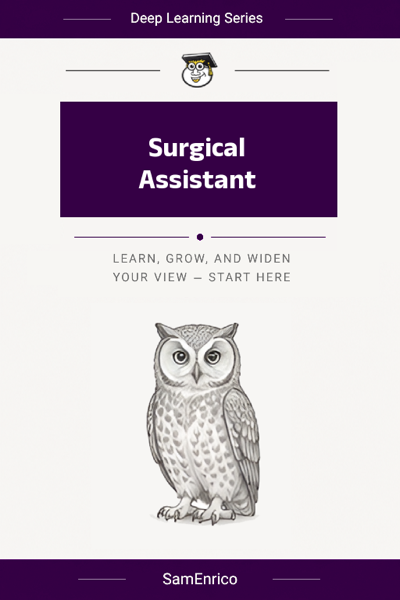
Non-FictionInformativeEducational
Surgical Assistant eBook
A Coursebook on Surgical Assistant
by Cone Zola
A Coursebook on Surgical Assistant
Formats
Free sample
Chapter 1: The Surgeon’s Right Hand…--–- The first time I watched a surgical assistant work, I mistook her for a magician. She stood across from the surgeon, not speaking, not flinching, as a scalpel parted skin. Her hands moved before the surgeon asked—retracting, clamping, cutting suture—as if she could read his mind. When a small vessel sprayed blood across the field, she already had a clamp on it before the surgeon could say “bleeder.” The room was tense, the patient was unstable, and she was the calmest person in the operating room. After the case, I asked the surgeon what he thought of her.
He said, “She’s my right hand. I wouldn’t operate without her.” That was the moment I understood the difference between being in the room and being indispensable. This book is about becoming indispensable.The Invisible Expert Every operating room has a hierarchy. At the top sits the surgeon, the captain of the ship. Next to the surgeon, often unnoticed by the patient’s family, stands the surgical assistant.
To the untrained eye, the assistant appears to be doing simple tasks—holding a retractor, passing a sponge, cutting a piece of suture. But watch closely, and you will see something else. The assistant is predicting the next move, managing the exposure, controlling bleeding before it becomes a crisis, and handling tissue with the precision of a concert pianist. The assistant is the surgeon’s external pair of hands, the second set of eyes, and often the first voice to speak up when something goes wrong.This chapter will redefine what you think you know about the surgical assistant. It will strip away the myths—that assistants are merely “retractor holders” or “technicians” or “surgeons in training.” It will replace those myths with a clear, evidence-based understanding of a distinct profession.
You will learn the historical roots of surgical assisting, the modern legal definitions of first assist and second assist, the ethical obligations that separate a professional from a pair of hands, and the business realities that determine whether you can make a living doing this work. By the end of this chapter, you will not only understand what a surgical assistant does—you will see the path to becoming indispensable.The Long Shadow of the Barber-Surgeon To understand the surgical assistant, you must first understand where the role came from. The history of surgery is a history of apprenticeship. In medieval Europe, barbers performed bloodletting, tooth extractions, and minor surgeries because they had sharp razors and steady hands. Physicians, who held university degrees, considered surgery beneath them.
The barber-surgeon was the original surgical assistant—a skilled craftsman who learned by standing next to a master and doing. There was no formal education, no certification, no scope of practice. There was only the relationship: master and apprentice, surgeon and assistant.That relationship persisted for centuries. In the nineteenth century, as surgery moved into hospitals and anesthesia made longer operations possible, the need for a dedicated assistant became obvious. A single surgeon could not operate, manage bleeding, retract tissues, and monitor the patient’s vital signs simultaneously.
The assistant evolved from an apprentice into a necessary teammate. Early surgical texts, such as those by the American surgeon William Williams Keen, described the assistant’s duties in detail: positioning the patient, holding retractors, sponging blood, tying ligatures, and closing wounds. The assistant was, in Keen’s words, “the surgeon’s other hand.”The twentieth century brought specialization. As surgery divided into general, orthopedic, cardiac, neurologic, and dozens of other subspecialties, the assistant’s role fragmented. In some hospitals, surgical residents (doctors in training) served as assistants.
In others, experienced operating room nurses stepped into the role. In still others, specially trained non-physician practitioners emerged. By the 1980s, it became clear that a standardized profession was needed. The Association of Surgical Assistants was founded, certification examinations were developed, and the modern Certified Surgical First Assistant (CSFA) was born.Today, the surgical assistant is no longer an apprentice or a lucky nurse who happened to be in the room. The surgical assistant is a certified, credentialed, legally recognized professional with a distinct scope of practice, a code of ethics, and a career ladder.
You are entering a field that has fought for recognition and won. Your job is to honor that fight by mastering the craft.The Critical Distinction: First Assist vs. Second Assist vs. Student Observer Before you can function in an operating room, you must know exactly where you fit in the hierarchy. The surgical team is not a democracy.
It is a tightly choreographed hierarchy with specific roles, responsibilities, and legal boundaries. Confusing these roles can lead to patient harm, lawsuits, and the loss of your certification. Let us define them clearly.The First Assist The first assist stands directly across from the surgeon or on the same side as the surgeon, depending on the procedure. This is the most senior assistant in the room. The first assist performs what the law calls “advanced tissue manipulation.” In plain English, that means the first assist handles tissue, controls bleeding, and closes incisions.
The specific duties include:Using instruments to dissect tissue planes.Clamping bleeding vessels.Tying ligatures around vessels (in many hospitals, the surgeon ties while the first assist provides exposure and passes suture—see Chapter 7 for the full role clarification).Suturing wounds, including deep layers and skin.Holding deep retractors that require significant force or precise positioning.Operating electrosurgical devices, suction, and laparoscopic camera systems.Anticipating the surgeon’s next move and preparing instruments without being asked.The first assist does not make independent decisions about the surgical plan. The first assist does not diagnose disease or decide which tissue to remove. The first assist executes the surgeon’s plan with skill, speed, and safety. Think of the first assist as a concert violinist following the conductor’s lead—but a violinist so talented that the conductor trusts them to fill in the spaces without being told.The Second Assist The second assist stands on the opposite side of the table from the first assist or in a position that does not block the surgeon’s primary working angle. The second assist performs “exposure and support duties”—essential work that requires less tissue manipulation.
The specific duties include:Holding superficial retractors to keep the wound open.Cutting suture material as directed by the surgeon.Suctioning blood and irrigation fluid from the field.Holding retractors that protect adjacent organs (for example, retracting the bladder during a C-section—see Chapter 12).Changing instruments on the back table and Mayo stand.Managing the laparoscopic camera in some settings (though the first assist often does this in complex cases).The second assist is not a lesser professional. Many experienced surgical assistants function as second assists because the procedure requires two assistants. In a complex abdominal case, the surgeon may have a first assist on the right side and a second assist on the left side. Both are crucial. Both are skilled.
The difference is legal and functional: the first assist may suture and dissect; the second assist may not.The Student Observer The student observer is in the room…
This is the end of the free sample. Get the eBook to keep going. Buy now
About this book
Details
- Author
- Cone Zola
- Publisher
- SamEnrico
- Language
- English
- Genre
- Non-Fiction, Informative, Educational
- Released
- 2026-05-11
- Pages (approx.)
- 139
- Available as
- eBook, Audiobook

Read better in the ZLOADR app
Your eBooks on your phone or tablet. Sign in with your SamEnrico account and start reading.
More by Cone Zola
 Self Hypnosis for Sleep ConfidenceCone Zola$11.99
 The Nobel And RNA InterferenceCone Zola$11.99
 Competitive Threat MatrixCone Zola$11.99
 GAD Mindfulness WorkbookCone Zola$11.99
 ABCDE Method for Students GuideCone Zola$11.99
 Baba Yaga’s Bone House: The Witch Who Ate the MoonCone Zola$11.99
 Into the Abyss: The Forgotten Cave Explorers of AsiaCone Zola$11.99
 Understanding Grubben–decock–borghgraef SyndromeCone Zola$17.99
 BPO Escalation ManagementCone Zola$12.99
 Professional Services LLC GuideCone Zola$12.99
 How to Become a Clay MixerCone Zola$11.99
You may also like
 Hong Kong Handover 1997Dunn Johnnie$11.99
 Zumba For Postnatal Recovery CourseNeal Christian$11.99
 Zumba for BeginnersLadner Nikia$11.99
 YouTube Comment Mining GuideHumes Pandora$12.99
 Worry Box MeditationCarlin Rudy$11.99
 Workplace Stress MeditationNguyen Lynn$11.99
 Workplace Stress and Sleep RepairHawley Ivory$11.99
 Workplace Perfectionism CureDelaney Jeffry$11.99
 Workplace Injustice Anger GuideWallen Isabelle$11.99
 Work Addiction and Burnout LinkGreenwood Ester$11.99
 Women in Yoga and WellnessBeattie Galina$11.99
 Women in Stand Up ComedyChun Evangeline$11.99