
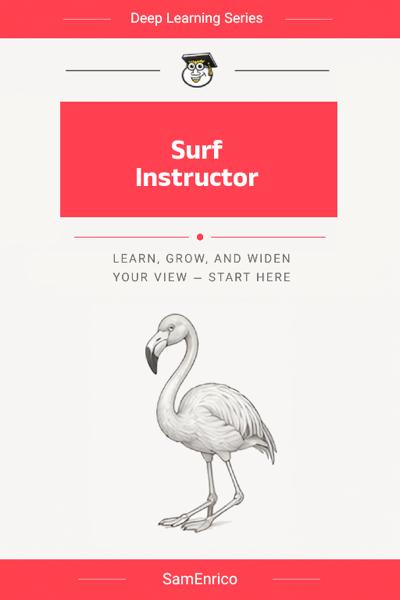
Surf Instructor eBook
A Coursebook on Surf Instructor
A Coursebook on Surf Instructor
Formats
Free sample
Chapter 1: The 80% Rule...--You have surfed for ten years. You can read a swell window, execute a proper bottom turn, and hold your own in a crowded lineup. You have never injured anyone. Students seem to like you. And yet, something is wrong.
Your students progress slowly. They look at you with polite confusion when you explain things. Some of them never come back for a second lesson, and you are not entirely sure why.The problem is not your surfing ability. The problem is that you have been treating surf instruction as a subset of surfing. It is not.
It is a distinct profession with its own body of knowledge, its own skill set, and its own failure modes. The best surfer in the water is almost never the best teacher. This is not an insult to surfers. It is an observation about the nature of expertise.Consider the difference between knowing how and knowing how to teach. When you surf well, your body executes a sequence of movements that you no longer consciously control.
You do not think about rotating your shoulders during a top turn. You just do it. This is called tacit knowledge—knowledge that lives in your muscles and intuition, unavailable for direct translation into words. Tacit knowledge is beautiful. It is also useless for teaching.Teaching requires explicit knowledge: the ability to break a movement into discrete components, name each component, diagnose errors in that component, and prescribe a correction.
Explicit knowledge is difficult to acquire precisely because it demands that you unlearn the efficiency of your own body. You must slow down what you do automatically and examine it like a mechanic examining an engine.Most surf instructors never make this transition. They stand on the beach and say things like "feel the wave" or "just go." These are not instructions. They are prayers. And when students fail—as they almost always do under such guidance—the instructor blames the student.
"Not enough commitment." "Too stiff." "Wrong attitude."This book exists because that approach is both cruel and ineffective. Students do not fail because they lack courage. They fail because their instructor has not given them a teachable path. And the instructor has not given them a teachable path because no one ever taught the instructor how to teach.This chapter will introduce the foundational framework that governs everything else in this book: the 80% Rule, the Three Pillars of Instruction, the Four Student Archetypes, and the 4-Step Fear Protocol. By the end of this chapter, you will understand why technical surfing ability accounts for only twenty percent of your effectiveness—and why the other eighty percent is entirely within your control to improve.--The 80% Rule: Why Your Surfing Ability Almost Doesn't Matter Let us begin with an uncomfortable question.
If you had to choose between two instructors for a complete beginner—one who surfs at an elite level but cannot explain a pop-up in simple terms, and one who surfs at an intermediate level but can diagnose and correct seven different pop-up errors in real time—which would you choose?The correct answer is the second instructor. And yet the surf industry consistently privileges the first. Surf schools hire based on the instructor's surfing reel. Students ask "how long have you been surfing?" as a proxy for quality. The assumption is that better surfers make better teachers.
This assumption is false.After analyzing thousands of lessons across dozens of surf schools, a consistent pattern emerges. Instructor effectiveness correlates with technical surfing ability only up to a very low threshold. Once an instructor can competently demonstrate the skill they are teaching—which for beginners requires only the ability to catch a two-foot wave and stand up—additional surfing ability adds almost nothing to student outcomes.The data suggests a rough breakdown. Technical surfing ability accounts for approximately twenty percent of effective instruction. The remaining eighty percent consists of professionalism, communication, empathy, logistics, risk management, and psychological attunement.
This is the 80% Rule.Let us be precise about what this rule does and does not claim. It does not claim that surfing ability is irrelevant. An instructor who cannot catch a wave cannot demonstrate anything. But once that minimum threshold is met—and it is a low threshold—additional surfing skill yields diminishing returns. A former professional surfer is not automatically a better beginner instructor than a competent intermediate who has studied pedagogy.The eighty percent breaks down further.
Professionalism accounts for about fifteen percent: showing up on time, having equipment ready, communicating cancellations clearly. Communication accounts for about twenty-five percent: using simple language, giving one instruction at a time, checking for understanding. Empathy accounts for about twenty percent: reading the student's emotional state, adjusting the lesson plan in real time, knowing when to push and when to pause. Risk management accounts for about fifteen percent: scanning the water, positioning correctly, anticipating hazards before they arrive. Logistics accounts for about five percent: board selection, wetsuit fit, tide timing.These percentages are not scientifically precise.
They vary by context. A lesson for an anxious adult requires more empathy; a lesson for a group of children requires more game-based logistics; an advanced coaching session requires more technical demonstration. But the underlying principle holds across contexts: the majority of effective instruction has nothing to do with how well you surf.This is liberating news. You cannot dramatically change your surfing ability in a weekend. But you can dramatically change your professionalism, your communication, your empathy, and your risk management.
The eighty percent is learnable. And this book will teach it.--The Three Pillars of Instruction: Safety, Progression, Fun Every lesson, every student, every wave reduces to three non-negotiable priorities. These are the Three Pillars of Instruction. They are ordered by importance. You cannot access the second pillar without securing the first.
You cannot access the third pillar without securing the second.Pillar One: Safety. This is non-negotiable. No student drowns. No student sustains a spinal injury. No student is struck by a loose board.
Safety is not a value among others. It is the condition for the possibility of teaching. If you cannot guarantee safety in a given set of conditions, you do not enter the water. Period.Safety requires specific competencies that are covered in detail in Chapter 7: the S.W.A.P. scanning method, spinal injury management, rip current identification, and the legal standard of care.
For now, internalize this principle: safety is not a checklist. It is a mindset. You are scanning constantly. You are anticipating constantly. You are positioning yourself relative to the weakest student constantly.
Your first job is lifeguard. Your second job is teacher. Never reverse that order.Pillar Two: Progression. The student must improve measurably during the session. This does not mean they must stand up on their first wave.
Progression can be smaller: they paddled more efficiently than last time. They looked down the line before standing. They identified a rip current on their own. Measurable improvement is what separates instruction from recreation.If a student completes a lesson without progressing, the fault is almost never the student's. It is the instructor's.
You chose the wrong board. You selected the wrong break. You gave unclear instructions. You failed to notice a correctable…
This is the end of the free sample. Get the eBook to keep going. Buy now
About this book
Details
- Author
- Higdon Yessenia
- Publisher
- SamEnrico
- Language
- English
- Genre
- Non-Fiction, Informative, Educational
- Released
- 2026-05-18
- Pages (approx.)
- 155
- Available as
- eBook, Audiobook

Read better in the ZLOADR app
Your eBooks on your phone or tablet. Sign in with your SamEnrico account and start reading.
More by Higdon Yessenia
 Maharishi TM Instruction PrimerHigdon Yessenia$11.99
 Yahoo's Epsilon ConnectionHigdon Yessenia$11.99
 Thimerosal Preservative FactsHigdon Yessenia$11.99
 Forgiveness Self Affirmation GuideHigdon Yessenia$11.99
 The John Wayne Gacy Detective TeamHigdon Yessenia$11.99
 The Chassepot Rifle: The Weapon That Won the Franco-Prussian WarHigdon Yessenia$11.99
 Understanding Multiple Joint Dislocations Metaphyseal DysplasiaHigdon Yessenia$17.99
 AI Working Capital AnalysisHigdon Yessenia$12.99
 Inditex Group GuideHigdon Yessenia$12.99
 How to Start a Bulk Carrier (cargo Ship) Business (Beginners Guide)Higdon Yessenia$11.99