
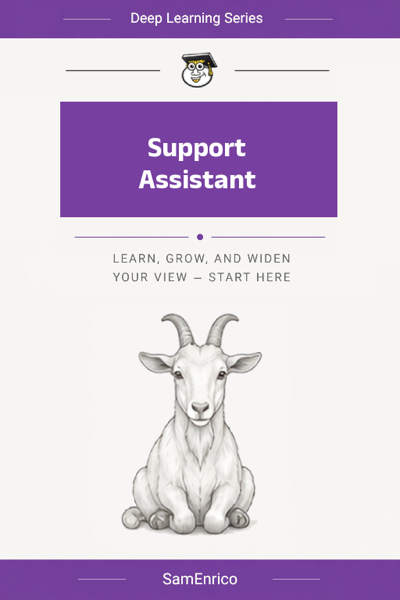
Non-FictionInformativeEducational
Support Assistant eBook
A Coursebook on Support Assistant
by Long Lance
A Coursebook on Support Assistant
Formats
Free sample
Chapter 1: The Invisible Hand...--The first time I realized I had become invisible, I was standing in a boardroom holding a cup of coffee that I had neither been asked to fetch nor reminded to brew. The CEO was mid-sentence, outlining a quarterly strategy that I had helped research, schedule, and refine over the preceding six weeks. He gestured toward a chart on the screen—a chart I had built at 11:00 PM the night before after discovering a critical data error in the original deck. No one in that room knew my name. No one knew about the chart.
But the meeting ran perfectly, the decision was made, and the CEO looked like a genius.That is the paradox of the modern support assistant. When you do your job flawlessly, no one knows you did anything at all. You become an invisible hand—guiding, correcting, protecting, and enabling. And if you are doing it right, that invisibility is not a failure of recognition. It is a sign of mastery.This chapter is not about learning to accept invisibility.
It is about understanding that the most powerful support assistants are not the ones who seek credit. They are the ones who make success look effortless, who absorb chaos before it reaches their executive, and who transform complexity into clarity without leaving a trace of their own labor. You are about to learn how to become that kind of professional.But first, we must dismantle a dangerous and outdated story—the story of what an assistant is supposed to be.The Ghost of the Typewriter For nearly a century, the word "assistant" carried baggage that has nothing to do with the modern role. Picture the cultural image: a quiet figure in a corner office, taking dictation, fetching coffee, typing letters, and answering phones with a rehearsed sweetness. This figure was competent but passive.
Necessary but invisible in a way that implied low status. A helper, not a partner.That image is a lie. Or more accurately, it is a fossil.The clerical assistant of the 1950s existed in a world of physical files, carbon paper, switchboards, and typewriters. The job was defined by tools, not by thinking. Speed and accuracy mattered.
Judgment and strategy were not required because the executive made all the decisions. The assistant executed.That world collapsed decades ago. Email, cloud storage, scheduling software, project management platforms, and now artificial intelligence have transformed the mechanical tasks of the old assistant into automated processes. Typing speed is irrelevant. Filing is algorithmic.
Scheduling is computational. The assistant who merely executes has been outsourced, automated, or rendered redundant.And yet, the demand for exceptional support assistants has never been higher. Top executives compete for elite assistants. Companies struggle to hire and retain them. Salaries for strategic executive assistants in major cities routinely exceed six figures.
Virtual assistants with specialized skills command premium rates.What changed? The role flipped from mechanical to strategic. From reactive to proactive. From task-completion to outcome-achievement. The modern assistant does not take orders—they anticipate needs.
They do not manage calendars—they protect time as a strategic asset. They do not answer phones—they manage relationships. They do not type letters—they draft board-level communications.The ghost of the typewriter still haunts the profession, however. Many assistants internalize the old story. They wait for instructions.
They hesitate to make decisions. They assume their work should remain invisible in the worst sense—unvalued, unseen, and unrewarded. Others, including some executives, still treat assistants as low-level operators rather than strategic partners.Your first job as a support assistant is to recognize that story for what it is: a relic. And then to write a new one.The Four Faces of the Modern Assistant Not all support roles are the same. Before you can master your craft, you need to understand which version of the role you currently occupy—and which version you want to grow into.
The book will refer back to these four role types repeatedly, and each chapter includes sidebars tailored to your specific context. Here they are, from broadest to most specialized.Administrative Assistant This is the most common entry point. Administrative assistants typically support a department, a team, or multiple managers rather than a single executive. Their work is broad but not necessarily deep: expense reports, travel booking, meeting coordination, document management, and internal communication. The challenge of this role is fragmentation—juggling competing demands from multiple stakeholders without clear authority.
The opportunity is learning the full ecosystem of business operations. Many exceptional executive assistants started here.Executive Assistant The executive assistant supports one or two senior leaders, often at the C-suite or vice president level. This role requires strategic gatekeeping—deciding who gets access to the executive's time, what information reaches them, and how priorities are set. Executive assistants are expected to anticipate needs, manage confidential information, and act as a trusted extension of their executive. The challenge is managing the intensity of a high-pressure relationship.
The opportunity is visibility into organizational strategy and decision-making at the highest levels.Personal Assistant Personal assistants blend professional and private support. They might manage household staff, schedule personal appointments, coordinate family travel, or handle private finances alongside professional tasks. This role requires exceptional discretion and boundary management—you will know things about your principal's life that no one else knows. The challenge is the blurred line between work and personal life. The opportunity is deep trust and often a more flexible, varied workday.Virtual Assistant Virtual assistants work remotely, often for multiple clients simultaneously.
They may specialize in specific tasks (social media management, email processing, bookkeeping) or offer general administrative support. This role requires self-discipline, time management across different time zones, and the ability to build trust without physical proximity. The challenge is isolation and inconsistent workloads. The opportunity is flexibility, autonomy, and potentially higher income through specialization.Throughout this book, you will see callout boxes labeled "For Administrative," "For Executive," "For Personal," and "For Virtual." These will help you filter the advice to your specific context. But here is the most important truth: all four roles are shifting toward the same center.
Administrative assistants are being asked to think strategically. Executive assistants are being asked to manage projects. Personal assistants are being asked to handle complex logistics. Virtual assistants are being asked to integrate deeply with client teams. The lines are blurring.
The future belongs to assistants who can operate across all four domains.The Three Mindset Shifts That Separate the Extraordinary from the Ordinary You can learn every tool, template, and technique in this book. But without the right mindset, none of it will matter. Here are the three shifts that separate assistants who survive from assistants who thrive.From Waiting to Anticipating The average assistant waits for instructions. "What would you like me to do next?" "Should I book that meeting?" "Do you want me to follow up?" These questions feel polite and safe. But they also signal dependence.
Every time you ask for direction, you transfer a small amount of cognitive load to your executive. Enough of those transfers, and you become a net drain rather than a force multiplier.The extraordinary assistant anticipates. They…
This is the end of the free sample. Get the eBook to keep going. Buy now
About this book
Details
- Author
- Long Lance
- Publisher
- SamEnrico
- Language
- English
- Genre
- Non-Fiction, Informative, Educational
- Released
- 2026-06-02
- Pages (approx.)
- 148
- Available as
- eBook, Audiobook

Read better in the ZLOADR app
Your eBooks on your phone or tablet. Sign in with your SamEnrico account and start reading.
More by Long Lance
 SAS Oman InsurgencyLong Lance$11.99
 Alcoholism and Codependency WorkbookLong Lance$11.99
 Alcoholic Parent HealingLong Lance$11.99
 Dream Timeline ProjectLong Lance$11.99
 Philippines Real Estate Virtual AssistantsLong Lance$12.99
 How to Produce Cleaning RagsLong Lance$11.99
 A Beginners Guide to Scrabble (Volume 1)Long Lance$11.99
You may also like
 Hong Kong Handover 1997Dunn Johnnie$11.99
 Zumba For Postnatal Recovery CourseNeal Christian$11.99
 Zumba for BeginnersLadner Nikia$11.99
 YouTube Comment Mining GuideHumes Pandora$12.99
 Worry Box MeditationCarlin Rudy$11.99
 Workplace Stress MeditationNguyen Lynn$11.99
 Workplace Stress and Sleep RepairHawley Ivory$11.99
 Workplace Perfectionism CureDelaney Jeffry$11.99
 Workplace Injustice Anger GuideWallen Isabelle$11.99
 Work Addiction and Burnout LinkGreenwood Ester$11.99
 Women in Yoga and WellnessBeattie Galina$11.99
 Women in Stand Up ComedyChun Evangeline$11.99