
Non-FictionInformativeEducational
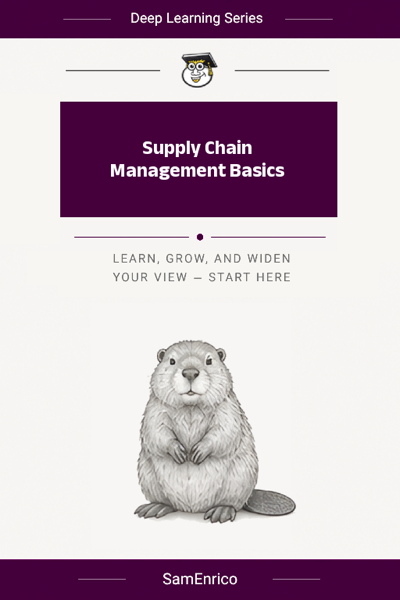
Supply Chain Management Basics eBook
A Coursebook on Supply Chain Management Basics
by Vinson Iesha
A Coursebook on Supply Chain Management Basics
Formats
Free sample
Chapter 1: The Metal Box That Changed Everything--– The world before the container was slow, fragmented, and local. If you wanted a sofa from Denmark delivered to your living room in Ohio, you didn’t just pay for the sofa. You paid for weeks of waiting, multiple transfers between truck and train and ship, and the inevitable damage from stevedores who handled every crate as if it contained bricks. More than half of the cost of international trade before 1956 was simply the cost of handling goods at the docks. Loading a ship required a small army of longshoremen, each gang moving less than five tons per hour.
Breakage, theft, and delay were not exceptions but expectations. Then came the box.This chapter tells the origin story of modern supply chain management through the single most important object you have probably never consciously noticed: the shipping container. Without understanding the container, you cannot understand why your sneakers cost thirty dollars instead of three hundred, why your grocery store has fresh grapes in January, or why supply chains became global in the first place. The container did not just change how things move. It changed where things are made, how companies organize themselves, and which cities and countries win or lose in the global economy.By the end of this chapter, you will understand why standardization matters more than speed, why physical infrastructure is the silent backbone of trade, and why a simple metal box remains the most powerful force in supply chain management.The World Before the Box: Chaos at the Waterfront Imagine a port in the early 1950s.
Not a sleek automated terminal with towering cranes and stacked containers, but a cluttered waterfront packed with longshoremen, wooden crates, barrels, sacks, and pallets of every imaginable size. A ship arrives from Europe carrying machinery, wine, textiles, and spare parts. Each item is packed differently. A crate of engines might weigh two tons; a barrel of olive oil, four hundred pounds; a carton of silk, thirty pounds but requiring careful handling. Every piece must be unloaded individually, catalogued, moved to a warehouse, and then reloaded onto trucks or trains that may or may not show up on time.The numbers are staggering.
In 1955, the average break-bulk cargo ship—the term for loose, non-containerized freight—required between one and two weeks to load or unload. Longshoremen worked in gangs of twenty to fifty men, earning good wages but working dangerous, erratic hours. Theft was so common that port cities developed black markets for “fell off the truck” goods. Spoilage ruined perishable shipments. And the cost per ton?
Approximately $5.86 to load a ship, adjusted for today’s dollars.This system did not scale. As global trade grew after World War II, ports became chokepoints. Ships sat idle at berths for weeks, burning money while workers struggled with incompatible packaging, missing paperwork, and the sheer physical limits of human lifting. Something had to change. But no one yet knew that the solution was not faster cranes or better workers.
The solution was making the cargo itself disappear into a standardized box.Malcom Mc Lean: The Trucker Who Saw the Future Malcom Mc Lean was not a shipping executive, a military logistician, or a government planner. He was a truck driver from North Carolina who built a small transport company into one of the largest trucking fleets on the East Coast. Every day, he watched his trucks sit idle at ports while cargo was unloaded manually. He realized that the expensive part of shipping was not moving goods across the ocean. The expensive part was handling them at the docks.Mc Lean’s insight was deceptively simple: instead of loading loose cargo onto a ship, why not load the entire truck trailer directly onto the vessel?
The trailer becomes the container. The goods never need to be touched after they leave the factory until they arrive at the customer’s door. No unpacking. No repacking. No longshoremen handling individual crates.
Just lift, place, and go.In 1956, Mc Lean put his theory to the test. He purchased a converted tanker ship, the Ideal X, and loaded fifty-eight aluminum truck trailers onto its deck. These were not yet the standardized intermodal containers we recognize today, but the principle was born. The Ideal X sailed from Newark, New Jersey, to Houston, Texas. The result was revolutionary: loading cost dropped from 5.86pertontojust5.86 per ton to just 5.86pertontojust0.16 per ton.
A reduction of ninety-seven percent.Mc Lean did not stop with a single voyage. He sold his trucking company, borrowed heavily, and built a new shipping line called Sea-Land. He designed ships specifically for containers, built ports equipped with gantry cranes to lift them, and negotiated with railroads to carry containers on flatcars. He fought unions, regulators, and competitors. He lost fortunes and made them back.
But by the late 1960s, containerization was no longer an experiment. It was an inevitability.The Invention of Standardization Mc Lean’s genius was not the container itself—similar ideas had been tried for decades. The genius was standardization. A container is not useful if every trucking company uses a different size, every railroad a different latching system, every port a different crane. For containerization to work globally, everyone had to agree on the same box.That agreement arrived in the 1960s through the International Organization for Standardization (ISO).
The ISO defined the external dimensions, corner fittings, strength requirements, and handling methods for shipping containers. The most common size became 20 feet long, 8 feet wide, and 8 feet 6 inches high—the twenty-foot equivalent unit, or TEU. Forty-foot containers (two TEUs) soon followed. Every container since then, from the smallest feeder ship to the largest ultra-large container vessel, is designed around these dimensions.Standardization created three critical effects. First, intermodalism: a container can travel from a factory in China, by truck to a rail terminal, by train to a port, by ship across the ocean, by another train to a distribution center, and by a final truck to a retailer—without ever being opened.
One box, one journey, one set of handling costs. Second, predictability: because every container has the same corner castings, cranes and chassis and stacking systems work identically everywhere. A container loaded in Shanghai will fit on a truck in Chicago. Third, scalability: standardized containers stack exactly on top of each other, allowing ever-larger ships. The Ideal X carried fifty-eight containers.
Today’s largest vessels carry over twenty-four thousand.To understand the power of standardization, this chapter introduces a concept we will revisit throughout the book: the Dalian vs. Detroit effect.The Dalian vs. Detroit Effect: How Containers Reshaped Geography Before containerization, manufacturing tended to cluster near its final markets. Factories located close to customers because transporting finished goods was expensive, slow, and risky. Detroit produced cars for North America.
Manchester produced textiles for Britain. Lyon produced silk for Europe. Geography was destiny.Containerization flipped this logic. When shipping a container across the ocean costs almost nothing compared to the value inside, distance becomes a minor factor. The real cost is not the miles but the handoffs.
Suddenly, it made economic sense to locate factories wherever labor, land, energy, and regulations were cheapest, then ship finished goods…
This is the end of the free sample. Get the eBook to keep going. Buy now
About this book
Details
- Author
- Vinson Iesha
- Publisher
- SamEnrico
- Language
- English
- Genre
- Non-Fiction, Informative, Educational
- Released
- 2026-05-04
- Pages (approx.)
- 155
- Available as
- eBook, Audiobook

Read better in the ZLOADR app
Your eBooks on your phone or tablet. Sign in with your SamEnrico account and start reading.
More by Vinson Iesha
 Time Boundary MasteryVinson Iesha$11.99
 The Travel Nap StrategyVinson Iesha$11.99
 Parent Death Guilt ResolutionVinson Iesha$11.99
 Pain Meditation WorkbookVinson Iesha$11.99
 Hybrid Team ProductivityVinson Iesha$11.99
 Prescription Aid Strategy GuideVinson Iesha$11.99
 Peloton Leaderboard EnvyVinson Iesha$11.99
 Amazon A9 Algorithm GuideVinson Iesha$11.99
 Crisis Burnout PreventionVinson Iesha$11.99
 The Day the Internet Broke: The Great DNS Crash of 2016Vinson Iesha$11.99
 The Whispering Walls of the Overlook HotelVinson Iesha$11.99
 The Last Chain Breaker: The Untold Story of the Angola 3Vinson Iesha$11.99
You may also like
 Hong Kong Handover 1997Dunn Johnnie$11.99
 Zumba For Postnatal Recovery CourseNeal Christian$11.99
 Zumba for BeginnersLadner Nikia$11.99
 YouTube Comment Mining GuideHumes Pandora$12.99
 Worry Box MeditationCarlin Rudy$11.99
 Workplace Stress MeditationNguyen Lynn$11.99
 Workplace Stress and Sleep RepairHawley Ivory$11.99
 Workplace Perfectionism CureDelaney Jeffry$11.99
 Workplace Injustice Anger GuideWallen Isabelle$11.99
 Work Addiction and Burnout LinkGreenwood Ester$11.99
 Women in Yoga and WellnessBeattie Galina$11.99
 Women in Stand Up ComedyChun Evangeline$11.99