

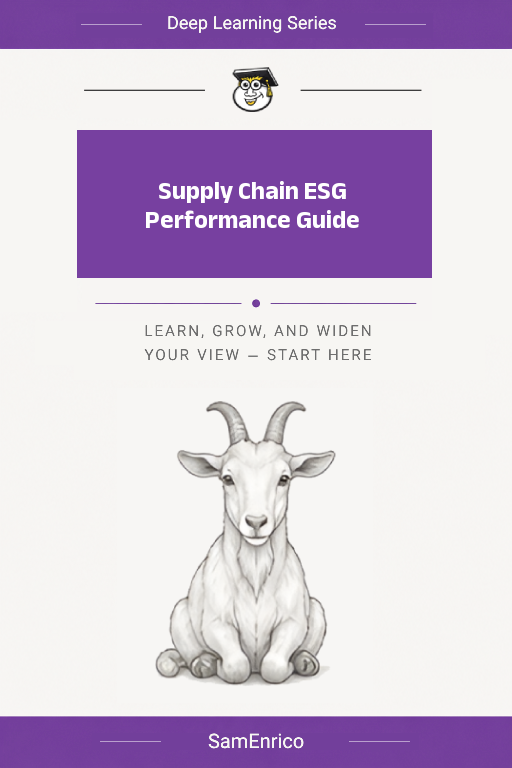
Non-FictionStrategic AtlasSupply Chain
Supply Chain ESG Performance Guide eBook
Compares public firms on supply chain emissions sc
by Coy Raphael
Compares public firms on supply chain emissions scope, supplier audits, forced labor policies, and traceability systems.
Formats
Free sample
Chapter 1: The 80% Lie--For the past decade, investors, regulators, and the public have been sold a comforting fiction. They have been told that when a company publishes a glossy sustainability report, touts a net-zero commitment, or earns a top ESG rating from a prominent agency, they are looking at a complete picture of that company’s environmental and social impact. That fiction has made fortunes for consultants, justified billions in “sustainable” investments, and allowed corporate leaders to sleep soundly after signing their names to ambitious climate pledges.Almost none of it is true.Not because the intentions are necessarily malicious. Not because the data is always fabricated. But because the entire architecture of corporate ESG reporting has been built with a deliberate, convenient blind spot.
That blind spot is the supply chain.Consider what a typical public company reports. It will measure and disclose its Scope 1 emissions—the direct pollution from its own factories and vehicles. It will report its Scope 2 emissions—the electricity it purchases to run its offices and data centers. It may even have a third-party auditor sign off on these numbers. Then it will declare itself “on track” to meet its science-based targets.Yet that same company likely has no idea what is happening in the factories that actually make its products.
It cannot tell you the carbon intensity of the steel that goes into its machinery, the labor conditions in the textile mills that weave its fabrics, or the origin of the cobalt in its batteries. It has outsourced not only production but also accountability. And the ESG rating agencies, for the most part, have let them get away with it.This chapter exposes the single most consequential lie in corporate sustainability: that what happens inside a company’s four walls matters more than what happens in its supply chain. In reality, approximately 90 percent of a company’s environmental impact—including water use, waste generation, biodiversity destruction, and chemical pollution—resides in its supply chain. Approximately 70 percent of its carbon footprint resides there as well.
The difference between these two numbers is not sloppiness; it reflects the fact that carbon is only one dimension of environmental harm. A company could achieve net-zero carbon emissions while simultaneously driving a rainforest to extinction through its sourcing practices, and its sustainability report would still call that a win.Worse, nearly all of the forced labor risk in modern commerce lives in the supply chain. Not in corporate headquarters. Not in flagship factories owned by the brand itself. But in Tier 2 component suppliers, Tier 3 raw material processors, and informal subcontractors that no annual report has ever named.The result is an ESG system that systematically rewards companies for ignoring their greatest risks.
A firm with perfect direct emissions but a supply chain riddled with forced labor receives a higher ESG score than a firm with moderate direct emissions that has invested heavily in supply chain transparency. The raters are not stupid; they simply lack the data to do otherwise. And the companies know it.This chapter will establish three foundational truths that the rest of this book will build upon. First, the performance gap: fewer than 20 percent of major public companies currently perform full supply chain due diligence across all four metrics that this book tracks—Scope 3 emissions accuracy, supplier audit velocity, forced labor remediation systems, and traceability depth. Second, the regulatory avalanche: laws including the EU’s Corporate Sustainability Due Diligence Directive, Germany’s Supply Chain Act, and the U.S.
Uyghur Forced Labor Prevention Act have made supply chain ignorance financially catastrophic, not just ethically embarrassing. Third, the inversion of ESG priorities: while climate remains the headline, social and governance factors are now the faster-moving risk indicators for investors and regulators, precisely because they are the ones most likely to be hidden in the supply chain.A Note on Numbers Before proceeding, a brief clarification that will be used consistently throughout this book. When we say that approximately 90 percent of a company’s environmental impact resides in its supply chain, we are referring to the full spectrum of environmental harm: greenhouse gas emissions, water consumption, land use change, biodiversity loss, chemical pollution, and waste generation. When we say approximately 70 percent of a company’s carbon footprint resides in the supply chain, we are referring specifically to Scope 3 emissions as defined by the Greenhouse Gas Protocol. The remaining 30 percent of carbon emissions are Scope 1 (direct) and Scope 2 (purchased energy).
The gap between 90 and 70 percent is not an error; it reflects the reality that a company’s non-carbon environmental impacts are even more concentrated in the supply chain than its carbon impacts. A factory that emits very little CO₂ can still consume enormous quantities of water or discharge toxic chemicals into local rivers. Those impacts are nearly always outsourced.With that precision established, let us examine the performance gap in detail.The Performance Gap: What Most Companies Don’t Know In 2024, a consortium of academic researchers and non-governmental organizations conducted the most comprehensive audit of supply chain ESG disclosure ever attempted. They examined 500 major public companies across ten sectors, including apparel, electronics, automotive, consumer packaged goods, pharmaceuticals, and industrial manufacturing. They asked a simple set of questions.
Does the company publicly disclose its complete list of Tier 1 suppliers? Does it disclose any information about Tier 2 or Tier 3 suppliers? Does it report Scope 3 emissions using activity-based data rather than spend-based estimates? Does it provide evidence of independent, unannounced supplier audits? Does it have a remediation process for forced labor allegations with publicly reported outcomes?The results were staggering.
Fewer than 20 percent of the 500 companies could answer yes to all of these questions. Most could not answer yes to more than one.The pattern varied by sector. Apparel and electronics, pressured by decades of activism and brand reputation risks, performed slightly better. Approximately 35 percent of large apparel brands disclosed full Tier 1 supplier lists. But that number collapsed to less than 5 percent when the question shifted to Tier 2.
In automotive, where supply chains are even more complex and fragmented, fewer than 10 percent of companies could trace a single high-risk raw material—cobalt, leather, aluminum—back to its origin. In pharmaceuticals and consumer packaged goods, where supply chains are often considered “less risky” by the investment community, the performance was even worse because the perceived risk had never triggered investment in transparency systems.This is the performance gap that this book exists to close. It is not a technology problem. Blockchain, Io T sensors, and AI-driven audit analytics have existed for years. It is not a regulatory problem.
Laws requiring due diligence have already passed in multiple jurisdictions. It is an accountability problem. Most public firms have simply not been forced to do the work, and the ESG rating industry has been too lenient in accepting partial disclosures as sufficient.One executive interviewed for this book, the chief sustainability officer of a Fortune 500 consumer goods company, put it with brutal honesty. “Our ESG rating is an A-minus,” she said, speaking on condition of anonymity. “But that rating is based almost entirely on our direct operations.
Our supply chain is a black hole. If we actually disclosed what we don’t know, our rating would drop to…
This is the end of the free sample. Get the eBook to keep going. Buy now
About this book
Details
- Author
- Coy Raphael
- Publisher
- SamEnrico
- Language
- English
- Genre
- Non-Fiction, Strategic Atlas, Supply Chain
- Released
- 2026-06-01
- Pages (approx.)
- 147
- Available as
- eBook, Audiobook

Read better in the ZLOADR app
Your eBooks on your phone or tablet. Sign in with your SamEnrico account and start reading.
More by Coy Raphael
 Affirmations For Authenticity GuideCoy Raphael$11.99
 Remote Review for HR TeamsCoy Raphael$11.99
 Proptech Investment GuideCoy Raphael$11.99
 Voice Tone and Pitch Cues GuideCoy Raphael$11.99
 Modesto Christmas Eve DisappearanceCoy Raphael$11.99
 The Sky Tree's Last Guardian: A Navajo Tale of Balance and StormsCoy Raphael$11.99
 How to Start a Abrasive Base Paper Business (Beginners Guide)Coy Raphael$11.99
 LinkedIn Mentor Ask Examples GuideCoy Raphael$12.99
 Understanding Paratyphoid FeverCoy Raphael$17.99
 General Ledger AccountantCoy Raphael$11.99
You may also like
 Hong Kong Handover 1997Dunn Johnnie$11.99
 Zumba For Postnatal Recovery CourseNeal Christian$11.99
 Zumba for BeginnersLadner Nikia$11.99
 YouTube Comment Mining GuideHumes Pandora$12.99
 Worry Box MeditationCarlin Rudy$11.99
 Workplace Stress MeditationNguyen Lynn$11.99
 Workplace Stress and Sleep RepairHawley Ivory$11.99
 Workplace Perfectionism CureDelaney Jeffry$11.99
 Workplace Injustice Anger GuideWallen Isabelle$11.99
 Work Addiction and Burnout LinkGreenwood Ester$11.99
 Women in Yoga and WellnessBeattie Galina$11.99
 Women in Stand Up ComedyChun Evangeline$11.99