
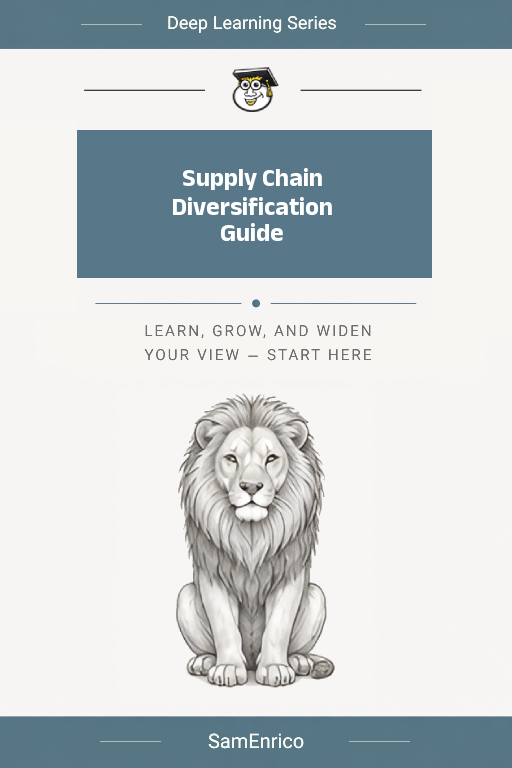
Non-FictionCrisis ManagementSupply Chain
Supply Chain Diversification Guide eBook
Build redundant supply chains across multiple coun
Build redundant supply chains across multiple countries to survive border closures and trade restrictions.
Formats
Free sample
Chapter 1: The Day the Supply Chain Died--–- Every supply chain professional remembers the exact moment they realized their network was fragile. For some, it was March 2020, when Chinese New Year extended into an indefinite lockdown and containers stopped moving. For others, it was late 2023, when Houthi attacks in the Red Sea forced every ship to reroute around the Cape of Good Hope, adding two weeks and thousands of dollars per container. And for a new generation, it was March 2026, when the Strait of Hormuz closed to Western-allied shipping, revealing that some chokepoints have no alternative.Marcus, a procurement director for a mid-sized toymaker, remembers the Hormuz closure like it was yesterday. His phone rang at 6:00 AM on a Tuesday.
The voice on the line was his logistics manager, sounding confused. “The port says nothing is moving. Something about the Strait. Do you know anything?” Marcus did not. He opened his laptop, searched for news, and felt his stomach drop.
The Strait of Hormuz—21 miles wide at its narrowest point—had been closed to Western-allied shipping. Through that 21-mile channel passed 84% of Middle East polyethylene exports. Polyethylene was the primary resin for his products. His orders for the holiday season had been placed in April, as always. The resin had been scheduled to ship in June.
It was now sitting inside the Persian Gulf, unable to leave.Marcus’s story is not unique. Over the past five years, supply chain professionals have lived through pandemic lockdowns that shuttered factories overnight, trade wars that redrew sourcing maps in weeks, maritime chokepoint closures that stranded billions in cargo, and sanctions that rendered established supplier relationships instantly obsolete. The era of the efficient, single-threaded supply chain is over. The era of the resilient, diversified supply chain has begun.This chapter is the wake-up call. It is not comfortable, but it is necessary.
By the time you finish, you will understand why the old paradigm of efficiency-first supply chains has failed, how the last five years have permanently reshaped global trade, and why diversification is no longer a tactical insurance policy but a strategic capability that separates market leaders from the rest.The Old Playbook: Efficiency at Any Cost Before 2020, the dominant supply chain paradigm was efficiency. Just-in-time inventory. Single-source suppliers. Consolidated logistics. Centralized distribution.
Every decision optimized for lower cost and faster turns. Disruptions were rare, localized, and brief. The cost of redundancy exceeded the expected cost of disruption. Shareholders demanded low costs and high inventory turns. Supply chain was a cost center, not a strategic function.The logic was seductive.
Why hold safety stock when your supplier could deliver in three days? Why qualify a second supplier when your primary had never missed a shipment? Why build a second warehouse when your single DC ran at 95% capacity? Every dollar spent on redundancy was a dollar not spent on growth. Every hour spent on contingency planning was an hour not spent on product development.Then the pandemic came.The single factory in Wuhan that produced 80% of the world’s steering wheel components closed.
The single port in Los Angeles that processed 40% of US imports became a parking lot for container ships. The single just-in-time delivery model that worked beautifully in stable conditions became a just-in-case nightmare overnight.The trade war followed. The single tariff decision that erased years of cost advantage for Chinese-made goods sent companies scrambling to Vietnam, Mexico, and India—only to discover that those countries also faced capacity constraints and their own trade complexities.The Red Sea crisis followed that. The single maritime chokepoint that connected Europe and Asia became a war zone. Every ship rerouted around the Cape of Good Hope, adding two weeks and thousands of dollars per container.
Goods still moved, but slowly and expensively.And then Hormuz closed. No alternative. No rerouting. No movement. Everything inside the Persian Gulf stayed there.The Five Disruption Categories That Changed Everything The fragility of single-threaded supply chains has been exposed across five distinct disruption categories.
Each has permanently altered the risk landscape. Each has made diversification not just advisable but essential.1. Pandemic and Health Crises The COVID-19 pandemic was the most severe supply chain shock in modern history. Factory closures in China during the initial outbreak created cascading shortages globally. Labor shortages at ports, warehouses, and trucking companies created bottlenecks that took months to clear.
Container imbalances—empty containers piling up at some ports while others faced severe shortages—disrupted trade patterns for two years.The key lesson from the pandemic is that health crises do not respect borders and they do not provide warning. A virus that emerges in one city can shut down production on three continents within weeks. Companies that relied on a single country for production—or a single port for imports—were hit hardest. Companies with distributed manufacturing and diversified logistics recovered faster.2. Geopolitical Conflict and Trade Wars The US-China trade war demonstrated that trade policy can change overnight.
Tariffs on hundreds of billions of dollars of goods were announced with minimal notice. Supply chains that had been optimized for Chinese manufacturing suddenly faced 25% cost increases. Companies scrambled to shift production to Vietnam, Mexico, and India—only to discover that those countries also faced capacity constraints and their own trade complexities.Russia’s invasion of Ukraine added another layer of geopolitical risk. Sanctions on Russian energy and materials forced companies to find alternative sources for aluminum, nickel, and natural gas. The conflict also disrupted grain shipments from Ukraine, affecting food supply chains globally.More recently, escalating tensions in the Middle East have demonstrated that even without a full-scale war, regional instability can close critical chokepoints.
The Strait of Hormuz closure in 2026 was not a war. It was a political escalation. But the economic impact was war-sized.3. Maritime Chokepoint Closures Global supply chains depend on a small number of critical maritime chokepoints. Each is a single point of failure.
The Red Sea crisis and the Strait of Hormuz closure revealed a fundamental vulnerability: some waterways have no alternatives.When Houthi attacks in the Red Sea began in late 2023, ships rerouted around the Cape of Good Hope. The journey was slower and more expensive, but goods still moved. The cost of that rerouting was estimated at $1 million per ship per voyage. But movement was possible.When Hormuz closed in 2026, there was no alternative. Everything inside the Persian Gulf stayed there.
No rerouting. No workaround. No movement. The 84% of Middle East polyethylene exports that normally passed through Hormuz simply stopped. The 30 to 50% of global nitrogen fertilizer exports stopped.
The quarter of the world’s liquefied natural gas trade stopped.The other chokepoints—the Panama Canal, the Strait of Malacca, the Turkish Straits—each have different closure risks, different alternatives, and different impacts on specific industries. But the common thread is concentration. Any company that routes a significant percentage of its supply through a single chokepoint is exposed.4. Climate and Natural Disasters Hurricanes, floods, wildfires, and droughts are increasing in frequency and severity. A single storm can close a major port for weeks.
A single flood can destroy a supplier’s entire inventory. A single wildfire can shut down transportation corridors for days.Climate risk is now supply chain risk.…
This is the end of the free sample. Get the eBook to keep going. Buy now
About this book
Details
- Author
- Purvis Claudette
- Publisher
- SamEnrico
- Language
- English
- Genre
- Non-Fiction, Crisis Management, Supply Chain
- Released
- 2026-06-01
- Pages (approx.)
- 140
- Available as
- eBook, Audiobook

Read better in the ZLOADR app
Your eBooks on your phone or tablet. Sign in with your SamEnrico account and start reading.
More by Purvis Claudette
 Mental Health ConversationsPurvis Claudette$11.99
 Sheppard Supreme Court VictoryPurvis Claudette$11.99
 Dream Creativity IncubatorPurvis Claudette$11.99
 Pet Loss and AnxietyPurvis Claudette$11.99
 Daily Goal Journal MethodPurvis Claudette$11.99
 The Retirement Housing Cash OfferPurvis Claudette$11.99
 The Test Taking Strategies GuidePurvis Claudette$11.99
 Respect Your BodyPurvis Claudette$11.99
 The Roswell Connection: Gang Wars and the UFO ConspiracyPurvis Claudette$11.99
 The Forgotten Massacre of El Salto: A Family's Erased LegacyPurvis Claudette$11.99
 Two Week Product Launch FunnelPurvis Claudette$12.99
 A Collector's Handbook to the Lancia Aprilla (1937-39)Purvis Claudette$11.99
You may also like
 Hong Kong Handover 1997Dunn Johnnie$11.99
 Zumba For Postnatal Recovery CourseNeal Christian$11.99
 Zumba for BeginnersLadner Nikia$11.99
 YouTube Comment Mining GuideHumes Pandora$12.99
 Worry Box MeditationCarlin Rudy$11.99
 Workplace Stress MeditationNguyen Lynn$11.99
 Workplace Stress and Sleep RepairHawley Ivory$11.99
 Workplace Perfectionism CureDelaney Jeffry$11.99
 Workplace Injustice Anger GuideWallen Isabelle$11.99
 Work Addiction and Burnout LinkGreenwood Ester$11.99
 Women in Yoga and WellnessBeattie Galina$11.99
 Women in Stand Up ComedyChun Evangeline$11.99