
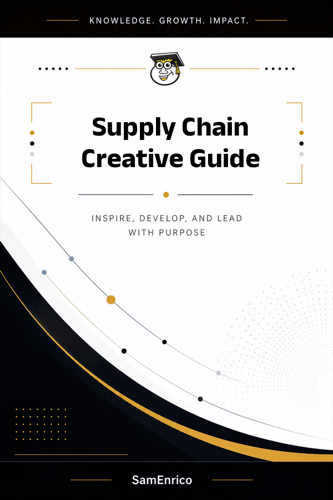
Non-FictionSelf-HelpSupply Chain Innovation
Supply Chain Creative Guide eBook
Redesign logistics and sourcing with innovative th
by Teal Ariane
Redesign logistics and sourcing with innovative thinking using this practical workbook.
Formats
Free sample
Chapter 1: The Logistics Autopsy--A $2.3 million mistake sat on a dock in Los Angeles. It arrived ten days after Christmas. The containers held seasonal decorations, gift sets, and promotional displays—all of it worthless by the time it cleared customs. Maria Gonzalez, the supply chain director for a mid-sized home goods retailer, watched the inventory land on her report as “available for sale” on January 4th. Her bonus evaporated.
Her boss, the CEO, stopped returning her emails. And the freight forwarder’s tracking system had shown “on schedule” until the morning the ship docked—three weeks late.Maria had done everything by the book. She had negotiated rates. She had built a spreadsheet with lead times. She had chosen the lowest-cost carrier.
And still, she failed.The post-mortem meeting was brutal. The logistics manager blamed the port congestion. The procurement lead blamed the supplier’s production delay. The CFO blamed Maria for not having a backup plan. Everyone had a theory.
No one had an answer that would prevent the same disaster from happening again.This is the problem with most supply chains. They are designed for a world that no longer exists—a world of predictable demand, stable shipping lanes, reliable suppliers, and linear thinking. That world is gone. And yet, most professionals continue to use the same tools, the same assumptions, and the same frameworks that failed Maria.This chapter will show you why. More importantly, it will give you a different way to think about your supply chain—not as a fixed machine to be optimized, but as a dynamic system to be adapted.
You will learn the difference between efficiency and adaptability, why chasing unit price destroys value, and how to perform a Logistics Autopsy on your own failures. By the end of this chapter, you will never look at a late shipment or a stock-out the same way again.The Myth of the Predictable Supply Chain For decades, supply chain management was taught as an engineering problem. You forecast demand. You calculate safety stock. You optimize routes.
You minimize inventory. The goal was efficiency—doing things right. And for a long time, this worked. Global trade expanded. Shipping costs fell.
Suppliers became reliable. You could plan six months in advance and be reasonably certain that your containers would arrive within a window of a few days.Then the world broke.The COVID-19 pandemic shut down factories, ports, and borders simultaneously. The Suez Canal blockage in 2021 held $9 billion of goods hostage for six days. The semiconductor shortage idled car plants for months. The Red Sea shipping attacks in 2023 and 2024 forced vessels to reroute around Africa, adding two weeks of transit time and hundreds of thousands of dollars in fuel costs.
And these are just the headline events. Every day, smaller disruptions—a supplier bankruptcy, a customs strike, a software outage, a weather event—ripple through supply chains that have no slack, no redundancy, and no backup plan.The professionals who survived these disruptions were not the ones with the most sophisticated spreadsheets or the lowest costs. They were the ones who could adapt. They rerouted shipments. They switched suppliers overnight.
They found creative workarounds. They had what this book calls adaptability—doing the right things when conditions change.Efficiency versus Adaptability Let us be precise about these two concepts because they will appear throughout this book.Efficiency means maximizing output for a given input. In supply chain terms, it means lower cost per unit, higher inventory turns, fuller trucks, shorter dock times, and less waste. Efficiency is measured by metrics like on-time delivery percentage, cost-per-order, and inventory carrying cost. It is a valuable goal.
No one wants to waste money.Adaptability means changing course when the original plan becomes invalid. In supply chain terms, it means rerouting shipments, switching suppliers, adjusting inventory targets, renegotiating terms, and reconfiguring networks. Adaptability is measured by metrics like time-to-recovery after a disruption, number of alternative suppliers, and flexibility of transportation contracts.Here is the crucial insight that most supply chain books get wrong: Efficiency and adaptability are not opposites. They are not trade-offs. They are two separate capabilities that both matter.
The mistake is optimizing for efficiency at the expense of adaptability—which is exactly what most organizations do.Consider an airline. An efficient airline fills every seat, turns around planes in thirty minutes, and has no spare aircraft. That works perfectly until a snowstorm hits. Then the entire system collapses because there is no slack. A more adaptable airline keeps a few spare planes, builds in longer turnaround times, and accepts lower load factors in exchange for the ability to recover from disruption.Consider a hospital.
An efficient hospital runs its operating rooms at 95% utilization and keeps minimal inventory of critical supplies. That works until a mass casualty event or a supply chain disruption. Then patients die because there is no buffer. A more adaptable hospital accepts lower utilization in exchange for surge capacity.Supply chains are no different. The most efficient supply chain is a single supplier, a single port, a single shipping lane, and zero inventory.
It is also the most fragile supply chain. The slightest disruption brings it to a halt.The tragedy is that most organizations do not choose fragility. They stumble into it. They optimize each decision locally—lowest freight cost, lowest unit price, lowest inventory—without realizing that these choices add up to a system with no resilience. They are like a dieter who cuts calories so aggressively that they lose muscle along with fat, leaving themselves weaker than when they started.Stupid Cost-Cutting versus Smart Cost-Cutting This brings us to a distinction that will save you years of frustration.
There are two kinds of cost-cutting in supply chain management. One destroys value. The other creates it.Stupid cost-cutting focuses on unit price alone. It squeezes suppliers until they have no margin for quality or innovation. It consolidates all volume with a single source to get a discount.
It reduces inventory to the absolute minimum. It chooses the cheapest freight option regardless of reliability. Stupid cost-cutting looks good on a spreadsheet in the short term. It gets you a bonus. It impresses the CFO.
And then it blows up when the single supplier has a fire, the cheap freight gets stuck in port, or the inventory runs out during a demand spike.Smart cost-cutting focuses on total system cost. It asks: What does this decision cost across the entire supply chain, not just on the invoice? Smart cost-cutting pays more for a reliable supplier because it reduces expediting costs and stock-outs. It keeps safety stock on critical items because the cost of a stock-out is higher than the carrying cost. It diversifies across multiple suppliers even if unit price is slightly higher because the cost of a single-point failure is catastrophic.
Smart cost-cutting looks worse on a spreadsheet in the short term. It requires explaining to the CFO why you are paying more. And then it saves the company millions when the disruption hits.Throughout this book, you will learn smart cost-cutting tools. Chapter 5 will teach you Total Cost of Ownership (TCO) analysis, which reveals that the "cheap" supplier often costs more. Chapter 11…
This is the end of the free sample. Get the eBook to keep going. Buy now
About this book
Details
- Author
- Teal Ariane
- Publisher
- SamEnrico
- Language
- English
- Genre
- Non-Fiction, Self-Help, Supply Chain Innovation
- Released
- 2026-06-11
- Pages (approx.)
- 158
- Available as
- eBook, Audiobook

Read better in the ZLOADR app
Your eBooks on your phone or tablet. Sign in with your SamEnrico account and start reading.
More by Teal Ariane
 Grief That Doesnt EndTeal Ariane$11.99
 Bedtime Mindfulness PracticeTeal Ariane$11.99
 Lactase Pill GuideTeal Ariane$11.99
 The Blue Zone Downshift HabitsTeal Ariane$11.99
 The Fela Kuti Revolution: How One Man Turned a Festival into a MovementTeal Ariane$11.99
 Purchase Requisition StreamliningTeal Ariane$12.99
 Duplicate Detection AITeal Ariane$12.99
 Understanding Sternal Cyst Vascular AnomaliesTeal Ariane$17.99
 How to Become a Sheet-metal WorkerTeal Ariane$11.99
 Cabriite MiningTeal Ariane$11.99
You may also like
 Hong Kong Handover 1997Dunn Johnnie$11.99
 Zumba For Postnatal Recovery CourseNeal Christian$11.99
 Zumba for BeginnersLadner Nikia$11.99
 YouTube Comment Mining GuideHumes Pandora$12.99
 Worry Box MeditationCarlin Rudy$11.99
 Workplace Stress MeditationNguyen Lynn$11.99
 Workplace Stress and Sleep RepairHawley Ivory$11.99
 Workplace Perfectionism CureDelaney Jeffry$11.99
 Workplace Injustice Anger GuideWallen Isabelle$11.99
 Work Addiction and Burnout LinkGreenwood Ester$11.99
 Women in Yoga and WellnessBeattie Galina$11.99
 Women in Stand Up ComedyChun Evangeline$11.99