
Non-FictionAnnual CheckupBenchmarkingIndustry
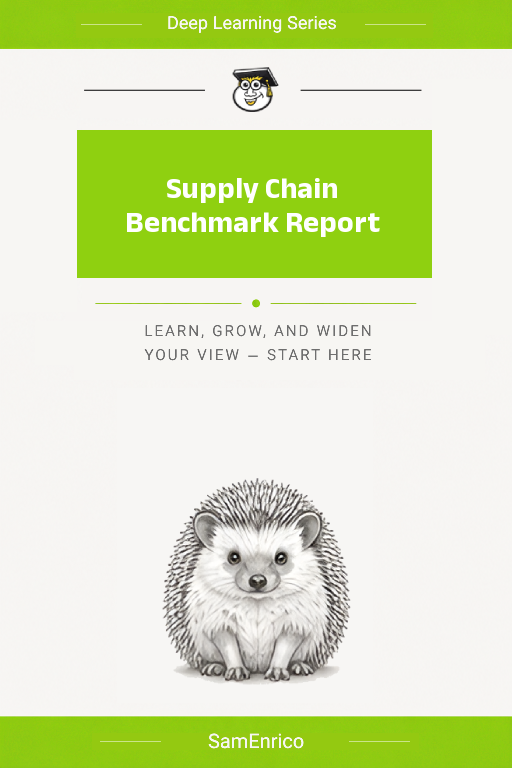
Supply Chain Benchmark Report eBook
Compare your supply chain resilience metrics again
Compare your supply chain resilience metrics against industry benchmarks to identify improvement opportunities.
Formats
Free sample
Chapter 1: The Fragility Lie--“Your supply chain is not resilient. You just haven’t had a bad day yet.”That sentence, spoken by a grizzled logistics director to a room of freshly minted MBAs at a conference in Atlanta in early 2020, would prove prophetic within ninety days. The audience chuckled nervously. The director wasn’t joking. He had lived through the 2011 Thailand floods that wiped out global hard drive production for eighteen months.
He had watched the 2010 Eyjafjallajökull volcanic eruption shut down European air freight for weeks. He knew something that most of his younger colleagues refused to accept: the lean, efficient, just-in-time supply chains that had won awards and padded bonuses for a decade were, in fact, brittle. They were optimized for a world that no longer existed.Then COVID-19 arrived. The Suez Canal ran aground. A war broke out in Ukraine.
Ships queued for weeks off Los Angeles. Semiconductor fabs burned. Droughts shut the Panama Canal. And suddenly, the entire business world woke up to an uncomfortable truth: efficiency without resilience is not a strategy. It is a gamble.This book exists because that gamble is no longer acceptable.
But before we can rebuild, we must first understand how we broke supply chains in the first place. We must dismantle the dogma that has been taught in business schools, celebrated in case studies, and rewarded by Wall Street for three decades. We must confront the Fragility Lie – the false belief that minimizing inventory, maximizing asset utilization, and centralizing production are always virtuous. They are not. Not anymore.The Gospel of Lean: How We Got Here To understand why resilience has become the defining challenge of modern supply chain management, we must travel back to the 1980s.
Toyota was not yet the world’s largest automaker, but it had discovered something revolutionary. While Detroit’s Big Three stockpiled months of inventory, Toyota’s factories ran on a few hours worth of parts. The Toyota Production System, later codified as Lean Manufacturing, promised something seductive: lower costs, higher quality, and faster throughput. The secret was Just-in-Time (JIT) – materials arrived exactly when needed, not a moment sooner.The logic was mathematically elegant. Inventory is waste.
Inventory ties up working capital. Inventory hides problems (defects, inefficiencies, poor supplier performance). By stripping away inventory, companies were forced to fix root causes. The result was a virtuous cycle of continuous improvement.For three decades, this logic prevailed. Consultants preached it.
Software companies built enterprise resource planning systems around it. Supply chain leaders earned promotions by reducing inventory days on hand year after year. Wall Street rewarded companies with high inventory turns and low capital intensity.But there was a hidden assumption buried deep within the JIT model: stability. JIT assumes that suppliers will deliver on time, every time. It assumes that transportation networks will operate without interruption.
It assumes that demand is predictable enough to schedule precise deliveries. In a stable world, JIT is not just efficient – it is optimal.The world is no longer stable.The Poly-Crisis Era: Why Everything Breaks at Once The term “poly-crisis” emerged from academic circles in the 2010s, but it entered business vocabulary during the 2020s. A poly-crisis is not simply multiple separate crises occurring simultaneously. It is a cascade – one disruption amplifies another, creating feedback loops that no single risk model can predict.Consider the supply chain events of 2020–2024, not as isolated incidents, but as a connected chain:COVID-19 (2020) – Factories in China shut down. Then European and North American plants followed.
Ports reduced operations. Trucking capacity collapsed. The just-in-time system, designed to hold three to five days of inventory, ran out in forty-eight hours.The Suez Canal Blockage (2021) – A single container ship, the Ever Given, ran aground and blocked 12% of global trade for six days. The backlog took months to clear. Ships rerouted around Africa, adding fourteen days to voyage times.
Container rates increased 600%.The Semiconductor Shortage (2021-2023) – Auto manufacturers had canceled chip orders early in the pandemic, expecting a deep recession. When demand rebounded faster than expected, they found themselves at the back of a very long line. Semiconductor lead times stretched from twelve weeks to over a year. Ford, GM, and Toyota collectively lost over $200 billion in revenue.The Ukraine War (2022) – Russia’s invasion disrupted wheat, sunflower oil, neon gas (critical for semiconductors), nickel, titanium, and energy supplies. Supply chains that had optimized for low-cost sourcing from Eastern Europe and Russia suddenly had to rebuild from scratch.The Panama Drought (2023-2024) – Low water levels reduced the number of ships that could transit the canal, forcing rerouting around South America or through the Suez – until the Red Sea became a conflict zone.The Red Sea Attacks (2024) – Houthi attacks on commercial shipping forced vessels to reroute around Africa, adding 10-14 days and over $1 million in fuel costs per voyage.What each of these events has in common is not their cause – pandemic, geopolitics, climate, conflict – but their effect.
Each event exposed a fundamental vulnerability in the lean supply chain model: no slack. There was no buffer. No margin for error. No time to adapt.The Three Illusions of Efficiency How did so many intelligent executives, at so many sophisticated companies, miss this vulnerability? The answer lies in three persistent illusions that have dominated supply chain thinking.Illusion #1: “Inventory is waste.”This is the original sin of lean thinking.
Inventory is not waste – inventory is optionality. Inventory is the ability to continue serving customers when a supplier fails. Inventory is time, translated into physical form.Consider two companies in the same industry. Company A holds fifteen days of safety stock. Company B holds three days.
In normal conditions, Company B looks more efficient – lower working capital, higher inventory turns, better return on assets. But when a port closure adds ten days of delay, Company B misses deliveries. Customers defect. Revenue is lost. The “efficiency” of Company B was an illusion created by assuming that disruptions would never happen.The correct framing is not “inventory is waste” but “inventory is insurance.” And like any insurance, the optimal amount depends on the risk profile.
A grocery store near a hurricane zone holds more inventory than a grocery store in a stable climate. A supply chain facing geopolitical risks should hold more inventory than one operating entirely within a single stable region.Illusion #2: “Single-sourcing drives leverage.”The logic seemed irrefutable. Consolidate purchases with one supplier. Give them 100% of your volume. Negotiate lower prices.
Build a partnership. The supplier invests in dedicated tooling and capacity. Everyone wins.Except when that supplier fails. A fire at a single factory. A bankruptcy hidden by creative accounting.
A geopolitical event that makes cross-border shipments impossible. Suddenly, 100% of your volume is at risk, and the cost savings from single-sourcing look very small compared to the revenue loss of a six-month outage.The semiconductor shortage provided a brutal education in this illusion. Automotive companies that had single-sourced critical chips from one foundry found themselves with no alternatives when that foundry allocated capacity to higher-margin customers. Companies that had maintained dual sourcing – even at higher cost – continued to ship vehicles.Illusion #3: “Efficiency is the only metric that matters.”This is the most insidious illusion because it…
This is the end of the free sample. Get the eBook to keep going. Buy now
About this book
Details
- Author
- Sandlin Denice
- Publisher
- SamEnrico
- Language
- English
- Genre
- Non-Fiction, Annual Checkup, Benchmarking, Industry
- Released
- 2026-05-28
- Pages (approx.)
- 158
- Available as
- eBook, Audiobook

Read better in the ZLOADR app
Your eBooks on your phone or tablet. Sign in with your SamEnrico account and start reading.
More by Sandlin Denice
 Congress Member Gaetz Ethics GuideSandlin Denice$11.99
 Rosemary Oil Memory BoostSandlin Denice$11.99
 Kidnap Crisis Local Intermediary Use GuideSandlin Denice$11.99
 Tariff Shift Rules GuideSandlin Denice$11.99
 Hypnotic Time Distortion AnalgesiaSandlin Denice$11.99
 The Double Life of Kim Philby: A Spy Among SpiesSandlin Denice$11.99
 The Forgotten Summit: Norgay’s Secret Ascent of K2Sandlin Denice$11.99
 Understanding ConjunctivitisSandlin Denice$17.99
 Dubai Student Counseling GuideSandlin Denice$12.99
 How to Start a Fennel Growing Business (Beginners Guide)Sandlin Denice$11.99
 Technical Marketing ManagerSandlin Denice$11.99
You may also like
 Hong Kong Handover 1997Dunn Johnnie$11.99
 Zumba For Postnatal Recovery CourseNeal Christian$11.99
 Zumba for BeginnersLadner Nikia$11.99
 YouTube Comment Mining GuideHumes Pandora$12.99
 Worry Box MeditationCarlin Rudy$11.99
 Workplace Stress MeditationNguyen Lynn$11.99
 Workplace Stress and Sleep RepairHawley Ivory$11.99
 Workplace Perfectionism CureDelaney Jeffry$11.99
 Workplace Injustice Anger GuideWallen Isabelle$11.99
 Work Addiction and Burnout LinkGreenwood Ester$11.99
 Women in Yoga and WellnessBeattie Galina$11.99
 Women in Stand Up ComedyChun Evangeline$11.99