
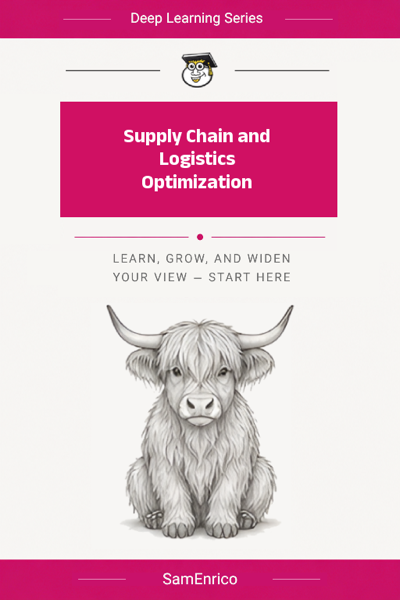
Non-FictionInformativeEducational
Supply Chain and Logistics Optimization eBook
A Coursebook on Supply Chain and Logistics Optimiz
A Coursebook on Supply Chain and Logistics Optimization
Formats
Free sample
Chapter 1: The Fragile Machine--–- On March 23, 2021, at 7:40 a.m. local time, a 1,300-foot container ship named the Ever Given drifted slightly to the left. The wind in the Suez Canal was gusting at 40 knots—strong but not unprecedented. The pilot, an expert with decades of experience navigating the narrow waterway, issued a series of steering commands. The ship, loaded with 18,300 containers carrying everything from IKEA furniture to Nike sneakers to medical ventilators, responded sluggishly.
Then it stopped responding at all. Its bow plowed into the sandy eastern bank of the canal. Its stern swung west and slammed into the opposite bank. The Ever Given was now a steel wedge, lodged diagonally across one of the world's most vital maritime arteries. And the global supply chain, which most people never thought about until that moment, suddenly had a face—and a name.For six days, the Ever Given sat motionless while a fleet of tugboats strained against its hull, dredgers sucked sand from beneath its bow, and the world watched on live webcams.
Behind the stuck ship, a queue of more than 400 vessels formed. Some carried oil. Some carried grain. Some carried the components for cars that could not be built, the parts for machines that could not be repaired, the toys that would not arrive for Christmas. By the time the Ever Given was freed, an estimated $9 billion in trade had been delayed or lost.
But the real cost was not measured in dollars. It was measured in broken assumptions.The assumption that global trade flows were smooth and reliable. The assumption that inventory could be minimized because delivery was certain. The assumption that efficiency—doing more with less—was the only metric that mattered. The Ever Given was not the cause of the supply chain crisis.
The Ever Given was the symptom. The disease was a decades-old philosophy called Just-in-Time, and it had made the world's supply chains into a fragile machine.The Toyota Miracle To understand how we arrived at this moment of fragility, you must travel back to 1970s Japan. The country was rebuilding its industrial base after World War II, but it faced a fundamental disadvantage: Japan is a small island nation with few natural resources and limited land. Large warehouses were expensive. Holding inventory was costly.
And Toyota, then a growing automaker competing against the giants of Detroit, could not afford to tie up capital in piles of parts that might sit for months before being used.Toyota's engineers, led by Taiichi Ohno, developed a radical new approach. Instead of stockpiling inventory, they would arrange for parts to arrive exactly when they were needed—no earlier, no later. Suppliers would deliver components directly to the assembly line, sometimes multiple times per day. The factory would hold only a few hours' worth of inventory at any moment. Ohno called this system kanban, which translates roughly to "signboard" or "card," referring to the visual signals that triggered each new delivery.The results were stunning.
Toyota's factories required far less space than their American counterparts. They had less capital tied up in inventory. They could respond to changes in customer demand more quickly because they were not buried under mountains of unsold parts. And crucially, the discipline of Just-in-Time forced Toyota and its suppliers to solve quality problems immediately—because there was no buffer inventory to cover for defective parts. If a supplier shipped bad components, the line would stop within hours.
That pain created relentless pressure to improve.By the 1980s, Just-in-Time had been codified into the Toyota Production System, and the Western business world took notice. Books like The Machine That Changed the World and Lean Thinking spread the gospel of lean manufacturing. Consultants flew to Tokyo to bow before Toyota executives and return home with Power Point decks. Business schools rewrote their operations curricula. Within a generation, Just-in-Time became not just a technique but an ideology.
The assumption that "lean equals optimal" was accepted as truth from boardrooms to factory floors.And for a long time, it worked. Globalization reinforced JIT's logic. Why hold inventory in a warehouse in Ohio when a supplier in Guangdong could ship exactly 5,000 units every Tuesday and Thursday, arriving just as the previous batch ran out? Why pay for storage when the ocean itself became the warehouse—containers stacked on ships that never stopped moving? The supply chain became a wonder of modern engineering, a ballet of synchronized movements that delivered fresh sushi to Kansas and Chilean grapes to Alaska in winter.
Most consumers never noticed. That was the sign of success.The Hidden Vulnerabilities But every machine has a breaking point. The Just-in-Time system had three hidden vulnerabilities that most executives chose to ignore.The first vulnerability was zero slack. When you hold only hours of inventory, any disruption—a port strike, a factory fire, a pandemic, a stuck ship—stops production. In a traditional system with weeks of buffer stock, a disruption is an inconvenience.
In a JIT system, a disruption is a catastrophe. The supply chain has no room to absorb shocks. It is a tightrope walker without a net, and the wind is always blowing.The second vulnerability was dependency concentration. As companies optimized for cost, they consolidated their purchasing. Instead of buying from five different suppliers across three regions, they bought from one supplier in the cheapest location.
That supplier might be the only source of a critical component—a specific type of microchip, a specialized fastener, a unique chemical compound. If that single supplier failed, there was no backup. The entire supply chain collapsed. This was not a bug. This was a feature of extreme efficiency.
But it turned a localized problem into a global crisis.The third vulnerability was invisible risk. The JIT supply chain is so complex, so distributed, so opaque that no single company can see more than one or two steps upstream. A car manufacturer knows its direct supplier for seats. It does not know the foam supplier for the cushions. It does not know the chemical plant that makes the foam's raw material.
It does not know the mine that provides the catalyst for that chemical. When that mine in a small town in a politically unstable country has a labor strike, the car manufacturer only learns about it when the seats stop arriving. By then, it is too late.These vulnerabilities were well understood by supply chain academics and a handful of prescient practitioners. But they were ignored because the cost of addressing them—holding more inventory, diversifying suppliers, building visibility tools—seemed unnecessary. Why pay for insurance against a fire that has never happened?
The system had worked for decades. The assumption was that it would continue to work forever.Then the pandemic arrived.The Pandemic Stress Test In February 2020, the Chinese government locked down Wuhan, a city of 11 million people and a major manufacturing hub for auto parts, electronics, and medical supplies. Factories closed. Ports slowed. Trucks stopped moving.
Companies that relied on Chinese suppliers suddenly discovered that they had no alternative sources and almost no inventory. Within weeks, assembly lines from Detroit to Stuttgart to Seoul went silent.The initial reaction was shock. Then came…
This is the end of the free sample. Get the eBook to keep going. Buy now
About this book
Details
- Author
- Schaefer Yuonne
- Publisher
- SamEnrico
- Language
- English
- Genre
- Non-Fiction, Informative, Educational
- Released
- 2026-06-02
- Pages (approx.)
- 140
- Available as
- eBook, Audiobook

Read better in the ZLOADR app
Your eBooks on your phone or tablet. Sign in with your SamEnrico account and start reading.
More by Schaefer Yuonne
 NVC For Neurodivergent Individuals WorkbookSchaefer Yuonne$11.99
 Net Debt Calculation GuideSchaefer Yuonne$11.99
 Drone Delivery ForecastSchaefer Yuonne$11.99
 Assertiveness in Performance ReviewsSchaefer Yuonne$11.99
 The Dan Castellaneta Homer OdysseySchaefer Yuonne$11.99
 The Silent Killer of the Prairies: Canada's First Forensic Entomology CaseSchaefer Yuonne$11.99
 Understanding Sixth Nerve PalsySchaefer Yuonne$17.99
 Technology Sales Middle EastSchaefer Yuonne$12.99
 Price Increase Script LibrarySchaefer Yuonne$12.99
 How to Become a DusterSchaefer Yuonne$11.99
You may also like
 Hong Kong Handover 1997Dunn Johnnie$11.99
 Zumba For Postnatal Recovery CourseNeal Christian$11.99
 Zumba for BeginnersLadner Nikia$11.99
 YouTube Comment Mining GuideHumes Pandora$12.99
 Worry Box MeditationCarlin Rudy$11.99
 Workplace Stress MeditationNguyen Lynn$11.99
 Workplace Stress and Sleep RepairHawley Ivory$11.99
 Workplace Perfectionism CureDelaney Jeffry$11.99
 Workplace Injustice Anger GuideWallen Isabelle$11.99
 Work Addiction and Burnout LinkGreenwood Ester$11.99
 Women in Yoga and WellnessBeattie Galina$11.99
 Women in Stand Up ComedyChun Evangeline$11.99