
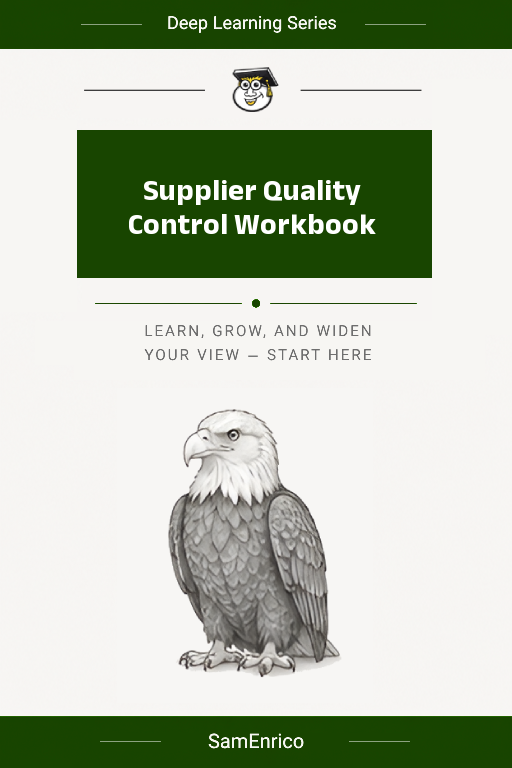
Non-FictionBusiness BriefQuality Assurance
Supplier Quality Control Workbook eBook
Test Chinese suppliers before committing to Brazil
by Artist Hilda
Test Chinese suppliers before committing to Brazil Ghana dropshipping. Order samples, inspect batches, and build supplier scorecards to reduce product defects.
Formats
Free sample
Chapter 1: The 3,000-Mile Lie--Imagine you have just wired $47,000 to a factory in Shenzhen. You have never met the owner. You have never stepped foot inside the building. Your only relationship is a string of We Chat messages, a few email attachments, and a single sample that arrived three months ago in a battered cardboard box.Now imagine that container arrives at the port of Tema in Ghana – after sixty days at sea, after transshipment through Brazil, after three customs inspections and two freight handovers – and every single unit is wrong. The color is off.
The plastic feels brittle. The packaging has disintegrated into pulp. Your customers are already demanding refunds. The supplier is not responding to messages. And your entire business is sitting inside a forty-foot steel box that is worth less than the freight you paid to move it.This is not a hypothetical disaster scenario.
This is the reality of cross-border trade without a quality control system. And it happens every day to entrepreneurs who believe that asking for a sample, checking a few online reviews, and sending a polite email is enough to guarantee quality.The lie that most importers believe is simple: distance does not matter. They assume that because they can order a product with a few clicks, the actual manufacturing, quality control, and logistics will somehow take care of themselves. They assume that a supplier with a "Gold" badge on Alibaba has earned that badge through consistent quality. They assume that a factory with glossy photos and a professional website must be legitimate.All of these assumptions are dangerous.
And in this chapter, you will learn why.The True Cost of the 3,000-Mile Lie The phrase "3,000-mile lie" refers to the physical and psychological distance between you and your supplier. From New York to Shenzhen is approximately 8,000 miles. From London to Guangzhou is 6,000 miles. From São Paulo to Yiwu is 11,000 miles. The exact number matters less than the reality: you are operating a business on the other side of the planet, and every mile between you and your factory increases the probability of miscommunication, corner-cutting, and outright fraud.But distance alone is not the problem.
The problem is that most quality control systems are designed for local, visible supply chains. A restaurant owner can inspect their produce delivery every morning. A bakery can reject a batch of flour before it enters the mixer. A local manufacturer can walk onto the factory floor and spot problems in real time.You cannot do any of these things. Your supply chain is invisible to you for weeks at a time.
Between the moment your supplier loads the container and the moment it arrives at your warehouse or your customer's door, you are blind. And blindness is expensive.Consider the math of defective goods. If you are selling a product that costs you 10perunitlanded(includingmanufacturing,freight,andcustoms),andyoureceiveacontainerof10,000unitswitha20percentdefectrate,youhavejustlost10 per unit landed (including manufacturing, freight, and customs), and you receive a container of 10,000 units with a 20 percent defect rate, you have just lost 10perunitlanded(includingmanufacturing,freight,andcustoms),andyoureceiveacontainerof10,000unitswitha20percentdefectrate,youhavejustlost20,000 in inventory that you cannot sell. But the real loss is larger. You also lose the freight cost you paid to move those defective units – another 3,000to3,000 to 3,000to5,000.
You lose the storage fees while you argue with the supplier. You lose customer trust when those defective units ship to buyers. And if those customers leave negative reviews, you lose future sales that you can never calculate.A 20 percent defect rate on a 10productcostsyounot10 product costs you not 10productcostsyounot20,000 but often $50,000 or more when you account for the cascading damage to your brand and operations.The 3,000-mile lie convinces you that this cannot happen to you. That your supplier is different. That your relationship is special.
That you have done enough due diligence.You have not. And the purpose of this book – starting with this chapter – is to give you a system that works whether you trust your supplier or not.The Three Points of Failure Framework Every supply chain has failure points. The key to quality control is identifying these points before they destroy your margin. Through my analysis of hundreds of supplier failures across dozens of industries, I have distilled all quality breakdowns into three categories. I call this the Three Points of Failure Framework.Point One: Supplier Quality Control Failure This is the failure most entrepreneurs fear.
It happens when the factory itself produces defective goods. The causes are almost always internal to the supplier: poor raw materials, untrained workers, broken machinery, rushed production schedules, or outright deception. A supplier quality control failure might look like a batch of t-shirts with crooked seams, a shipment of electronics that fail within a week, or plastic components that crack under normal use.The critical insight about supplier failures is that they are rarely random. When a supplier cuts corners, they usually cut the same corners consistently. A factory that substitutes cheap plastic for the specified engineering-grade material will do it for every order, not just yours.
A factory that rushes assembly to meet a deadline will rush every deadline. This consistency is actually good news: it means that if you detect a supplier failure early, you can predict future failures and act accordingly.Point Two: Freight Quality Control Failure This is the failure that entrepreneurs most often misdiagnose. A freight quality control failure happens after the goods leave the factory but before they reach you. The supplier may have produced perfect units, but the journey destroys them. Common freight failures include humidity damage (mold, rust, paper degradation), physical crushing (pallets stacked too high, cartons dropped), temperature damage (melting, freezing, warping), and theft (units removed and replaced with rocks or scrap).The tragedy of freight failures is that the supplier takes the blame.
You open a container, find damaged goods, and immediately email the supplier with accusations. The supplier replies that they shipped perfect units and the damage must have happened during transit. Now you have a dispute with no clear evidence, and you are stuck with damaged goods while two parties point fingers at each other.The solution, which you will learn in Chapter 8, is to document the handshake between supplier and forwarder so thoroughly that you can assign blame accurately. But first, you must recognize that freight failures exist and that they are distinct from supplier failures.Point Three: Receiving Quality Control Failure This is the failure that happens at your end – or your customer's end. A receiving quality control failure occurs when the inspection process itself is flawed.
Perhaps you only checked the top layer of cartons and missed damaged boxes underneath. Perhaps you did not test the product under real-world conditions. Perhaps your customer received a unit that worked perfectly out of the box but failed after three days of normal use, and you never tested for durability.Receiving failures are the most humiliating because they are your fault. The supplier delivered good units. The freight forwarder moved them safely.
But you failed to catch a problem before the goods went to customers, or you failed to set proper expectations for product lifespan. The remedy is a rigorous receiving protocol…
This is the end of the free sample. Get the eBook to keep going. Buy now
About this book
Details
- Author
- Artist Hilda
- Publisher
- SamEnrico
- Language
- English
- Genre
- Non-Fiction, Business Brief, Quality Assurance
- Released
- 2026-06-01
- Pages (approx.)
- 159
- Available as
- eBook, Audiobook

Read better in the ZLOADR app
Your eBooks on your phone or tablet. Sign in with your SamEnrico account and start reading.
More by Artist Hilda
 Alcoholism Harm Reduction WorkbookArtist Hilda$11.99
 Postpartum Anxiety Self CareArtist Hilda$11.99
 Workaholism Recovery for PoliceArtist Hilda$11.99
 Representation Warranty InsuranceArtist Hilda$11.99
 The Last Stand at Dara: Justinian's Gambit (540 AD)Artist Hilda$11.99
 How to Produce an Allis-chalmers Model 6-12Artist Hilda$11.99
 StreamerArtist Hilda$11.99
 Ultimate Handbook Guide to Djibouti : (Djibouti) Travel GuideArtist Hilda$11.99
You may also like
 Hong Kong Handover 1997Dunn Johnnie$11.99
 Zumba For Postnatal Recovery CourseNeal Christian$11.99
 Zumba for BeginnersLadner Nikia$11.99
 YouTube Comment Mining GuideHumes Pandora$12.99
 Worry Box MeditationCarlin Rudy$11.99
 Workplace Stress MeditationNguyen Lynn$11.99
 Workplace Stress and Sleep RepairHawley Ivory$11.99
 Workplace Perfectionism CureDelaney Jeffry$11.99
 Workplace Injustice Anger GuideWallen Isabelle$11.99
 Work Addiction and Burnout LinkGreenwood Ester$11.99
 Women in Yoga and WellnessBeattie Galina$11.99
 Women in Stand Up ComedyChun Evangeline$11.99