
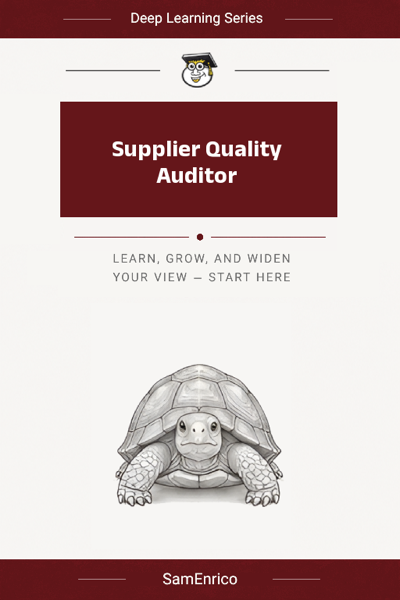
Non-FictionInformativeEducational
Supplier Quality Auditor eBook
A Coursebook on Supplier Quality Auditor
by Kyle Alla
A Coursebook on Supplier Quality Auditor
Formats
Free sample
Chapter 1: The Receiving Dock Lie--– The cardboard box arrived on a Tuesday, wrapped in brown tape and stamped with a Certificate of Analysis that looked legitimate enough. The receiving clerk scanned the barcode, noted the quantity of 5,000 units, and wheeled the box to the quarantine area where three parts would be pulled for inspection. The plan called for a sample size of 125 units with an Acceptable Quality Level of 0.65%. If the sample contained one or fewer defects, the entire lot would roll to the production line. If it contained two or more, the lot would be rejected and sent back to the supplier at their expense.
This was the system. It had been the system for seventeen years. Everyone trusted the system.The inspector, a twenty-two-year veteran named Teresa who had once found a dead mouse inside a sealed bearing assembly, pulled her 125 units. She measured, probed, and recorded. The capacitor values were within tolerance.
The solder joints looked clean. The date codes matched the certificate. Teresa signed the release form, and the box rolled to Line 3, where 5,000 units were loaded into feeders and attached to circuit boards destined for a brake control module. Six weeks later, a woman in Ohio lost her brakes while merging onto a highway, swerved into a guardrail, and survived with a broken collarbone. Her lawyer found the capacitor that failed – the one that had passed inspection, the one that had a legitimate-looking certificate, the one that should have worked.This is the lie of the receiving dock.
It is the lie that quality can be inspected into a product after it is made, that a sample of 125 units can represent 5,000, that a Certificate of Analysis is the same as trust, that the supplier’s interest in quality is the same as yours. It is the most expensive lie in manufacturing, and the entire profession of Supplier Quality Auditing exists to expose it.The truth, learned over decades of recalls, fires, injuries, and bankruptcies, is brutal and simple: What you inspect is not what you get. What you audit is what you get.This chapter is about that truth. It is about why the modern SQA role was born from the ashes of failed inspection systems. It is about the difference between counting defects and preventing them.
And it is about the fundamental transformation that every quality professional must undergo: from a passive gatekeeper who sorts good parts from bad, to an active investigator who builds quality into the supply chain before the first part is ever made.The Mathematics of Mistrust The woman in Ohio did not sue the receiving clerk or the inspector. She sued the automotive manufacturer, who sued the Tier 1 supplier, who sued the capacitor manufacturer, who had already declared bankruptcy and disappeared. The final settlement was 17million,paidbytheautomotivemanufacturer’sproductliabilityinsurance,whichraisedtheirpremiumsby40017 million, paid by the automotive manufacturer’s product liability insurance, which raised their premiums by 400% for the next five years. The total cost of that single counterfeit capacitor, traced through the chain of liability, exceeded 17million,paidbytheautomotivemanufacturer’sproductliabilityinsurance,whichraisedtheirpremiumsby40030 million before accounting for the brand damage that no spreadsheet can capture.Let us examine the mathematics that made this outcome inevitable, because until you understand the math, you will be tempted to believe that more inspection is the answer. It is not.The Sample Size Problem.
The inspection plan called for a sample of 125 units out of 5,000 – a sampling rate of 2.5%. The Acceptable Quality Level was set at 0.65%, meaning the manufacturer was willing to accept up to 32 defective units per 5,000-lot. The probability that a random sample of 125 units would contain at least one defective unit, given an actual defect rate of 2% (the real rate from the counterfeit supplier), is approximately 92%. But the probability that it would contain enough defective units to trigger a rejection – at least two defective units – is only about 60%. In other words, a lot with 2% defects would pass inspection 40% of the time.
This is not a bug in the sampling plan. It is the feature. Sampling plans are designed to accept some defective lots because 100% inspection is too expensive. But when the defect is safety-critical, “some defective lots” means “some dead customers.”The Inspection Paradox. Even if the manufacturer switched to 100% inspection – checking every single capacitor before it went to the line – the counterfeit capacitors would still have passed.
Why? Because the counterfeiters did not put defects in every unit. They alternated good and bad units, knowing that the first and last units of a run are most likely to be inspected. They sourced legitimate capacitors for the samples and counterfeit capacitors for the rest. They printed fake Certificates of Analysis using a real laboratory’s letterhead.
Inspection, no matter how thorough, cannot detect what it does not know to look for. You cannot inspect for a missing specification. You cannot inspect for a fraudulent certificate. You cannot inspect for intent.The Capability Illusion. Many quality professionals believe that if a supplier is “capable” – meaning their process consistently produces output within specification – then inspection is unnecessary.
But capability assumes that the process is stable, that the inputs are controlled, that the measurements are accurate, and that the operator is following the procedure. The counterfeit capacitor supplier had none of these things. They had no process. They bought random batches from liquidators, tested none of them, and shipped all of them. A capability study of a non-existent process is a meaningless exercise.
Yet manufacturers routinely accept capability data from suppliers without verifying that the process described in the capability study is the process actually used for production.The mathematics all point to the same conclusion: Product inspection is necessary but not sufficient. It catches some defects some of the time. It never catches systematic fraud. It never prevents the root cause. It is the equivalent of installing a smoke detector that only works when you are awake to hear it.The Seven Flaws of Receiving Inspection The receiving dock is where most quality programs begin.
It is also where they end, which is the problem. Over-reliance on receiving inspection exhibits seven fatal flaws that the SQA role was designed to address.Flaw One: Inspection is backward-looking. By the time a part arrives at your receiving dock, it has already been made, packed, shipped, and invoiced. The labor is spent. The material is consumed.
The machine time is used. No amount of inspection can recover those costs. You are paying for defects, then paying to find them, then paying to dispose of them. The only way to avoid paying for defects in the first place is to ensure they are never made.Flaw Two: Inspection cannot detect what it does not know to seek. Teresa had been inspecting capacitors for seven years.
She knew the nominal value, the tolerance, the physical dimensions, and the solderability requirements. She did not know that the capacitor’s voltage rating was incorrect because the voltage rating was not on the inspection plan. No one had thought to verify voltage rating because the supplier’s certificate said it was correct. The woman in Ohio died because no one asked the right question.Flaw Three: Sampling accepts statistical risk. Every sampling plan has a producer’s risk (rejecting…
This is the end of the free sample. Get the eBook to keep going. Buy now
About this book
Details
- Author
- Kyle Alla
- Publisher
- SamEnrico
- Language
- English
- Genre
- Non-Fiction, Informative, Educational
- Released
- 2026-05-08
- Pages (approx.)
- 147
- Available as
- eBook, Audiobook

Read better in the ZLOADR app
Your eBooks on your phone or tablet. Sign in with your SamEnrico account and start reading.
More by Kyle Alla
 Burnout Boundaries With Technology GuideKyle Alla$11.99
 Eyelid Ptosis Self Esteem GuideKyle Alla$11.99
 Wyler Deep Focus PathKyle Alla$11.99
 Giving Critical Feedback Without ResentmentKyle Alla$11.99
 Screen Time and Sleep GuideKyle Alla$11.99
 The Secret Olympics: How a Video Game Exposed Cold War Tensions (1984)Kyle Alla$11.99
 Report Specification GenerationKyle Alla$12.99
 EU Platform Workers DirectiveKyle Alla$12.99
 How to Become a Distribution-field EngineerKyle Alla$11.99
 Understanding Mental Retardation-polydactyly-uncombable HairKyle Alla$17.99
You may also like
 Hong Kong Handover 1997Dunn Johnnie$11.99
 Zumba For Postnatal Recovery CourseNeal Christian$11.99
 Zumba for BeginnersLadner Nikia$11.99
 YouTube Comment Mining GuideHumes Pandora$12.99
 Worry Box MeditationCarlin Rudy$11.99
 Workplace Stress MeditationNguyen Lynn$11.99
 Workplace Stress and Sleep RepairHawley Ivory$11.99
 Workplace Perfectionism CureDelaney Jeffry$11.99
 Workplace Injustice Anger GuideWallen Isabelle$11.99
 Work Addiction and Burnout LinkGreenwood Ester$11.99
 Women in Yoga and WellnessBeattie Galina$11.99
 Women in Stand Up ComedyChun Evangeline$11.99