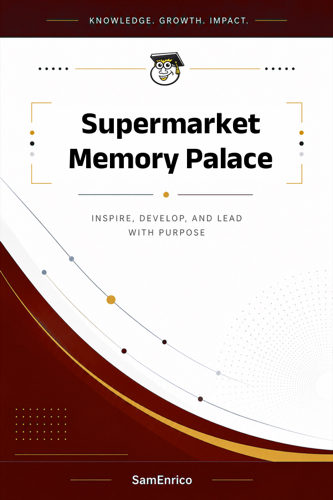
Supermarket Memory Palace
Use grocery store aisles to remember shopping list
Use grocery store aisles to remember shopping lists and categories.
Formats
About this book
Free sample
Chapter 1: The Doorway Thief--–- You have been robbed more times than you know. Not by a masked stranger in a dark alley, but by a set of sliding glass doors at your local grocery store. Every time you walk through them, roughly 40 percent of your short-term memory vanishes into thin air. You feel it happen—that strange, hollow confusion as you grab a cart and suddenly think, Wait, why am I here? What did I need?
You stand in the produce section, staring at bananas you don't want, while the three things you actually came for slip further into the fog.This chapter is not about memory techniques. Not yet. First, we need to understand the enemy. Because you cannot defeat what you cannot name.The phenomenon has a name: the Doorway Effect. It was first studied rigorously by psychologists at the University of Notre Dame in 2011, but every human being has experienced it thousands of times.
You walk from the living room to the kitchen and forget why. You step off the elevator onto your floor and draw a blank on which door is yours. You pass through the sliding doors of a supermarket and your mental shopping list crumbles like a sandcastle at high tide.Here is what is happening inside your brain. Your hippocampus—the seahorse-shaped region responsible for memory and spatial navigation—treats doorways as event boundaries. When you pass through a physical threshold, your brain unconsciously decides that the previous context is no longer relevant and begins encoding the new environment from scratch.
This was evolutionarily useful for your ancestors, who needed to shift attention from "inside the cave" (safe, sleeping) to "outside the cave" (dangerous, hunting). But in a modern supermarket, it is a disaster. Your brain is not being lazy. It is being efficient in exactly the wrong way.The Doorway Effect explains why you can recite your entire shopping list while driving to the store, only to forget it the moment your feet hit the linoleum floor. It is not age.
It is not stress. It is not a "bad memory." It is architecture.The Silent Confession of the Shopping List Most…
This is the end of the free sample. Get the eBook to keep going. Buy now
Contents
- Chapter 1
- Chapter 2
- Chapter 3
- Chapter 4
- Chapter 5
- Chapter 6
- Chapter 7
- Chapter 8
- Chapter 9
- Chapter 10
- Chapter 11
- Chapter 12
Details
- Author
- Lemons Dewayne
- Publisher
- SamEnrico
- Language
- English
- Genre
- Non-Fiction, Self-Help, Everyday Memory
- Released
- 2026-06-09
- Pages (approx.)
- 140
- Available as
- eBook, Audiobook

Read better in the ZLOADR app
Your eBooks on your phone or tablet. Sign in with your SamEnrico account and start reading.
More by Lemons Dewayne
 Facility Decontamination OperationsLemons Dewayne$11.99
 Macros for Older AdultsLemons Dewayne$11.99
 FAST Skill Self RespectLemons Dewayne$11.99
 Skill Learning Weekly ReviewLemons Dewayne$11.99
 OKR for Marketing TeamsLemons Dewayne$12.99
 My Emergency Placement NightLemons Dewayne$11.99
 Goal Visualization GuideLemons Dewayne$11.99
 Grief and Technology After SpouseLemons Dewayne$11.99
 The Architect Who Built a Nation: Edwin Lutyens and New Delhi's Grand VisionLemons Dewayne$11.99
 The Last Breath: The Untold Story of the First Successful Lung TransplantLemons Dewayne$11.99
 How to Produce MasksLemons Dewayne$11.99
 How to Produce a Wide Span VehicleLemons Dewayne$11.99