
Non-FictionHealth & WellnessSkin Protection
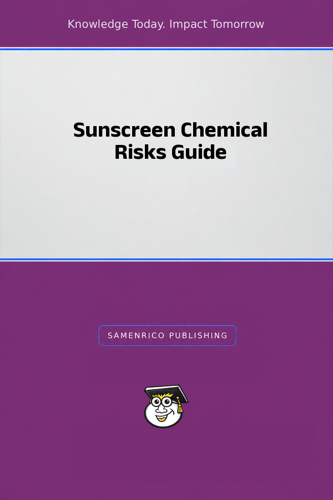
Sunscreen Chemical Risks Guide eBook
Questions oxybenzone and octinoxate absorption, of
Questions oxybenzone and octinoxate absorption, offering mineral sunscreen alternatives for skin protection.
Formats
Free sample
Chapter 1: The Uncomfortable Question--–- You have probably never woken up wondering whether your sunscreen is safe. You have been taught to believe that sunscreen is medicine for your skin, a protective shield that allows you to enjoy the outdoors without paying the price of premature aging or skin cancer. Dermatologists recommend it. Doctors use it. Parents slather it onto their children with the same reflexive care they use when buckling a car seat or installing a smoke detector.
Sunscreen feels like safety. Sunscreen looks like responsibility. But what if the story is more complicated than the bottle lets on?What if the chemicals designed to protect you are quietly entering your bloodstream? What if the same product you apply to your child’s face every morning contains ingredients that disrupt hormones, mimic estrogen, and persist in human tissues for days or weeks after the last application? What if the sunscreen industry has known about these concerns for decades but has chosen to market reassurance rather than transparency?These are not hypothetical questions posed by alarmists or conspiracy theorists.
They are the central findings of peer-reviewed research conducted by the United States Food and Drug Administration, published in the Journal of the American Medical Association, and confirmed by independent laboratories around the world. The data exists. The conclusions are clear. And yet, most consumers have never heard them.This chapter does something unusual for the opening of a guidebook. It does not immediately offer solutions.
It does not rush to recommend a brand or a routine. Instead, it asks you to sit with an uncomfortable question for a few pages: could the very products we trust to protect us be causing harm we have not yet fully measured?By the end of this chapter, you will understand why that question is not only reasonable but urgently necessary. You will learn the difference between chemical and mineral sunscreens—a distinction that most consumers cannot name but that fundamentally changes the safety profile of what you put on your skin. You will see the data from the FDA’s landmark absorption study, which shattered the long-held assumption that sunscreen ingredients stay on the surface of the skin. And you will begin to understand why the regulatory system designed to protect you has failed to keep pace with the science.This book is not an anti-sunscreen screed.
Let that be perfectly clear from the first page. Skin cancer is real. UV radiation is dangerous. Sun protection is essential. But the choice of protection matters, and for too long, consumers have been told that all sunscreens are created equal.
They are not. The evidence is overwhelming that some sunscreen ingredients carry risks that others do not—and that safer alternatives exist right now, on shelves today, ready to be used.The goal of this book is simple: to give you the information you need to make an informed choice. Not to scare you away from the sun. Not to make you paranoid about every product in your bathroom. But to ensure that when you reach for sunscreen tomorrow morning, you know exactly what you are putting on your skin, exactly what is entering your body, and exactly what alternatives exist.Let us begin.The Skin Cancer Imperative Before we discuss the risks of sunscreen chemicals, we must acknowledge the undeniable reality that makes sun protection necessary.
Skin cancer is the most common malignancy in the United States. According to the American Cancer Society, more people are diagnosed with skin cancer each year than all other cancers combined. One in five Americans will develop skin cancer by age seventy. Melanoma, the deadliest form, kills approximately one person every hour of every day.These numbers are not abstract statistics. They represent real people—parents, siblings, friends, neighbors—whose lives are cut short or dramatically altered by a disease that is largely preventable.
Ultraviolet radiation from the sun is classified as a Group 1 carcinogen by the International Agency for Research on Cancer, the same category that includes tobacco smoke and asbestos. The causal link between UV exposure and skin cancer is one of the most firmly established relationships in environmental medicine.This is why public health organizations have spent decades urging sun protection. The message is simple and correct: limit time in direct sunlight during peak hours, wear protective clothing and hats, seek shade, and apply sunscreen to exposed skin. Sunscreen is not the only tool, but it is an important one. When applied correctly, broad-spectrum sunscreen reduces the risk of squamous cell carcinoma by approximately 40 percent and melanoma by approximately 50 percent, according to long-term Australian studies.So let us be unequivocal: this book is not telling you to stop wearing sunscreen.
Anyone who tells you to abandon sun protection is giving dangerous advice. The question is not whether to protect your skin from UV damage. The question is how to do so most safely.The answer, as you will learn throughout these chapters, is not to abandon sunscreen but to choose a different kind of sunscreen—one that works through a different mechanism, does not penetrate the skin, and has a decades-long safety record. The solution exists. It is available today.
And you do not need to compromise on protection to access it.The Two Families of Sunscreen Most people do not know that sunscreens fall into two fundamentally different categories. They grab a bottle based on SPF number, brand recognition, or price. But the distinction between chemical and mineral sunscreens is the single most important factor in determining safety.Chemical sunscreens are organic compounds that absorb UV radiation and convert it into heat. They work by molecular absorption: UV photons excite electrons in the chemical's molecular bonds, raising them to a higher energy state. When those electrons return to their ground state, they release the energy as heat, which dissipates from the skin.
The chemical itself is not consumed in this process, allowing it to repeat the cycle hundreds or thousands of times before degrading.The most common chemical sunscreen ingredients in the United States include oxybenzone (benzophenone-3), octinoxate (ethylhexyl methoxycinnamate), octisalate (ethylhexyl salicylate), homosalate, octocrylene, and avobenzone. Each has a different absorption spectrum, meaning they block different portions of the UV range. This is why most chemical sunscreens contain three to six active ingredients—to achieve broad-spectrum coverage across both UVA and UVB.Chemical sunscreens have dominated the market for decades because they are cosmetically elegant. They rub in clear, feel light on the skin, and blend easily under makeup. They do not leave the white, chalky residue associated with older mineral formulas.
For consumers who prioritize appearance and texture, chemical sunscreens have been the obvious choice.Mineral sunscreens (also called physical sunscreens) are inorganic particles that sit on top of the skin and provide protection through a combination of reflection, scattering, and absorption. The two FDA-approved mineral ingredients are zinc oxide and titanium dioxide. These particles are too large to penetrate healthy, intact skin when formulated at non-nanoparticle sizes. Instead, they form a uniform film that blocks UV radiation through multiple mechanisms.Zinc oxide is the gold standard of mineral protection. It provides excellent coverage across the entire UVA and UVB spectrum, making it the…
This is the end of the free sample. Get the eBook to keep going. Buy now
About this book
Details
- Author
- Guillen Robbyn
- Publisher
- SamEnrico
- Language
- English
- Genre
- Non-Fiction, Health & Wellness, Skin Protection
- Released
- 2026-06-09
- Pages (approx.)
- 147
- Available as
- eBook, Audiobook

Read better in the ZLOADR app
Your eBooks on your phone or tablet. Sign in with your SamEnrico account and start reading.
More by Guillen Robbyn
 Escobar Drug Lord AftermathGuillen Robbyn$11.99
 Perfectionism in Academia HandbookGuillen Robbyn$11.99
 Stress and Adrenal Fatigue GuideGuillen Robbyn$11.99
 Antwerp Heist Escape TunnelGuillen Robbyn$11.99
 Whispers of the Glass Ceiling: The Unseen Lives of the Women Who Built the Empire StateGuillen Robbyn$11.99
 The Silent Summit: The First Voices of the AlpsGuillen Robbyn$11.99
 Understanding Female Sexual Arousal DisorderGuillen Robbyn$17.99
 Selling Excellence ManagerGuillen Robbyn$11.99
 How to Start a Hobby in LapidaryGuillen Robbyn$11.99
 Remote Team Personality ClashGuillen Robbyn$12.99
 Running Strategy Meetings for Product LaunchesGuillen Robbyn$12.99
You may also like
 Hong Kong Handover 1997Dunn Johnnie$11.99
 Zumba For Postnatal Recovery CourseNeal Christian$11.99
 Zumba for BeginnersLadner Nikia$11.99
 YouTube Comment Mining GuideHumes Pandora$12.99
 Worry Box MeditationCarlin Rudy$11.99
 Workplace Stress MeditationNguyen Lynn$11.99
 Workplace Stress and Sleep RepairHawley Ivory$11.99
 Workplace Perfectionism CureDelaney Jeffry$11.99
 Workplace Injustice Anger GuideWallen Isabelle$11.99
 Work Addiction and Burnout LinkGreenwood Ester$11.99
 Women in Yoga and WellnessBeattie Galina$11.99
 Women in Stand Up ComedyChun Evangeline$11.99