
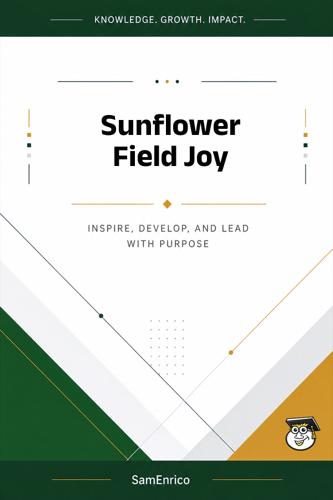
Non-FictionSelf-HelpMood Lifting
Sunflower Field Joy eBook
Visualize a field of sunflowers to lift your spiri
Visualize a field of sunflowers to lift your spirits and release sadness.
Formats
Free sample
Chapter 1: The Yellow Door...--–- Before you can change how you feel, you need somewhere safe to feel it. This is not weakness. This is infrastructure. Every city builds fire stations before there is a fire. Every farmer prepares the soil before the first seed is planted.
And you, before you attempt to lift your spirits or release your sadness, need a mental sanctuary that your brain can learn to trust. Not a fantasy escape from reality, but a rehearsal space for resilience. This chapter is not about pretending sadness doesn't exist. It is about building a room of your own where sadness is allowed to visit but does not get to live.The Problem with Trying to "Think Positive" from an Empty Room You have probably tried to cheer yourself up before. Someone told you to "look on the bright side" or "count your blessings." And maybe that worked for a moment, or maybe it made you feel worse because the bright side felt like a lie.
Here is why that happens: your brain does not respond well to commands. When you tell yourself "be happy" from a place of exhaustion, grief, or anxiety, your brain hears "you are failing at happiness." That creates shame, which deepens sadness, which makes you try harder, which fails again. It is a loop.The missing piece is not more effort. It is a location.Every successful visualization practice in sports psychology, trauma recovery, and mindfulness begins with the same step: building a safe place. A basketball player does not visualize the championship-winning shot from a noisy locker room.
They build a quiet court in their mind, with specific dimensions, specific sounds, specific light. A trauma survivor does not jump straight into processing painful memories. They first construct a "safe harbor" visualization—a beach, a library, a childhood porch—that they can return to when the work becomes overwhelming. The same principle applies to you and your sadness. You cannot release what you have never been able to hold.
And you cannot hold it without a container.Your sunflower field is that container.Why a Sunflower Field? The Neuroscience of Natural Spaces You might be wondering: why sunflowers? Why not a beach, a forest, a mountain cabin? Those are also excellent choices, and if you already have a reliable mental sanctuary, you are welcome to adapt this book's practices to that space. But sunflowers offer three unique advantages for the specific goal of lifting spirits while releasing sadness.First, sunflowers are heliotropic.
They physically turn toward light, even on cloudy days. This is not a metaphor—it is a biological fact. Young sunflowers track the sun from east to west, then reorient overnight to face east again, waiting for dawn. Your brain can learn this same pattern: not the denial of darkness, but the active choice of orientation. When you visualize a sunflower field, you are not pretending the clouds don't exist.
You are practicing the act of turning.Second, sunflowers grow in community. A single sunflower is striking. A field of them is overwhelming in the best way. They do not compete for light; they grow tall together, each stalk supporting the others by creating a microclimate that reduces wind and retains moisture. This models a truth about joy: it is not a solo achievement.
Even when you are alone, your joy echoes the people who have loved you, the ancestors who survived, the strangers who will read this book after you. The field holds you without demanding that you hold it alone.Third, sunflowers have a clear lifecycle that mirrors emotional seasons. They are planted, they grow, they bloom, they droop, they drop seeds, and then the stalks stand bare through winter until spring returns. This is not failure. This is perennial truth.
You will not be asked to feel joyful every day. You will be asked to trust that the field exists even when you cannot see it.The neuroscience behind this is straightforward but powerful. When you vividly imagine a natural scene using multiple senses, your brain activates the same neural regions as if you were actually there. The visual cortex lights up. The insula processes the imagined feeling of soil underfoot.
The amygdala, which governs fear and sadness, receives input from the prefrontal cortex saying "this is safe." Over time, with repetition, the neural pathway to the field becomes faster and more automatic than the pathway to rumination. You are not erasing sadness. You are building a new road to joy that can eventually be traveled in seconds.Safety First: Who This Chapter Is For (And Who Should Slow Down)Before you build anything, a necessary pause. This book is designed for situational sadness—the grief of loss, the weight of disappointment, the fog of loneliness, the ache of a hard season. It is not designed as a replacement for medical treatment.
If you are experiencing thoughts of self-harm, have lost interest in almost everything for more than two weeks, cannot get out of bed, or are under the care of a psychiatrist for major depression or bipolar disorder, please use this book as a supplement to professional care, not a substitute. The practices here can support therapy and medication, but they cannot replace them.Additionally, if you have a history of trauma—especially complex trauma or PTSD—some visualization exercises may trigger flooding (an overwhelming rush of memory and emotion). This chapter is generally safe, but future chapters (specifically Chapter 2, which asks you to plant sadness, and Chapter 8, which asks you to visualize forgiveness) include specific trauma warnings. You are always allowed to skip an exercise, modify it, or do it with a therapist present. The field is yours.
You set the rules.For readers with aphantasia (the inability to generate mental images), this chapter includes a specific alternative practice at the end. You are not broken. Your brain simply uses different pathways, and we will work with those.Building Your Field: The Five-Sense Foundation Close your eyes if you are able. If closing your eyes makes you anxious or dizzy, keep them open and soften your gaze on a neutral spot—a blank wall, the floor, the sky outside a window. Take one breath using the Breathing Foundation that will be used throughout this book.
Here it is: inhale through your nose for four seconds, hold for two seconds, exhale through your mouth for six seconds. The long exhale signals safety to your vagus nerve, which runs from your brainstem to your abdomen and governs your rest-and-digest state. Do this three times. Do not rush. The field is not going anywhere.Now, begin to build.Sight.
Imagine a wooden gate in front of you. It is painted a cheerful yellow—not neon, not pale, but the yellow of a sunflower petal at midday. The paint is slightly weathered, because this gate has welcomed you before and will welcome you again. There is a simple iron latch or a round wooden knob. Behind the gate, you see the first row of sunflowers.
Their petals are gold, their centers dark brown or nearly black, heavy with seeds. The sky above is not necessarily cloudless—clouds are allowed—but there…
This is the end of the free sample. Get the eBook to keep going. Buy now
About this book
Details
- Author
- Ordonez Daphine
- Publisher
- SamEnrico
- Language
- English
- Genre
- Non-Fiction, Self-Help, Mood Lifting
- Released
- 2026-06-09
- Pages (approx.)
- 118
- Available as
- eBook, Audiobook

Read better in the ZLOADR app
Your eBooks on your phone or tablet. Sign in with your SamEnrico account and start reading.
More by Ordonez Daphine
 TM For ADHD Focus Improvement WorkbookOrdonez Daphine$11.99
 The Joy Finding GuideOrdonez Daphine$11.99
 Financial Advisors EQ GuideOrdonez Daphine$11.99
 The Self Esteem After Weight Change GuideOrdonez Daphine$11.99
 The Blood of Isfahan: Nadir Shah's March on Delhi (1739)Ordonez Daphine$11.99
 Overcoming Self-Limiting BeliefsOrdonez Daphine$11.99
 How to Become a Spout Tender IiOrdonez Daphine$11.99
 AI Financial Data SovereigntyOrdonez Daphine$12.99
 Toyota SWOT Repeat GuideOrdonez Daphine$12.99
 Understanding Mycobacterium Avium Complex InfectionOrdonez Daphine$17.99
You may also like
 Hong Kong Handover 1997Dunn Johnnie$11.99
 Zumba For Postnatal Recovery CourseNeal Christian$11.99
 Zumba for BeginnersLadner Nikia$11.99
 YouTube Comment Mining GuideHumes Pandora$12.99
 Worry Box MeditationCarlin Rudy$11.99
 Workplace Stress MeditationNguyen Lynn$11.99
 Workplace Stress and Sleep RepairHawley Ivory$11.99
 Workplace Perfectionism CureDelaney Jeffry$11.99
 Workplace Injustice Anger GuideWallen Isabelle$11.99
 Work Addiction and Burnout LinkGreenwood Ester$11.99
 Women in Yoga and WellnessBeattie Galina$11.99
 Women in Stand Up ComedyChun Evangeline$11.99