
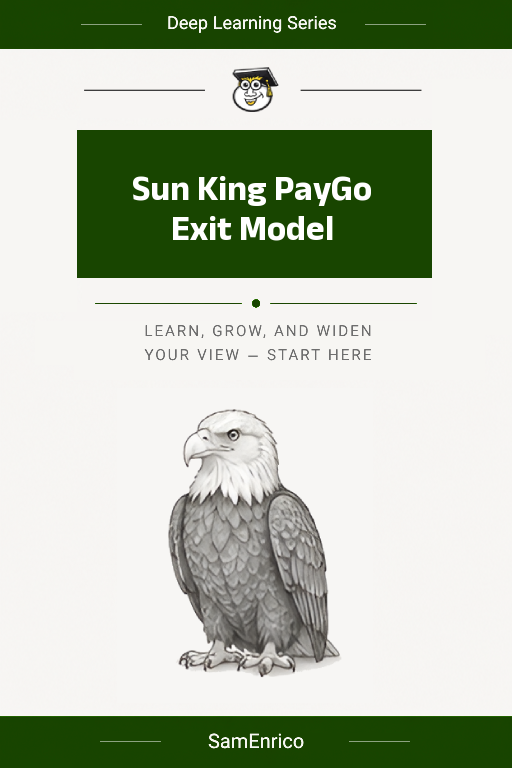
Sun King PayGo Exit Model eBook
Execute PayGo solar exits using Sun King's distrib
Execute PayGo solar exits using Sun King's distribution scale and acquisition by global energy players.
Formats
Free sample
Chapter 1: The Density Mandate--–- The email arrived at 11:47 PM on a Tuesday. The subject line read, “Strategic Opportunity – Off-Grid Solar.” Anu, the founder of a five-year-old PAYGo company in Lagos, almost deleted it. She had received dozens of similar emails from consultants, investment bankers, and tire-kickers. But this one was different. The sender’s domain was not a generic Gmail address.
It was @totalenergies.com. The message was short: “We have been watching your distribution network in Nigeria for eighteen months. We would like a confidential conversation about a potential acquisition. No bankers. Just you and me.”Anu’s heart raced.
She had built her company from a single warehouse in Ikeja to a network of 1,200 agents across three states. She had raised $18 million from impact investors. She had survived currency devaluation, a near-default on a working capital facility, and the departure of her co-founder. And now, a global energy major was knocking. But as she scrolled through her latest management accounts, she realized a painful truth.
Her collection rate had slipped to 71%. Her agent churn was 14% per month. And her customer base, while loyal, was spread too thin—just 42 customers per agent, compared to the 105 that Sun King had achieved in Kenya. She replied to the email: “Thank you for your interest. I am flattered.
But I am not sure we are ready.” She never heard back.That story, told to me over coffee in Nairobi three years later, is the reason this book exists. Anu’s company had good technology, a real social mission, and a growing customer base. What it did not have was density. And without density, the email from Total Energies might as well have been spam. This chapter debunks the most dangerous myth in PAYGo: that failures stem from bad technology, weak products, or insufficient capital.
The truth is more brutal. Most PAYGo startups die as orphans—unwanted, unsold, and eventually unwound—because they never achieved sufficient distribution density to attract a strategic acquirer. An exit is not a financial event. It is a density event.The 600 Million Doorsteps To understand density, start with the problem that PAYGo was invented to solve. Across sub-Saharan Africa and parts of Asia, approximately 600 million people live without access to reliable electricity.
They are not a monolith. They include farmers in rural Tanzania who walk two hours to charge a phone at a market stall, market vendors in Lagos who spend 30% of their daily income on diesel generators, and families in northern Nigeria who live in darkness not because they cannot afford electricity, but because the grid has never reached them.For decades, the development industry approached this problem with charity. NGOs distributed solar lanterns for free, which broke within months and were never replaced. Governments subsidized solar home systems that ended up in the homes of the wealthy, not the poor. Then came PAYGo, short for “pay-as-you-go.” The innovation was not technological—solar panels existed, batteries existed, GSM chips existed.
The innovation was financial. A customer could acquire a solar home system for a small down payment, then pay daily or weekly via mobile money over 6 to 12 months. At the end of the term, they owned the system outright.The model worked brilliantly—on paper. By 2020, dozens of PAYGo companies had raised over $1.5 billion from impact investors, development finance institutions, and venture capital funds. Companies like d.light, Mobisol, Off Grid Electric (now ZOLA), and Sun King (formerly Greenlight Planet) grew rapidly.
They deployed millions of solar home systems. They brought light, phone charging, and television to off-grid households for the first time.Then the trouble began. Collection rates started to fall. Agent networks proved expensive to maintain. Currency devaluations in Nigeria, Kenya, and Tanzania wiped out dollar-denominated balance sheets.
One by one, companies began to fail. Mobisol was acquired at a fire-sale price. Off Grid Electric was folded into a struggling parent company. Dozens of smaller PAYGo startups simply disappeared—their assets repossessed, their customer records lost, their investors writing off the entire investment.The survivors—Sun King most prominently—did something different. They did not necessarily have better technology.
Their panels were not more efficient. Their batteries did not last longer. What they had was density. And density, as this chapter will show, is the only metric that predicts whether a PAYGo company will end up acquired by a global energy giant or wind up in the graveyard of failed social enterprises.Defining Density: More Than Just Customers Let us be precise. When I say “density,” I do not mean a large customer base.
A company can have 2 million customers spread across 15 countries and still be low-density. That is not a moat; it is a mess. Density has four components, each measurable and each critical to exit readiness.First, customers per agent. This is the most important operational metric in PAYGo. An agent is a local entrepreneur who sells systems, collects payments, and provides basic technical support.
Sun King, as of 2025, operates with approximately 38,000 active agents and roughly 4 million active contracts—yielding about 105 customers per agent. That ratio means each agent is profitable. Their commission income from 105 customers—approximately $0.50 per customer per month—adds up to a meaningful livelihood. They are not quitting. They are not defecting to competitors.In contrast, low-density companies operate at 30 to 50 customers per agent.
At that ratio, agents earn barely enough to cover their transportation costs. They churn. They sell multiple brands. They prioritize whichever product pays the highest commission that week, which is rarely yours. Anu’s company, the one that received the Total Energies email, operated at 42 customers per agent.
She did not have an agent network. She had a churn problem dressed up as a distribution network.Second, customers per square kilometer. This is the geographic dimension of density. Sun King clusters its agents and customers in high-population districts. In Kisumu County, Kenya, the company serves approximately 18 customers per square kilometer.
In Lagos State, Nigeria, the density exceeds 40 customers per square kilometer. That clustering reduces field support costs, enables same-day collections, and allows agents to service multiple customers in a single trip.Low-density companies scatter. They pursue the myth of “national coverage” because it sounds impressive in investor updates. They open warehouses in distant cities before achieving density in their first market. They service customers who are three hours apart by motorcycle.
The result is that field operations cost 30–40% of revenue instead of 15–20%. That spread is the difference between profitability and perpetual subsidy.Third, countries with >100,000 active customers. Expansion is expensive. Legal setup, licensing, warehousing, agent recruitment, and regulatory compliance in a new country costs a minimum of 2–3millionbeforecollectingasinglepayment.Acompanythatspreadsitselfacross10countrieswith50,000customerseachhasincurred2–3 million before collecting a single payment. A company that spreads itself across 10 countries with 50,000 customers each has incurred 2–3millionbeforecollectingasinglepayment.Acompanythatspreadsitselfacross10countrieswith50,000customerseachhasincurred20–30 million in expansion costs for a customer base that is subscale in every jurisdiction.Sun King operates in 11 African countries, but the distribution is not equal.
Kenya, Nigeria, and Tanzania each exceed 500,000 active customers. The remaining eight countries are smaller but are fed from regional hubs—warehouses in Nairobi, Lagos, and Dar es Salaam. The rule is simple: do not open a new country until you have at least 100,000 active customers…
This is the end of the free sample. Get the eBook to keep going. Buy now
About this book
Details
- Author
- Shepherd Dortha
- Publisher
- SamEnrico
- Language
- English
- Genre
- Non-Fiction, Business Brief
- Released
- 2026-05-29
- Pages (approx.)
- 158
- Available as
- eBook, Audiobook

Read better in the ZLOADR app
Your eBooks on your phone or tablet. Sign in with your SamEnrico account and start reading.
More by Shepherd Dortha
 Twelve Step Meetings DecodedShepherd Dortha$11.99
 Music Theory MemorizationShepherd Dortha$11.99
 Depression Fatigue ManagementShepherd Dortha$11.99
 Female Blue Angel PilotShepherd Dortha$11.99
 Assertiveness in Financial ConversationsShepherd Dortha$11.99
 Disappointment In HealthShepherd Dortha$11.99
 Little Boy and Fat Man Design DifferencesShepherd Dortha$11.99
 The Betrayal Code: How a Math Genius Cracked the Stock Market—Then Sold Out the WorldShepherd Dortha$11.99
 Splendid Little War: The Battle of Santiago de Cuba (1898)Shepherd Dortha$11.99
 Crowns and Chaos: The Year That Changed Royalty ForeverShepherd Dortha$11.99
 The Complete Guide to the RemedyShepherd Dortha$11.99
 VFX Production ManagerShepherd Dortha$11.99
You may also like
 Hong Kong Handover 1997Dunn Johnnie$11.99
 Zumba For Postnatal Recovery CourseNeal Christian$11.99
 Zumba for BeginnersLadner Nikia$11.99
 YouTube Comment Mining GuideHumes Pandora$12.99
 Worry Box MeditationCarlin Rudy$11.99
 Workplace Stress MeditationNguyen Lynn$11.99
 Workplace Stress and Sleep RepairHawley Ivory$11.99
 Workplace Perfectionism CureDelaney Jeffry$11.99
 Workplace Injustice Anger GuideWallen Isabelle$11.99
 Work Addiction and Burnout LinkGreenwood Ester$11.99
 Women in Yoga and WellnessBeattie Galina$11.99
 Women in Stand Up ComedyChun Evangeline$11.99