
Non-FictionSelf-HelpSummer SchoolAcademic Burnout
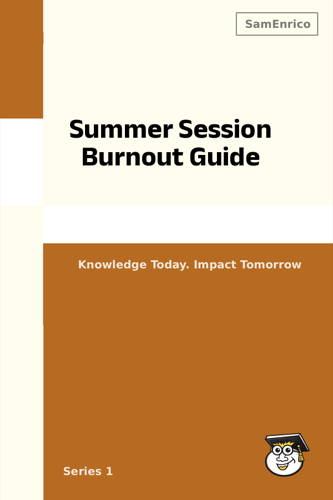
Summer Session Burnout Guide eBook
Survive accelerated courses without burning out be
Survive accelerated courses without burning out before the next semester begins.
Formats
Free sample
Chapter 1: The Math of Melting--–- The summer after my sophomore year, I did everything right. I registered for two 4-week courses—one in June, one in July—so they wouldn't overlap. I bought the textbooks before the first day. I cleared my work schedule. I told my friends I'd see them in August.
I got straight A's. And then I showed up to fall semester so profoundly broken that I cried in the campus bookstore over a $200 chemistry access code. Not because of the price—because I couldn't remember how to read. The words on the package blurred and swam. My hands shook.
My chest felt hollow. I sat down on the floor between the biology flashcards and the overpriced hoodies, and I thought: What is wrong with me?The answer, I learned years later, was that I had walked directly into a trap that hundreds of thousands of students fall into every summer. The trap has a name, but most people don't know it. The trap has mathematics, biology, and psychology behind it. And the trap is so counterintuitive that the harder you try, the deeper you sink.This chapter is called "The Math of Melting" because that's exactly what happens to your brain in a compressed summer course.
It doesn't break like a twig—snap, done, obvious. It melts like ice cream left on a dashboard. Slowly at first. Then all at once. And by the time you notice, you're already on the floor of a bookstore wondering why you can't read.The Numbers Nobody Tells You Let's start with a simple fact that sounds like an exaggeration but is mathematically undeniable: a 4-week summer course compresses sixteen weeks of learning into twenty-eight days.
That is not a typo. A standard fall or spring semester runs fifteen to sixteen weeks, including finals. A summer session—the kind that runs from early June to late June, or July to August—crams the same number of instructional hours, the same volume of readings, the same quantity of assignments, and the same complexity of exams into approximately one-quarter of the time.Here is what that looks like in hours.In a traditional fifteen-week semester, a three-credit course requires approximately forty-five to fifty-four total hours of work, including class time, studying, assignments, and exam preparation. That breaks down to three to four hours per week. Manageable.
You can take four or five courses at once, work a part-time job, see your friends on weekends, and still sleep seven hours a night. The system is designed for this pace.Now take that same forty-five to fifty-four total hours and squeeze it into four weeks. The weekly workload jumps to eleven to fourteen hours per course. If you take two summer courses—which most students do, because summer feels like a chance to "catch up" or "get ahead"—your weekly academic commitment becomes twenty-two to twenty-eight hours. That is a part-time job on top of whatever else you have going on.
And if you take three courses? Thirty-three to forty-two hours per week. That's a full-time job with overtime, except you're also paying tuition for the privilege.But here is where the math gets truly cruel. Those weekly totals assume you study efficiently every single day. They assume no sick days, no mental health crashes, no family obligations, no car trouble, no roommate crises, no "I just can't look at another Power Point" afternoons.
In reality, students in summer courses lose at least ten to twenty percent of their available study time to exhaustion, distraction, and the simple fact that human beings are not machines.Adjust for that reality, and your two-course summer load requires twenty-five to thirty-five hours of focused work per week. Every week. Without a break. For four to six weeks straight.Now you understand why my brain melted.The Myth of "Just Six Weeks"Students fall into the summer session trap because of a single seductive belief: I can do anything for six weeks. This belief is not entirely wrong.
The human body can tolerate remarkable short-term stress. Soldiers train for basic training. Athletes compete in tournaments. Parents survive newborn sleep schedules. Six weeks of intensity is survivable.But survivable is not the same as sustainable.
And the problem with "I can do anything for six weeks" is that it ignores what happens on day forty-two.Let me introduce you to a concept that will appear throughout this book: cumulative fatigue. Cumulative fatigue is not the same as being tired after a long day. It is not the same as needing a nap. Cumulative fatigue is the slow, invisible build-up of physiological and cognitive debt that compounds daily. Each day of insufficient sleep, each skipped meal, each hour of forced focus beyond your natural limit adds a small amount to your fatigue balance.
You don't feel it on day three. You barely notice it on day seven. By day fourteen, you might feel "a little run down." By day twenty-one, you're snapping at friends and forgetting where you put your keys. By day twenty-eight, you're crying over chemistry access codes.The mathematics of cumulative fatigue follows a rule that students consistently underestimate: fatigue compounds like interest on a credit card, but you don't get a monthly statement. You don't see the balance growing until you're already in debt.Let me make this concrete with an example drawn from dozens of student interviews.
Take a student—let's call her Maya—who starts a 4-week summer course with excellent habits. She sleeps seven hours a night, eats three meals a day, studies in focused blocks, and takes one evening off per week. By the end of week one, she has a small fatigue debt: maybe six hours of cumulative sleep loss from early mornings and late-night studying. Nothing concerning.By the end of week two, the small debt has grown. Maya has now lost approximately fifteen hours of sleep relative to her baseline.
Her cognitive processing speed has dropped by ten percent. Her working memory capacity has decreased by eight percent. She doesn't notice these changes because they happen gradually, but they are real and measurable.By the end of week three, Maya's fatigue debt has reached critical mass. She has lost twenty-five to thirty hours of sleep over the course of the month. Her reaction time is comparable to someone with a blood alcohol concentration of 0.05.
Her ability to learn new information has dropped by twenty percent. She is now spending more time studying to achieve the same results, which creates more fatigue, which further impairs her learning. This is the melt. Not a single catastrophic failure, but a slow, accelerating spiral.Maya finishes the course with a B-plus. She feels relieved.
She takes two weeks off before her July course begins. She sleeps in, watches television, and tells herself she has recovered. But the research on cognitive residue—which we will explore in depth in Chapter 9—shows that two weeks of unstructured rest is rarely enough to clear severe cumulative fatigue. Maya starts her July course already depleted. By the end of July, she is running on fumes.
By the first week of August, she is not recovering at all between study sessions. By the time fall semester…
This is the end of the free sample. Get the eBook to keep going. Buy now
About this book
Details
- Author
- Scarborough Ayanna
- Publisher
- SamEnrico
- Language
- English
- Genre
- Non-Fiction, Self-Help, Summer School, Academic Burnout
- Released
- 2026-06-08
- Pages (approx.)
- 146
- Available as
- eBook, Audiobook

Read better in the ZLOADR app
Your eBooks on your phone or tablet. Sign in with your SamEnrico account and start reading.
More by Scarborough Ayanna
 Failure Fear in JournalismScarborough Ayanna$11.99
 The Sunday Night Anxiety CureScarborough Ayanna$11.99
 Taylor Swift Country Roots GuideScarborough Ayanna$11.99
 Creative Arts Cognitive ProtectionScarborough Ayanna$11.99
 The Drumbeat of the Cosmos: How the Djembe Shaped the WorldScarborough Ayanna$11.99
 The Silent Architect: How Florence Harding Shaped a PresidencyScarborough Ayanna$11.99
 Understanding Friedel–heid–grosshans SyndromeScarborough Ayanna$17.99
 How to Start a Bag Frame Business (Beginners Guide)Scarborough Ayanna$11.99
 AI Sensitivity Analysis GuideScarborough Ayanna$12.99
 AI Emotion & Reputation HandbookScarborough Ayanna$12.99
 Academic CounselorScarborough Ayanna$11.99
You may also like
 Hong Kong Handover 1997Dunn Johnnie$11.99
 Zumba For Postnatal Recovery CourseNeal Christian$11.99
 Zumba for BeginnersLadner Nikia$11.99
 YouTube Comment Mining GuideHumes Pandora$12.99
 Worry Box MeditationCarlin Rudy$11.99
 Workplace Stress MeditationNguyen Lynn$11.99
 Workplace Stress and Sleep RepairHawley Ivory$11.99
 Workplace Perfectionism CureDelaney Jeffry$11.99
 Workplace Injustice Anger GuideWallen Isabelle$11.99
 Work Addiction and Burnout LinkGreenwood Ester$11.99
 Women in Yoga and WellnessBeattie Galina$11.99
 Women in Stand Up ComedyChun Evangeline$11.99