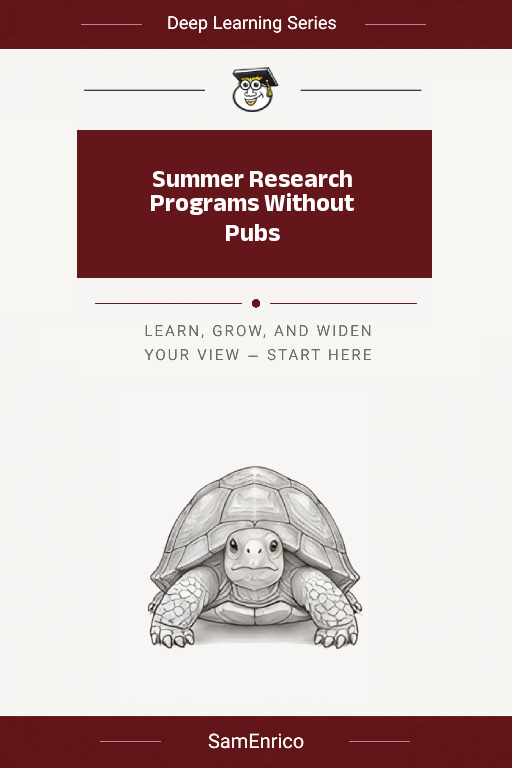
Summer Research Programs Without Pubs eBook
Select intensive summer research experiences that
Select intensive summer research experiences that yield posters, presentations, and strong letters even without journal articles.
Formats
Free sample
Chapter 1: The Publication Trap--When Sarah arrived at her summer research program in June of her sophomore year, she brought three things: a new notebook, a set of pipettes her parents had bought her as a gift, and a knot of anxiety so tight in her stomach that she could barely eat breakfast. The knot had a name, and the name was publication. Sarah had spent the previous three months scrolling through Linked In posts from classmates who had already secured "co-author" status on papers from their freshman year labs. She had read the subreddits where pre-med students claimed that without a first-author paper, you might as well not apply to medical school. She had internalized the message so completely that by the time she walked into her mentor's office for the first time, she had already decided that this summer would be a failure unless she walked away with a journal article.Her mentor, a third-year Ph D student named Marcus, asked her a simple question on day one: "What do you want to get out of this summer?"Sarah took a breath and said what she thought she was supposed to say.
"I want to publish."Marcus nodded slowly. Then he said something that would change the entire trajectory of her summer. He said, "That's not going to happen. And that's not a problem."Sarah felt the knot tighten. But Marcus kept talking.
He explained that his lab's average time from data collection to journal acceptance was fourteen months. He explained that the paper he was currently revising had been submitted nine months ago and was now on its second round of reviews. He explained that even if Sarah worked sixty hours a week for ten weeks, even if she discovered something genuinely novel, the timeline of academic publishing simply did not bend to the calendar of an undergraduate summer. The best she could hope for, he said, was a poster, a presentation, and a letter of recommendation so detailed and specific that graduate programs would fight over her.Sarah had never considered that a letter might be more valuable than a paper. She had never considered that the absence of a publication might be the norm, not the exception.
And she had certainly never considered that her obsession with publishing might be actively harming her chances of success.This chapter is for every student who has ever felt that knot. It is for the high schooler who sees peers posting about "research experience" on college applications and panics. It is for the undergraduate who has been told that without a publication, graduate school is a fantasy. It is for the student who is about to spend a summer in a lab, terrified that ten weeks of hard work will amount to nothing if there is no DOI at the end.Here is the truth that no one tells you: the vast majority of summer research programs do not result in publications. Not because the students are lazy or the research is weak, but because the timeline of academic publishing was designed for professional scientists working over years, not for undergraduates working over weeks.
And here is the second truth, the one that will set you free: that is perfectly fine. In fact, it is the expected outcome. The students who succeed from summer research are not the ones who publish. They are the ones who produce posters, deliver presentations, and earn letters. Everything else is noise.Let us start by understanding the timeline problem.The Mathematics of Academic Publishing The average time from initial submission to final acceptance in peer-reviewed STEM journals is between six and eighteen months.
This is not an opinion. It is a documented fact drawn from thousands of journals across dozens of disciplines. A 2022 analysis of over 100,000 papers found that the median time from submission to acceptance was 147 days for journals in the life sciences, 162 days for chemistry, and 213 days for economics. And those numbers represent the fast end. In high-impact journals like Nature or Science, the process often takes twelve to eighteen months or longer, with multiple rounds of revision, additional experiments requested by reviewers, and editorial decisions that can take months on their own.Now consider the structure of a typical summer research program.
The student arrives in late May or early June. The first one to two weeks are consumed by orientation, safety training, and learning the basic layout of the lab. The next two to three weeks involve learning techniques—how to run a gel, how to code in Python, how to handle cell cultures without contaminating everything. By week four or five, the student begins collecting data. By week seven or eight, they have enough data to analyze.
Week nine is for making sense of the numbers. Week ten is for creating a poster.That timeline, from orientation to poster, is ten weeks. Seventy days. There is no room for the six to eighteen months of peer review. There is barely room for a first draft of a manuscript.
The student who walks into a summer program expecting to publish is not ambitious. They are misinformed.This is not a failure of the student. It is a structural feature of how science works. Peer review is slow because it is supposed to be slow. Reviewers are unpaid volunteers who fit reading papers into the cracks of their own research schedules.
Editors juggle hundreds of submissions at once. Journals have backlogs. Revisions require additional experiments, which require additional time. The system is not broken. It is simply not designed for undergraduates with ten-week windows.There is, of course, an exception to every rule.
Some students do publish from summer programs. They are the ones who join labs where a senior graduate student or postdoc has already completed most of the work and simply needs help with the final figures or the literature review. In these cases, the student's name is added to a manuscript that was already in progress, and the paper is submitted shortly after the summer ends. This does happen. But it is rare, and it is almost entirely outside the student's control.
You cannot will a near-complete manuscript into existence. You cannot force a PI to add your name to a paper that does not yet exist. And the students who chase this outcome—who ask on day one, "When will I be an author?"—often find themselves in the worst possible position: they are assigned tedious, low-skill work that has no chance of leading to authorship, or they are quietly ignored by mentors who see them as grade-grubbers rather than scientists.The Predatory Journal Trap The desperation to publish has created a shadow industry that preys on exactly the students this book serves. Predatory journals—publications that charge fees to accept any paper regardless of quality or scientific validity—have exploded in number over the past decade. These journals send flattering emails to student inboxes: "We have identified your outstanding research potential" or "Your work would be a perfect fit for our upcoming special issue." They promise rapid peer review, sometimes as fast as two weeks from submission to publication.
They charge fees ranging from a few hundred to a few thousand dollars. And they publish anything.For a student desperate…
This is the end of the free sample. Get the eBook to keep going. Buy now
About this book
Details
- Author
- Whitworth Gudrun
- Publisher
- SamEnrico
- Language
- English
- Genre
- research, Student's Shortcut, Summer Research
- Released
- 2026-05-29
- Pages (approx.)
- 143
- Available as
- eBook, Audiobook

Read better in the ZLOADR app
Your eBooks on your phone or tablet. Sign in with your SamEnrico account and start reading.
More by Whitworth Gudrun
 Diverse Perspectives MethodWhitworth Gudrun$11.99
 HIIT for Swimmers GuideWhitworth Gudrun$11.99
 Facebook Time Management CourseWhitworth Gudrun$11.99
 Survey Verbatim Response Themes AIWhitworth Gudrun$11.99
 Aging Eyes Low Vision GuideWhitworth Gudrun$11.99
 Bubbles and Blood: The Collapse of the Dutch Tulip ManiaWhitworth Gudrun$11.99
 The 72-Hour Standoff: Inside the 1979 U.S. Embassy Hostage Crisis in TehranWhitworth Gudrun$11.99
 Understanding Carbohydrate Deficient Glycoprotein SyndromeWhitworth Gudrun$17.99
 Distance Learning Cheap MasterWhitworth Gudrun$12.99
 How to Become a Injection-molding-machine TenderWhitworth Gudrun$11.99
 Maintainability EngineeringWhitworth Gudrun$11.99
 Strong PoisonWhitworth Gudrun$8.99