
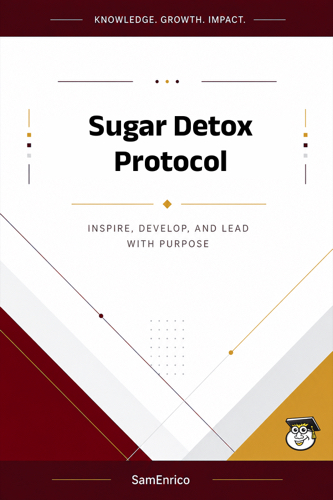
Sugar Detox Protocol eBook
Seven day plan to eliminate added sugar and reduce
Seven day plan to eliminate added sugar and reduce cravings.
Formats
Free sample
Chapter 1: The Dopamine Heist--It starts innocently enough. A cookie after lunch. A latte on the way to work. A small bowl of ice cream while watching television. These are not sins, not moral failures, not evidence of weak character.
They are, however, the opening moves of a carefully orchestrated biological takeover—one that has been engineered over decades by the food industry and hardwired into your brain through millions of years of evolution.You did not wake up one day lacking willpower. You were not born with a defective "off switch" for sweets. The reason you cannot stop at one cookie has nothing to do with discipline and everything to do with neurochemistry. Specifically, it has to do with a small, almond-shaped region deep in your brain called the nucleus accumbens—the command center of your reward system. And sugar, it turns out, is one of the most effective hijackers of that system ever discovered.This chapter will fundamentally change how you understand every craving you have ever experienced.
By the time you finish reading, you will no longer blame yourself for "failing" at diets. You will no longer believe that some people are simply born with more control around sugar. Instead, you will see the truth: your brain has been systematically altered by a substance that acts remarkably like an addictive drug. And like any addiction, it can be reversed—not through willpower, but through understanding and the right protocol.The Currency of Pleasure: Understanding Dopamine To understand why sugar has such power over you, you must first understand dopamine. Most people have heard of dopamine as the "feel-good chemical"—the brain's natural reward molecule.
But that description is incomplete and, in some ways, misleading. Dopamine is not primarily about pleasure. It is about anticipation and motivation. It is the chemical that says, "Do that again."Consider what happens when you see a plate of fresh chocolate chip cookies. Before you have taken a single bite, your brain begins releasing dopamine.
This surge creates the feeling of wanting, craving, anticipating. It is the "I need that" sensation that drives you toward the reward. After you eat the cookie, a different set of chemicals—endorphins and serotonin—produce the actual feeling of pleasure and satisfaction. Dopamine's job is to ensure you remember the cookie and seek it out again.This system evolved for survival. When your ancient ancestors found a source of ripe fruit or honey, dopamine flooded their brains, motivating them to eat as much as possible while the resource lasted.
In an environment where sugar was rare and winter was coming, this was a brilliant adaptation. The problem is that you no longer live in that environment. Sugar is not rare. It is in everything. And your brain has not received the memo.The Hijacking Mechanism: How Sugar Becomes an Addictive Substance Here is where the story takes a dark turn.
Sugar does not merely activate the dopamine system—it supercharges it. When you consume sugar, especially refined sugar without the buffering effects of fiber, protein, or fat, the dopamine release is significantly larger and faster than what occurs with natural foods. A handful of berries produces a modest, sustained dopamine signal. A can of soda produces a spike that rivals what is seen with certain drugs of abuse.This is not metaphor. This is measured neuroscience.
In landmark studies using brain imaging, researchers have shown that sugar consumption activates the same reward circuitry as nicotine, cocaine, and alcohol. The nucleus accumbens lights up like a Christmas tree. Dopamine levels can increase by 150 to 200 percent above baseline—a surge that is difficult to achieve through any natural behavior other than sex or, arguably, winning a large sum of money.The food industry knows this. They have known it for decades. Food scientists have created what is called the "bliss point"—the precise concentration of sugar, fat, and salt that maximizes dopamine release without overwhelming the palate.
That is not an accident. Your favorite packaged snack has been mathematically optimized to keep you coming back.But the hijacking does not stop at the initial surge. The real damage occurs with repeated exposure.The Down-Regulation Problem: Why You Need More Each Time The brain is designed to maintain balance. When a system is overstimulated, the brain adapts by becoming less sensitive to that stimulus. This process is called down-regulation.
In the case of dopamine, chronic overstimulation from sugar causes the brain to reduce the number of dopamine receptors—the docking stations that receive the dopamine signal.Think of it like this: Imagine you live next to a train track. On the first day, every train startles you awake. After a month, you sleep through the noise because your brain has learned to turn down the volume. The same principle applies to dopamine. After weeks, months, or years of daily sugar consumption, your brain has turned down the volume on its reward system.This is why the first bite of a donut is transcendent, but by the fifth donut, you are barely registering pleasure.
This is why a single square of high-quality dark chocolate used to be satisfying, but now you need an entire bar. Your brain has not become stronger. It has become numb. It requires more sugar to achieve the same dopamine signal—the same feeling of "enough."This phenomenon has a name in addiction medicine: tolerance. And it is the hallmark of every substance use disorder.The Crash Cycle: Why Hunger Follows Sugar The dopamine heist is only the first act.
The second act involves a hormone called insulin, and it explains why eating sugar makes you hungry for more sugar within an hour or two.When you consume sugar, it enters your bloodstream rapidly, especially in the absence of fiber, protein, or fat. Your blood glucose levels spike. In response, your pancreas releases insulin, whose job is to shuttle that glucose out of your blood and into your cells—muscle, liver, fat—for storage. This is a normal, healthy process in moderation.But the spike-and-crash cycle that follows a high-sugar meal or snack is anything but moderate. The rapid rise in blood sugar triggers a massive insulin surge.
That surge often overcorrects, driving blood sugar down too far and too fast. Within 60 to 90 minutes, your blood glucose levels may drop below baseline, a state called reactive hypoglycemia.Your body interprets low blood sugar as an emergency. The brain, which runs exclusively on glucose in the absence of ketones, cannot function without fuel. So your body releases stress hormones—adrenaline and cortisol—to signal that you need to eat immediately. What do you crave in that state?
Not broccoli. You crave sugar. Your body demands the fastest possible source of glucose to correct the emergency.This is the crash cycle. Eat sugar. Spike.
Crash. Crave more sugar. Eat more sugar. Repeat. Each cycle makes the next one more intense.
And each cycle trains your brain to expect sugar as the solution to its own distress.This is not a moral failing. This is physiology. You are not weak for wanting sugar after a sugar crash. You are experiencing a predictable hormonal cascade that your body has learned to produce.Leptin…
This is the end of the free sample. Get the eBook to keep going. Buy now
About this book
Details
- Author
- Dempsey Vanna
- Publisher
- SamEnrico
- Language
- English
- Genre
- Non-Fiction, Self-Help, Detox
- Released
- 2026-06-09
- Pages (approx.)
- 145
- Available as
- eBook, Audiobook

Read better in the ZLOADR app
Your eBooks on your phone or tablet. Sign in with your SamEnrico account and start reading.
More by Dempsey Vanna
 Menopause Restless Leg GuideDempsey Vanna$11.99
 The Trigger Temperature CheckDempsey Vanna$11.99
 SAS Escape and EvasionDempsey Vanna$11.99
 Persona Creation Team WorkshopDempsey Vanna$11.99
 Bark of the First MoonDempsey Vanna$11.99
 Frozen Echoes of the Sky: The Lost Viking Space Artifacts of the ArcticDempsey Vanna$11.99
 Cold Storage Production WorkersDempsey Vanna$11.99
 How to Start a Snowmobiling - Recreational BusinessDempsey Vanna$11.99
 Earn Out Negotiation HandbookDempsey Vanna$12.99
 ESL Prop Box CreationDempsey Vanna$12.99
 Understanding Gamborg–nielsen SyndromeDempsey Vanna$17.99
You may also like
 Hong Kong Handover 1997Dunn Johnnie$11.99
 Zumba For Postnatal Recovery CourseNeal Christian$11.99
 Zumba for BeginnersLadner Nikia$11.99
 YouTube Comment Mining GuideHumes Pandora$12.99
 Worry Box MeditationCarlin Rudy$11.99
 Workplace Stress MeditationNguyen Lynn$11.99
 Workplace Stress and Sleep RepairHawley Ivory$11.99
 Workplace Perfectionism CureDelaney Jeffry$11.99
 Workplace Injustice Anger GuideWallen Isabelle$11.99
 Work Addiction and Burnout LinkGreenwood Ester$11.99
 Women in Yoga and WellnessBeattie Galina$11.99
 Women in Stand Up ComedyChun Evangeline$11.99