
Non-FictionSelf-HelpSudden Loss
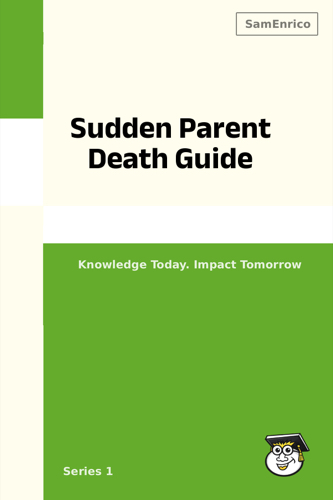
Sudden Parent Death Guide eBook
Process the trauma of unexpected loss of a mother
by Barton May
Process the trauma of unexpected loss of a mother or father.
Formats
Free sample
Chapter 1: The Permission Slip...--–- The phone rings at 2:14 AM. You know before you answer. Not because you are psychic, not because you sensed something wrong in the hours before—but because no one calls at 2:14 AM with good news. Your mother’s name appears on the screen, but your father is the one who speaks. His voice is wrong.
Stretched thin like a rubber band about to snap. He says the words. Your mother is dead. Or your father is gone. Or there has been an accident.
Or they found him. Or she didn’t wake up. The specific arrangement of syllables doesn’t matter yet. What matters is that your life has just split into two parts: everything before that phone call, and everything after.This chapter is called The Permission Slip, and it is the most important chapter in this book—not because it contains the most practical advice or the most clinical expertise, but because it is the only chapter you need to read right now if you cannot read anything else. If you opened this book in the first 72 hours, your brain is not working correctly.
You are reading words but not absorbing them. You are flipping pages but forgetting what you just saw. This is not a character flaw. This is neurobiology. And the only thing I need you to take from this chapter is permission.
Permission to fall apart. Permission to feel nothing. Permission to handle this badly. Permission to survive in whatever shape that takes. You have it.
All of it. Right now, without doing anything else.Let me tell you what is happening inside your skull. The moment you heard the news, your brain’s prefrontal cortex—the part responsible for planning, reasoning, impulse control, and executive function—began to shut down. Not because it is weak. Because it is smart.
The brain has a built-in emergency protocol for overwhelming trauma: it temporarily disables the higher cognitive functions so you do not have to process the full weight of the loss all at once. In their place, the amygdala—your brain’s fear and threat detection center—takes over. You are now operating in survival mode. Your brain believes, on a neurological level, that you are in danger. Because from an evolutionary perspective, the sudden loss of an attachment figure is danger.
Human infants cannot survive without caregivers. Your adult brain still carries that ancient wiring. When a parent dies, especially without warning, your brain treats it as a threat to your own survival. This is why you feel like you are dying too. You are not.
But your nervous system does not know that yet.The numbness you feel—that strange, floating, disconnected sensation where nothing seems real and you are watching yourself from above—has a clinical name: dissociation. It is not a sign that you are in denial or that you are handling this badly. It is your brain’s anesthetic. Your brain has essentially injected itself with a chemical version of novocaine, numbing the emotional nerve endings so the full pain does not hit you all at once. This is a gift, even though it does not feel like one.
It is your brain buying you time. The dissociation will fade. The numbness will crack. The pain will come. But right now, in these first hours and days, your brain is doing exactly what it is supposed to do.
You do not need to fight it. You do not need to try to feel more. You do not need to force yourself to cry or to stop crying or to feel anything other than what you are feeling. The only requirement right now is to keep breathing. That is literally it.Alongside the dissociation, you may experience a phenomenon that feels like madness but is actually extremely common: magical thinking.
This is the irrational belief that your thoughts or actions can reverse time and undo the death. You might find yourself thinking that if you do not tell anyone, it won’t be true. If you don’t say the words out loud, maybe she will walk through the door. If you avoid the hospital, if you don’t look at the body, if you don’t answer the next phone call—maybe the last phone call never happened. You might catch yourself talking to your dead parent as if they can hear you.
You might avoid throwing away their coffee cup because throwing it away feels like making it official. You might feel that if you can just get through the next hour without crying, somehow that will bring them back. This is not psychosis. This is not denial. This is the brain desperately trying to protect you by creating a loophole.
Joan Didion wrote about this in The Year of Magical Thinking after her husband died suddenly of a heart attack. She kept his shoes in the closet because, she wrote, he would need them when he came back. She knew he was not coming back. But knowing and feeling are different things. Magical thinking is the gap between what your rational mind knows and what your emotional mind can accept.
It will fade. But in the meantime, you do not need to fight it. You do not need to correct yourself. You do not need to say “that’s irrational” every time you catch yourself doing it. Let your brain have its coping mechanism.
It is working.Your body is also reacting. You might have no appetite. This is because digestion is a non-essential function during a threat response. Your body has diverted blood flow away from your stomach and toward your large muscle groups—in case you need to fight or run. You might have trouble sleeping.
This is because your brain is in a state of hyperarousal, scanning the environment for additional threats. Every noise might make you jolt awake. You might find yourself unable to fall asleep until 4 AM, then sleeping for 14 hours straight. Both are normal. You might experience panic attacks: sudden waves of intense fear, racing heart, shortness of breath, chest tightness, sweating, trembling, or a feeling of impending doom.
Panic attacks feel like heart attacks. They are not heart attacks. They are your sympathetic nervous system hitting the gas pedal while your parasympathetic nervous system (the brake) has temporarily failed. They will pass. They always pass.
If you have chest pain that radiates down your arm or into your jaw, or if you have a history of heart disease, go to the emergency room. But for most people, the chest tightness is muscle tension from holding back sobs. Let yourself cry. Crying activates the parasympathetic nervous system. It is literally calming.You might also experience what grief researchers call “grief brain.” You will lose your keys.
You will forget why you walked into a room. You will stare at your phone and not remember the password you have typed ten thousand times. You will call your sibling by the wrong name. You will show up to appointments on the wrong day. This is not early dementia.
This is not a sign that you are falling apart. This is your brain conserving energy by deprioritizing non-essential cognitive…
This is the end of the free sample. Get the eBook to keep going. Buy now
About this book
Details
- Author
- Barton May
- Publisher
- SamEnrico
- Language
- English
- Genre
- Non-Fiction, Self-Help, Sudden Loss
- Released
- 2026-06-07
- Pages (approx.)
- 128
- Available as
- eBook, Audiobook

Read better in the ZLOADR app
Your eBooks on your phone or tablet. Sign in with your SamEnrico account and start reading.
More by Barton May
 Twelve Step Convention NavigationBarton May$11.99
 Romantic Needs ConversationBarton May$11.99
 Transition from ISO 9001 2015Barton May$11.99
 Phone Salary Negotiation GuideBarton May$11.99
 Hypnosis Headphone RequirementsBarton May$11.99
 John Dewey HumanismBarton May$11.99
 Squat Bodyweight GuideBarton May$11.99
 The Spice Routes of the Swahili Coast: A Feast of African Botanical BrillianceBarton May$11.99
 A Collector's Handbook to the Panhard Dyna 120Barton May$11.99
 How to Start a Aircraft Rental and Leasing BusinessBarton May$11.99
 How to Produce Work PlatformsBarton May$11.99
 AccountEdge AI Payroll ProcessingBarton May$12.99
You may also like
 Hong Kong Handover 1997Dunn Johnnie$11.99
 Zumba For Postnatal Recovery CourseNeal Christian$11.99
 Zumba for BeginnersLadner Nikia$11.99
 YouTube Comment Mining GuideHumes Pandora$12.99
 Worry Box MeditationCarlin Rudy$11.99
 Workplace Stress MeditationNguyen Lynn$11.99
 Workplace Stress and Sleep RepairHawley Ivory$11.99
 Workplace Perfectionism CureDelaney Jeffry$11.99
 Workplace Injustice Anger GuideWallen Isabelle$11.99
 Work Addiction and Burnout LinkGreenwood Ester$11.99
 Women in Yoga and WellnessBeattie Galina$11.99
 Women in Stand Up ComedyChun Evangeline$11.99