
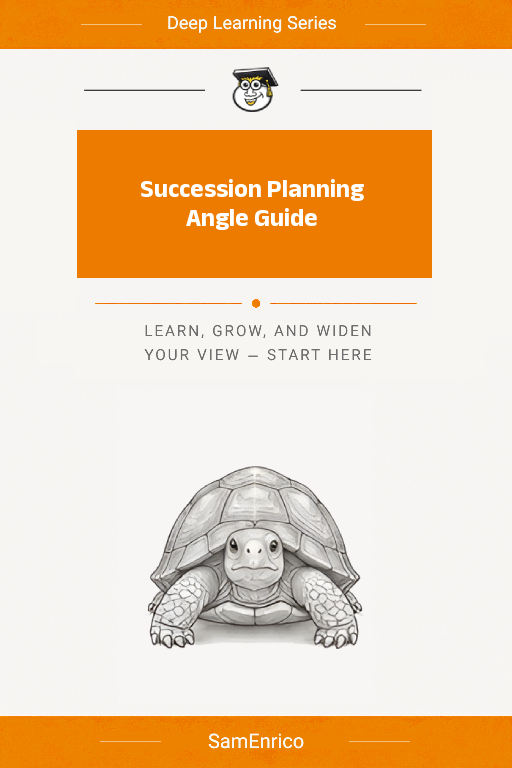
Non-FictionProfessional's Cheat SheetSuccession
Succession Planning Angle Guide eBook
Frame your promotion as part of the company's succ
Frame your promotion as part of the company's succession and retention strategy for key talent.
Formats
Free sample
Chapter 1: The Quiet Before...--–- The Friday afternoon email arrived at 4:47 PM, three minutes before everyone’s out-of-office messages turned on for the weekend. Sarah had been with the company for eleven years. She had survived three reorgs, two acquisitions, and one CEO who cried during the holiday party. She knew where the bodies were buried—literally, in the sense of the old server room that still housed the legacy database no one remembered existed but that ran the customer billing system every Tuesday at 3 AM.The email was from HR. It was brief.
"After a thorough search process, we are pleased to announce the appointment of Marcus Chen as our new Vice President of Client Operations. Marcus joins us from a competitor, where he led..."Sarah closed her laptop. She did not cry. She did not rage. She simply sat there, in her home office, watching the afternoon light fade, and realized something she had been avoiding for years: she had been waiting for a promotion that was never coming to her.
It would always come to someone else. Someone with a fancier title at a different company. Someone who did not know about the 3 AM billing system. Someone who would spend six months learning what Sarah could have taught them in a week.Six weeks later, Sarah accepted an offer from a direct competitor. Her salary increased by 34 percent.
Her title was Vice President. And her former company spent the next nine months trying to figure out why client satisfaction scores had dropped, why the billing system kept failing, and why no one seemed to know how to fix either problem.The person who had been promoted over her, Marcus, lasted fourteen months. He left for another competitor, citing "cultural misalignment." The company posted his role again. The cycle continued.Sarah’s story is not unusual. It is not even remarkable.
It happens in every industry, in every geography, at every scale. What makes it worth telling is not the tragedy of it—people leave jobs every day—but the sheer, stubborn, expensive stupidity of it. Sarah was not asking for a corner office. She was asking to be seen as what she already was: the only logical successor for the role she understood better than anyone. And her company said no, not because she was unqualified, but because they had no framework for saying yes.This book is for everyone who has been Sarah.
And for everyone who might become her, if they do not act first.The Crisis No One Talks About Every company has a succession problem. Some know it. Most do not. The ones that know it are the ones that have already lost a Sarah. The ones that do not know it are the ones that will.Succession planning, in theory, is simple: identify critical roles, identify potential successors, develop those successors, and promote them when the time comes.
In practice, it is a disaster. Most companies treat succession planning as a compliance exercise—a spreadsheet updated once a year, reviewed by HR, and filed away until the next annual cycle. They are not planning for succession. They are planning for the illusion of succession.The result is a crisis that unfolds so slowly that no one notices until it is too late. Key employees leave.
Institutional knowledge walks out the door. External hires are brought in at premium salaries, only to fail at twice the rate of internal candidates. Morale erodes among the high-potential employees who watched the external hire walk past them. And the cycle repeats.This is not an opinion. It is a pattern.
The data is clear: companies that prioritize internal talent development and have transparent succession pipelines significantly outperform those that do not. Yet most companies continue to operate as if their best people will never leave, as if institutional knowledge is automatically transferred, as if external candidates are always better.They are wrong on all counts.Why This Book Exists Most books about succession planning are written for one audience: HR leaders and executives. They talk about frameworks, metrics, and best practices. They are useful, in their way. But they miss the most important perspective entirely: the perspective of the high-potential employee who is trying to navigate a system that was not designed for them.That is where this book begins.
It is not a book about how HR should manage succession pipelines. It is a book about how you, the high-potential employee, can use the hidden logic of succession planning to frame your promotion as something your company already wants—a retention strategy, a risk mitigation tool, an investment in continuity.The angle is everything. When you ask for a promotion as a reward for past performance, you are asking your company to look backward. When you frame your promotion as a succession solution, you are asking your company to look forward. Backward looks like expense.
Forward looks like investment. Expense gets cut. Investment gets funded.This chapter introduces the foundational concepts that will guide every conversation, every negotiation, and every decision in the rest of this book. By the time you finish it, you will understand why Sarah lost, why Marcus failed, and why you do not have to repeat either of their stories.The Disaster Metric Let us begin with a question: what would happen if you left your job tomorrow?Not in the abstract, philosophical sense. Not "the company would survive, everyone is replaceable." In the specific, measurable, terrifying sense.
Which clients would call your boss on Monday morning, confused about who was handling their account? Which internal processes would halt because only you know the password, the workaround, the vendor contact? Which strategic initiatives would stall because no one else understands the context behind the last three years of decisions?That is what this book calls the Disaster Metric. It is the gap between what your company thinks it would lose if you left and what it would actually lose. For most employees, the Disaster Metric is large.
For high-potential employees—the ones who have been around long enough to know how things really work—it is enormous.The tragedy is that most companies never calculate the Disaster Metric. They do not want to know. Because knowing would force them to act, and acting would require admitting that they have been underinvesting in the people who actually keep the lights on.Consider the specific categories of loss that the Disaster Metric captures:Relational capital. The clients who stay because they trust you, not because of the brand. The vendors who go the extra mile because you have a history with them.
The internal partners who collaborate effectively because you have built trust over years of joint problem-solving.Contextual knowledge. The understanding of why past decisions were made, even the ones that look irrational from the outside. The awareness of which landmines are buried where. The ability to distinguish between "this is how we have always done it" and "this is the one way that actually works."Operational memory. The undocumented processes that keep things running.
The workarounds that no one remembers writing down. The informal networks that actually get things done, as opposed to the…
This is the end of the free sample. Get the eBook to keep going. Buy now
About this book
Details
- Author
- Yancey Charis
- Publisher
- SamEnrico
- Language
- English
- Genre
- Non-Fiction, Professional's Cheat Sheet, Succession
- Released
- 2026-06-01
- Pages (approx.)
- 131
- Available as
- eBook, Audiobook

Read better in the ZLOADR app
Your eBooks on your phone or tablet. Sign in with your SamEnrico account and start reading.
More by Yancey Charis
 Alcoholism Recovery for Shift WorkersYancey Charis$11.99
 Morning Micro Habits GuideYancey Charis$11.99
 The Joy Harjo BiographyYancey Charis$11.99
 Sardinian Lifestyle GuideYancey Charis$11.99
 Anger ABC Model WorkbookYancey Charis$11.99
 Self Talk For RetirementYancey Charis$11.99
 Longevity Master GuideYancey Charis$11.99
 Dopamine Serotonin GutYancey Charis$11.99
 Where the Poppies Never FellYancey Charis$11.99
 The Tiger of Mysore: Tipu Sultan's Last StandYancey Charis$11.99
 The Essential Guide to Contemporary Singer/songwriterYancey Charis$11.99
 How to Produce Religious CraftsYancey Charis$11.99
You may also like
 Hong Kong Handover 1997Dunn Johnnie$11.99
 Zumba For Postnatal Recovery CourseNeal Christian$11.99
 Zumba for BeginnersLadner Nikia$11.99
 YouTube Comment Mining GuideHumes Pandora$12.99
 Worry Box MeditationCarlin Rudy$11.99
 Workplace Stress MeditationNguyen Lynn$11.99
 Workplace Stress and Sleep RepairHawley Ivory$11.99
 Workplace Perfectionism CureDelaney Jeffry$11.99
 Workplace Injustice Anger GuideWallen Isabelle$11.99
 Work Addiction and Burnout LinkGreenwood Ester$11.99
 Women in Yoga and WellnessBeattie Galina$11.99
 Women in Stand Up ComedyChun Evangeline$11.99