
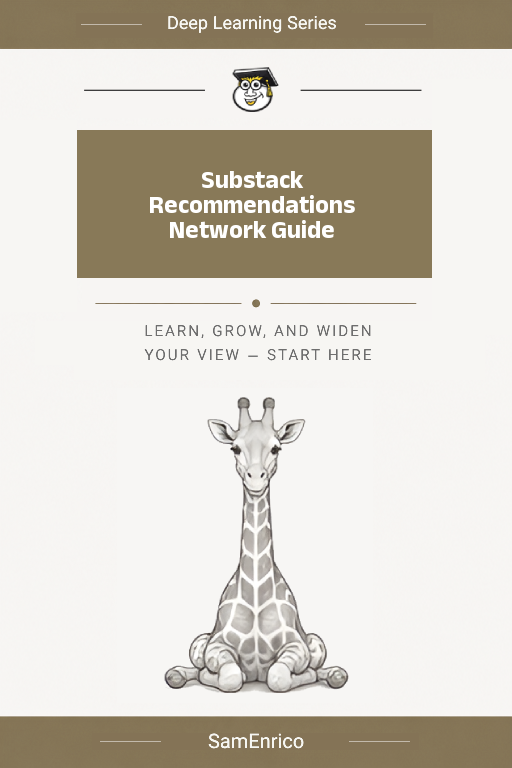
Non-FictionZero-to-One CreatorPlatform Growth
Substack Recommendations Network Guide eBook
Maximize Substack's recommendation engine to gain
by Chung Alycia
Maximize Substack's recommendation engine to gain subscribers through other newsletters in your niche.
Formats
Free sample
Chapter 1: The 47-Dollar Mistake--–- I spent forty-seven dollars and three months of my life to learn that Twitter is a lie. The forty-seven dollars went to a promoted tweet campaign for my shiny new Substack, a newsletter about the intersection of behavioral psychology and workplace productivity. I had high hopes. I had a clever tagline. I had twelve stock photos of people smiling at laptops.
What I did not have was subscribers. After ninety days, forty-seven dollars, and approximately one thousand four hundred minutes of my attention funneled into the endless scroll, I had acquired exactly thirty-one email addresses. Twenty of those never opened a single email. Nine opened one and disappeared. Two became paying subscribers, which sounds like a victory until you do the math: I had effectively paid twenty-three dollars and fifty cents for each of those two subscribers, and they would need to stay for seven months just for me to break even on the customer acquisition cost.
They did not stay. One churned after the second month. The other after the fourth. I had built a machine that converted my time, my money, and my hope into a net negative. This is not a humble brag about early struggles before a triumphant pivot.
This is a confession. I was doing exactly what every growth guru on the internet told me to do: build an audience on social media, drive traffic to a landing page, convert that traffic into email subscribers, and then monetize those subscribers. It was the standard funnel. It was the conventional wisdom. And it was catastrophically wrong.The problem was not my writing.
The problem was not my offer. The problem was the fundamental assumption that social media platforms are reliable engines for newsletter growth. They are not. They have never been. But something has changed in the last eighteen months that made this old playbook not just inefficient but actively harmful.
Substack, the platform that hosts hundreds of thousands of newsletters, quietly rewrote its recommendation algorithm. Most writers did not notice. Most writers are still out there on X, formerly known as Twitter, posting threads that go nowhere, chasing likes that buy nothing, and watching their open rates decline as their social media followers increase. They are trapped in a game they cannot win because they are playing by rules that no longer apply. This book exists because I eventually stopped playing that game.
I deleted my social media promotion calendar. I stopped measuring retweets. I stopped caring about how many people saw my posts. Instead, I started paying attention to something else entirely: the recommendation graph.What I discovered changed everything. In the twelve months after abandoning social media as a growth channel, my Substack grew from three hundred eleven subscribers to over seven thousand.
Not because I wrote better, though I did write more consistently. Not because I had some viral breakout, though a few posts did well. The growth happened because I learned to speak the language of Substack's algorithm. I learned that the platform no longer cares primarily about who you are in some static, averaged sense. It cares about what readers do in sequence.
It cares about the journey from one newsletter to the next. And the single most powerful signal you can send to that algorithm is not a like, not a comment, not a restack, but a recommendation. The official Substack recommendation button is worth approximately five times more algorithmic weight than any other engagement signal. I did not make up that number. It comes from Substack's own technical documentation, buried in a series of engineering blog posts that most writers have never read.
The company has been transparent about this, but transparency does not matter if no one is paying attention.This chapter is the foundation for everything that follows. Before we talk about tactics, before we build spreadsheets and outreach sequences and recommendation pods, we have to agree on a single premise: the old way is dead. The social media funnel is a relic. If you are still spending more than ten percent of your growth energy on Twitter, Instagram, Linked In, or Tik Tok, you are throwing away time that could be generating ten times the return if redirected into the recommendation graph. I am not saying social media has no value.
I am saying it has been demoted. It is no longer the primary engine. It is the auxiliary wheel, nice to have but not essential. The primary engine, the thing that actually moves the needle for writers on Substack in 2025 and beyond, is the network of recommendations you build with other writers. This is not networking in the old sense of exchanging business cards at awkward mixers.
This is algorithmic networking. Every time you recommend another publication, you are not just helping that writer. You are telling Substack's sequential model that you belong in the same conversation as that writer's audience. You are inserting yourself into the reading journey of every person who reads that publication. And that is how you grow without social media.Let me be specific about what I mean when I say the old playbook is broken.
The old playbook assumed a linear funnel. You post content on social media. A certain percentage of people click the link. A certain percentage of those people hit the subscribe button. A certain percentage of those people become paid subscribers.
This funnel worked reasonably well from roughly 2015 to 2022. The conversion rates were never great, but they were predictable. A good Twitter thread might convert at one to two percent. A viral post might hit five percent. You could run the numbers and make a reasonable bet on your return on investment.
Those days are over for three structural reasons, none of which are your fault and none of which you can reverse through sheer effort.First, social media platforms have systematically reduced the visibility of external links. Twitter, now X, has made it abundantly clear that they want users to stay on the platform, not click away to Substack or any other newsletter service. The algorithm deprioritizes posts with links. The user interface hides link previews behind additional clicks. The platform has become a walled garden that pretends to be an open web but actively discourages departure.
This is not a conspiracy theory. This is public information from every major platform's earnings calls, where they brag about increasing time on site and decreasing outbound clicks. You are fighting against the business model of multibillion dollar companies when you try to drive traffic from social media to your newsletter. You can win occasionally, but the odds are stacked against you.Second, the attention span of social media users has collapsed to the point where the average session is measured in seconds, not minutes. A user scrolling Twitter is in what I call the distraction state.
They are not looking for depth. They are not looking for commitment. They are looking for the next dopamine hit, the next laugh, the next outrage, the next confirmation of their existing beliefs. Asking a person in the distraction state to pause, click a link, wait for a page to load, read a multi-paragraph…
This is the end of the free sample. Get the eBook to keep going. Buy now
About this book
Details
- Author
- Chung Alycia
- Publisher
- SamEnrico
- Language
- English
- Genre
- Non-Fiction, Zero-to-One Creator, Platform Growth
- Released
- 2026-05-29
- Pages (approx.)
- 130
- Available as
- eBook, Audiobook

Read better in the ZLOADR app
Your eBooks on your phone or tablet. Sign in with your SamEnrico account and start reading.
More by Chung Alycia
 Feeding Assistance for CaregiversChung Alycia$11.99
 The Stance Recovery GuideChung Alycia$11.99
 Sportsbook App CompulsionChung Alycia$11.99
 Grocery Store NavigationChung Alycia$11.99
 From Tongogara To TorontoChung Alycia$11.99
 Circadian Rhythm And Immune FunctionChung Alycia$11.99
 Relapse Prevention Sleep and Circadian CourseChung Alycia$11.99
 Epigenetics of Growth Hormone AgingChung Alycia$11.99
 The Writing Deadline PanicChung Alycia$11.99
 The Cabbage Tree Islanders: Australia's First Marine BiologistsChung Alycia$11.99
 The Golden Ledger: John E. Wideman and the Birth of Modern FinanceChung Alycia$11.99
 First to the Moon: The Untold Story of Luna 2Chung Alycia$11.99
You may also like
 Hong Kong Handover 1997Dunn Johnnie$11.99
 Zumba For Postnatal Recovery CourseNeal Christian$11.99
 Zumba for BeginnersLadner Nikia$11.99
 YouTube Comment Mining GuideHumes Pandora$12.99
 Worry Box MeditationCarlin Rudy$11.99
 Workplace Stress MeditationNguyen Lynn$11.99
 Workplace Stress and Sleep RepairHawley Ivory$11.99
 Workplace Perfectionism CureDelaney Jeffry$11.99
 Workplace Injustice Anger GuideWallen Isabelle$11.99
 Work Addiction and Burnout LinkGreenwood Ester$11.99
 Women in Yoga and WellnessBeattie Galina$11.99
 Women in Stand Up ComedyChun Evangeline$11.99