
Non-FictionSelf-HelpCreator Economy
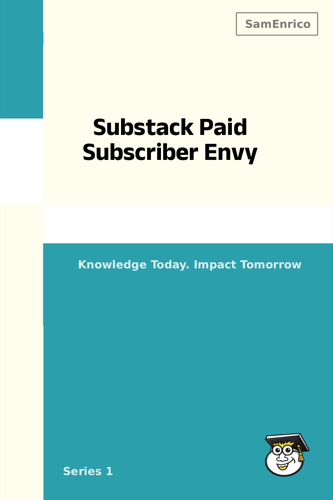
Substack Paid Subscriber Envy eBook
Addresses comparing newsletter growth and monetiza
Addresses comparing newsletter growth and monetization with peers.
Formats
Free sample
Chapter 1: The Green Chicken Problem--It was 3:47 on a Tuesday afternoon when Sarah, a former journalist with 4,200 free subscribers and 47 paid ones, made the mistake she would later call her “Dashboard Death Spiral.”She had just published what she believed was her best piece yet—a deeply reported essay on the collapse of a local housing market. She had spent eighteen hours on it. She had cried twice while writing it. She had sent it to her list with a subject line she considered “perfect.”She opened her Substack dashboard to watch the numbers roll in.Twenty minutes later: three new free subscribers. Zero paid.She refreshed.
Two more free. Zero paid.She refreshed again. Then she did the thing she knew she should not do. She clicked over to “Top Publications” in her niche.There it was. A newsletter called The Daily Dime—launched four months after hers—had a green banner reading “#1 in Finance.” The writer, a 24-year-old former crypto trader with a cartoon avatar, had posted a 400-word listicle titled “5 Ways to Know If You Are Poor.” It had generated 1,200 likes and, according to public estimates, forty-seven new paid subscribers in a single day.Sarah closed her laptop.
She walked to her kitchen. She stood there for ten minutes, holding the refrigerator handle, not opening it.She was experiencing Substack Paid Subscriber Envy.And she had no idea that the problem was not her writing, her topic, or her work ethic. The problem was the lens through which she was measuring herself.The Feeling No One Talks About If you are reading this book, you know the feeling.It arrives without warning. You check your dashboard. You see a new paid subscriber—good.
A small win. You allow yourself a moment of satisfaction. Then, like a reflex, you check someone else’s number. A peer. Maybe someone who started after you.
Maybe someone you privately consider less talented, less insightful, less deserving.Their number is bigger.The satisfaction vanishes. Your chest tightens. Your mind begins a loop: What am I doing wrong? Why them and not me? Should I quit?This is not jealousy.
Jealousy is wanting what someone else has while wishing they did not have it. Envy is wanting what someone else has while believing their success reveals your failure. Envy is quieter, more insidious, and far more dangerous to a creator’s longevity.The dirty secret of the newsletter economy is that almost every successful writer has nearly quit—not because of low numbers, but because of someone else’s high numbers. The comparison trap has killed more newsletters than bad writing, poor SEO, or algorithm changes combined.This chapter exists to pull you out of that trap. Not by telling you to “stop comparing yourself” (useless advice, like telling a hungry person to stop thinking about food).
But by revealing the structural illusion that makes you compare the wrong things in the first place.The Conversion Illusion: Why Your Brain Lies to You Here is the central deception that powers Substack Paid Subscriber Envy.Most writers believe that a large free list is the primary driver of a large paid list. They believe that if they just grow their free subscribers—through Recommendations, social media, word of mouth—the paid subscribers will follow as a natural percentage. They believe the relationship is linear: more free = more paid.This is the Conversion Illusion.The Conversion Illusion is the false belief that a large free list automatically leads to large paid income. It feels true because it is mathematically plausible. If you have 10,000 free subscribers and the average conversion rate is 3%, you should have 300 paid subscribers.
That is simple math.But the Conversion Illusion hides three critical distortions.First, conversion rates are not fixed. They vary wildly based on the type of free subscriber you attract. A free subscriber who came from a Linked In post about “10 Quick Tips” converts at a different rate than a free subscriber who came from a guest essay on a peer’s paid newsletter. The source determines the conversion probability, not just the number.Second, the Conversion Illusion treats all free subscribers as equal. They are not.
A free subscriber who opens every email, replies occasionally, and has been on your list for eight months is an entirely different asset than a free subscriber who signed up for a free PDF, never opened an email, and will unsubscribe in six weeks. The first has high “Loyalty Weight.” The second has none.Third, the Conversion Illusion makes you optimize for the wrong metric. You start chasing Gross Volume—total email addresses—because you believe volume drives conversion. You run giveaways, free lead magnets, and “tag a friend” campaigns. You add 2,000 free subscribers in a month.
Your conversion rate drops from 4% to 2%. Your paid subscriber count stays flat. You feel confused and defeated.The writer with 20,000 free subscribers and a 2% conversion rate has 400 paid subscribers. The writer with 1,000 free subscribers and a 20% conversion rate has 200 paid subscribers. The second writer makes half the revenue with one-twentieth the list size.
Yet the first writer often envies the second, because the first writer sees the “smaller” number and assumes failure.This is the paradox that opens the book. And it brings us to the Green Chicken.The Green Chicken: A Case Study in Business Model Confusion Doomberg is a finance newsletter on Substack. It has a green chicken as its logo. It charges $300 per year. It has, by most estimates, between 3,000 and 5,000 paid subscribers.
That puts its annual revenue between $900,000 and $1.5 million.If you are a writer with 10,000 free subscribers and 200 paid subscribers at $10/month, you are earning $24,000 per year. You look at Doomberg’s green chicken and feel a wave of inadequacy. “How,” you ask yourself, “does a cartoon chicken outperform my serious, well-researched publication?”The answer is not in the content. The answer is in the business model.Doomberg is not a newsletter. Doomberg is a boutique financial analysis firm that happens to use Substack as its distribution channel.
The team behind Doomberg includes former energy traders, analysts, and researchers. They produce proprietary data models. They have institutional clients who pay for private reports. The newsletter is the marketing engine for a much larger consulting and data business.You, on the other hand, may be a solo writer. You wake up, research a topic, write an essay, hit send, and hope for the best.
You do not have a team. You do not have institutional clients. You do not have proprietary data models.You are not comparing newsletters. You are comparing a media company to a solo operator. They are different species.This is the first and most important diagnostic question you must ask yourself when envy strikes: What business am I actually in?The Media Business: You produce content at scale.
You have a team. You monetize through ads, sponsorships, and high-volume subscriptions. Your goal is reach.The Expert Business: You have proprietary knowledge or data. You monetize through high-ticket subscriptions, consulting, or services. Your goal is depth.The Creator Business: You produce content as an individual.
You monetize through direct fan support, lower-tier subscriptions, and digital products. Your goal is connection.The Hybrid Business: You mix two…
This is the end of the free sample. Get the eBook to keep going. Buy now
About this book
Details
- Author
- Holland Kathy
- Publisher
- SamEnrico
- Language
- English
- Genre
- Non-Fiction, Self-Help, Creator Economy
- Released
- 2026-06-06
- Pages (approx.)
- 135
- Available as
- eBook, Audiobook

Read better in the ZLOADR app
Your eBooks on your phone or tablet. Sign in with your SamEnrico account and start reading.
More by Holland Kathy
 Hoffa Disappearance Documentary Review GuideHolland Kathy$11.99
 Hemostatic Dressing UsageHolland Kathy$11.99
 Foot Direction Nonverbal CuesHolland Kathy$11.99
 Bedroom EnvironmentHolland Kathy$11.99
 The Underqualified Confidence GuideHolland Kathy$11.99
 Remote Work Tool StackHolland Kathy$11.99
 Atomic Habits For ConfidenceHolland Kathy$11.99
 Zeroes to Zeros: The Enigma of the Vanished Bitcoin BillionaireHolland Kathy$11.99
 The Bloodhound and the Ballot: How Dogs Uncovered a Voter Fraud RingHolland Kathy$11.99
 Growing BrowningiaHolland Kathy$11.99
 How to Produce Ventilation Fan PartsHolland Kathy$11.99
 UAE VAT for Startups GuideHolland Kathy$12.99
You may also like
 Hong Kong Handover 1997Dunn Johnnie$11.99
 Zumba For Postnatal Recovery CourseNeal Christian$11.99
 Zumba for BeginnersLadner Nikia$11.99
 YouTube Comment Mining GuideHumes Pandora$12.99
 Worry Box MeditationCarlin Rudy$11.99
 Workplace Stress MeditationNguyen Lynn$11.99
 Workplace Stress and Sleep RepairHawley Ivory$11.99
 Workplace Perfectionism CureDelaney Jeffry$11.99
 Workplace Injustice Anger GuideWallen Isabelle$11.99
 Work Addiction and Burnout LinkGreenwood Ester$11.99
 Women in Yoga and WellnessBeattie Galina$11.99
 Women in Stand Up ComedyChun Evangeline$11.99