
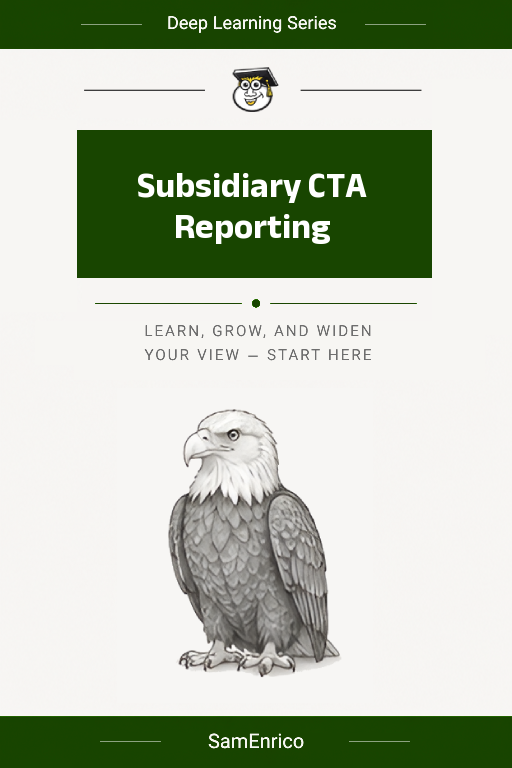
Non-FictionAnnual CheckupSubsidiaryConsolidation
Subsidiary CTA Reporting eBook
Report beneficial ownership for subsidiary entitie
Report beneficial ownership for subsidiary entities including consolidated reporting options.
Formats
Free sample
Chapter 1: The Whiplash Era...--The first thing you need to understand about subsidiary reporting under the Corporate Transparency Act is that everything you read before March 2025 is effectively obsolete.Not outdated in the way a税法 textbook from 2019 is outdated—still useful for foundational concepts but missing recent developments. No, the guidance published before March 26, 2025, is fundamentally wrong for today's compliance landscape. If you rely on it, you will waste resources, create unnecessary work for your legal team, and potentially expose your organization to liability by filing reports that are no longer required—or worse, failing to file reports that are still mandatory under the new, narrowed regime.This is not hyperbole. It is the reality of what we call the "Whiplash Era" of beneficial ownership reporting.The March 26, 2025, Earthquake On March 21, 2025, the Financial Crimes Enforcement Network (Fin CEN) issued an Interim Final Rule that fundamentally rewrote the CTA's reporting requirements -2. The rule became effective on March 26, 2025 -10.
By the time you read this sentence, the regulatory landscape had already shifted beneath your feet.Here is what changed, in plain terms: Before March 2025, the CTA required approximately 32 million entities—essentially every corporation, LLC, and similar entity created by filing a document with a secretary of state—to report their beneficial owners to Fin CEN -1. After March 2025, that universe of reporting companies shrank to a tiny fraction of its former size.The Interim Final Rule redefined "reporting company" to mean only entities that satisfy two conditions: (1) they are formed under the laws of a foreign country, and (2) they have registered to do business in any U.S. state or tribal jurisdiction by filing a document with a secretary of state or similar office -2-4.In other words, the only entities that must file Beneficial Ownership Information (BOI) reports under the current rule are foreign entities that have qualified to do business in the United States. Domestic entities—those formed in the United States—are completely exempt. Not partially exempt.
Not subject to a delayed deadline. Completely, entirely, and (for now) permanently exempt from all BOI reporting requirements -7-10.The Dual Reality You Must Navigate This creates what we call the "Dual Reality" of subsidiary CTA compliance. On one hand, we have the current legal reality: domestic entities need do nothing, while foreign reporting companies face a narrow but real filing obligation. On the other hand, we have the contingency reality: the Interim Final Rule is, as its name suggests, interim. It could be revised, struck down by litigation, or replaced by a final rule that reimposes reporting obligations on domestic entities -2-4.This book is written for both realities.
When you read a chapter that discusses filing requirements, penalties, or compliance procedures, pay close attention to the "Applies To" banner at the beginning of each chapter. Some guidance applies only to foreign reporting companies under current law. Other guidance applies only as contingency planning for a potential reversal of the Interim Final Rule. Ignoring these distinctions will lead to compliance errors.What This Means for Subsidiaries If you are reading this book, you likely manage or advise a corporate group with subsidiary entities. Your subsidiaries may be domestic (formed in a U.S.
state), foreign (formed under foreign law but registered in the U.S.), or a mix of both. Understanding how the Interim Final Rule applies to each category is the foundation of everything that follows.For domestic subsidiaries, the answer is simple under current law: they are exempt. Period. You do not need to file BOI reports for them. You do not need to update previously filed reports.
You do not even need to report that they have become exempt -10. The Interim Final Rule removed domestic entities from the definition of "reporting company" entirely -10. They are no more subject to the CTA than a sole proprietorship or a trust.For foreign subsidiaries that have registered to do business in the U.S. , the answer is more complex. These entities—often structured as branches or qualified entities of a foreign parent—are the primary targets of the current reporting regime -2-7.
They must file initial BOI reports within 30 days of the Interim Final Rule's publication date (if registered before publication) or within 30 days of receiving notice that their registration is effective (if registered on or after publication) -4-7.However, even for these foreign reporting companies, there is a critical carve-out: they are not required to report any U.S. persons as beneficial owners -4-7. If all of a foreign subsidiary's beneficial owners are U.S. persons, the subsidiary may have nothing to report at all—a scenario we explore in detail in Chapter 6.The Litigation Risk You Cannot Ignore No discussion of the current landscape would be complete without addressing the elephant in the room: the Interim Final Rule is legally vulnerable.The CTA was enacted by Congress with bipartisan support and signed into law in 2021. Its express purpose was to combat money laundering, tax evasion, and terrorist financing by eliminating anonymous shell companies.
The Interim Final Rule, issued by Fin CEN without notice-and-comment rulemaking (hence "interim" rather than "final"), dramatically narrows the statute's reach in a way that many legal scholars believe exceeds the agency's authority -2.The "Major Questions Doctrine"—a legal principle holding that agencies cannot decide issues of major economic or political significance without clear congressional authorization—looms over the Interim Final Rule -2. If challenged in court, the rule faces an uncertain fate. It could be upheld, modified, or struck down entirely. Moreover, a change in presidential administration could lead to a new Treasury Secretary rescinding the rule or issuing a final rule that reimposes reporting obligations on domestic entities -8.This is why this book repeatedly emphasizes contingency planning. The compliance work you do today—mapping your corporate structure, collecting Fin CEN IDs for beneficial owners, documenting exemption statuses—is not wasted effort even if you are currently exempt.
It is insurance against a future reversal that could give you as little as 30 days to file reports for dozens or hundreds of subsidiaries.The Global Context While the United States has stepped back from broad BOI reporting, the rest of the world has moved in the opposite direction. The European Union maintains public registers of beneficial ownership. The United Kingdom requires "persons of significant control" to be disclosed. The global standard, set by the Financial Action Task Force (FATF), calls for transparent beneficial ownership information accessible to competent authorities -3.The United States is now an outlier. This matters for multinational enterprises because your foreign subsidiaries may be subject to BOI reporting in their home jurisdictions even if your U.S.
parent is exempt. Moreover, the U.S. banking system continues to require beneficial ownership information under the Customer Due Diligence (CDD) Rule, which remains in effect despite the CTA's narrowing -3-5. As we discuss in Chapter 10, the penalty for willful non-compliance with the CTA—even in its narrowed form—can reach 500perday,upto500 per day, up to 500perday,upto10,000, plus potential criminal liability -1.What You Will Learn in This Book This book is organized into five parts, each building on the last.Part I: The New Landscape (Chapters 1-2)…
This is the end of the free sample. Get the eBook to keep going. Buy now
About this book
Details
- Author
- Schwartz Anna
- Publisher
- SamEnrico
- Language
- English
- Genre
- Non-Fiction, Annual Checkup, Subsidiary, Consolidation
- Released
- 2026-06-01
- Pages (approx.)
- 154
- Available as
- eBook, Audiobook

Read better in the ZLOADR app
Your eBooks on your phone or tablet. Sign in with your SamEnrico account and start reading.
More by Schwartz Anna
 Spin Class Sprint Workouts CourseSchwartz Anna$11.99
 Event Liability Insurance GuideSchwartz Anna$11.99
 Capital Gains Exclusion StrategySchwartz Anna$11.99
 The Solo Agers Connection PlanSchwartz Anna$11.99
 Beginner Fitness for Night ShiftSchwartz Anna$11.99Beginner Fitness for Night ShiftSchwartz Anna$11.99
 Power in the Shadows: The Untold Influence of Vice Presidents Who Changed HistorySchwartz Anna$11.99
 The Vanishing Billionaire: The Mysterious Disappearance of Bobby LeachSchwartz Anna$11.99
 Understanding Diabetes Insipidus, Nephrogenic Type 2Schwartz Anna$17.99
 Beneficial Owner DefinitionSchwartz Anna$12.99
 YardmanSchwartz Anna$11.99
 How to Start a Hobby in KaraokeSchwartz Anna$11.99
You may also like
 Hong Kong Handover 1997Dunn Johnnie$11.99
 Zumba For Postnatal Recovery CourseNeal Christian$11.99
 Zumba for BeginnersLadner Nikia$11.99
 YouTube Comment Mining GuideHumes Pandora$12.99
 Worry Box MeditationCarlin Rudy$11.99
 Workplace Stress MeditationNguyen Lynn$11.99
 Workplace Stress and Sleep RepairHawley Ivory$11.99
 Workplace Perfectionism CureDelaney Jeffry$11.99
 Workplace Injustice Anger GuideWallen Isabelle$11.99
 Work Addiction and Burnout LinkGreenwood Ester$11.99
 Women in Yoga and WellnessBeattie Galina$11.99
 Women in Stand Up ComedyChun Evangeline$11.99