
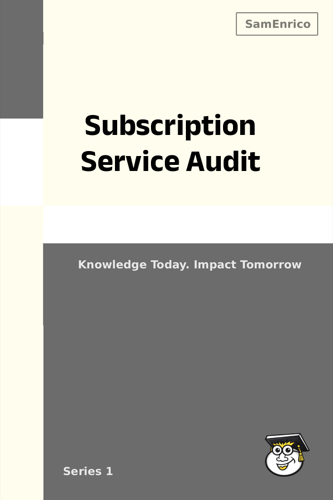
Subscription Service Audit eBook
Cancel unused monthly subscriptions to save money.
Cancel unused monthly subscriptions to save money.
Formats
Free sample
Chapter 1: The Subscription Grave...--You are bleeding money right now. You cannot feel it, see it, or smell it, but the financial hemorrhage has been underway for months, possibly years. Unlike a stolen wallet or an unexpected car repair, this loss produces no adrenaline spike, no urgent phone call to the bank, no sleepless night spent calculating damages. Instead, it arrives in gentle, forgettable increments—$9.99 here, $14.99 there, perhaps a $39.99 charge that you vaguely remember authorizing for a project you abandoned three jobs ago. The amounts are small enough to ignore individually but collectively large enough to reshape your financial future.
This is the quiet violence of the subscription economy, and you are its unwilling donor.Consider a woman named Sarah, a composite character drawn from hundreds of real readers who have completed the audit you are about to undertake. Sarah earns $68,000 per year as a marketing coordinator. She considers herself financially responsible—she pays her credit card bill in full each month, contributes 5 percent to her 401(k), and rarely makes impulse purchases over $100. Yet when she printed twelve months of bank statements at the urging of a financially savvy friend, she discovered something that made her nauseous. Over the previous year, Sarah had paid $1,847 for subscription services she either did not use or had completely forgotten about.
That sum included a language learning app she installed during a failed New Year’s resolution ($119.88 annually), a meal kit service that shipped exactly two boxes before she canceled the food but not the subscription ($540), a gym membership she visited three times in fourteen months ($560), a cloud storage plan for a laptop she no longer owned ($119.88), and a half-dozen other small charges that had simply blended into the background noise of her financial life. When Sarah calculated what that $1,847 could have become if invested instead, assuming a conservative 7 percent annual return over thirty years, the number reached nearly $14,000. Fourteen thousand dollars. For nothing.Sarah is not exceptional. She is not careless, irresponsible, or uniquely susceptible to marketing tricks.
She is a normal human being with a normal brain that evolved to notice immediate threats, not slow financial leaks. And that is precisely why you need this chapter—not because you are bad with money, but because your brain was never designed to defend against the subscription industrial complex.The Micro-Transaction Fallacy Let us begin with a simple experiment. Imagine I ask you to reach into your pocket and hand me a crisp twenty-dollar bill. You would hesitate, would you not? Twenty dollars buys lunch, a movie ticket, a decent bottle of wine.
Now imagine instead that I ask you to sign up for a service that costs $9.99 per month, auto-renewing indefinitely. That feels different, does it not? Smaller. More manageable. Almost trivial.This is the Micro-Transaction Fallacy, and it is the single most powerful psychological weapon in the subscription industry's arsenal.
Your brain processes a one-time payment of $120 very differently from twelve monthly payments of $10, even though the total is identical. The reason lies in something called "payment decoupling"—a phenomenon studied extensively in behavioral economics. When you pay for a product or service in small, recurring increments, your brain separates the pain of payment from the pleasure of consumption. The $10 monthly charge feels like background noise, while the $120 annual charge feels like a real expense worthy of consideration.The subscription industry has built an entire economic model on this cognitive glitch. They know, with mathematical certainty, that you are far more likely to tolerate a $9.99 monthly charge than a $119.88 annual charge, even when the annual charge would save you money.
They know that once you have entered your credit card information, the friction of canceling feels greater than the annoyance of the ongoing charge. They know that the default—renew, renew, renew—is their greatest ally and your greatest enemy.Consider the math on a national scale. According to a 2023 study by the subscription management platform C+R Research, the average American wastes $348 per year on unused subscriptions. That is the mean. The median is lower—around $200—because high-waste outliers pull the average upward.
But even at $200 per person, multiplied by approximately 250 million American adults, you arrive at $50 billion annually. Fifty billion dollars vanishing into auto-renewals for services people either forgot they had or never wanted in the first place. That sum could pay off the student loan debt of every public school teacher in America. It could fully fund the National Park Service for two decades. It could buy a house for every homeless veteran in the country.
Instead, it flows quietly into corporate bank accounts, extracted in $9.99 increments that nobody bothered to stop.The Subscription Identity Crisis Before we can cancel a single subscription, we must first understand something more fundamental: why you signed up for these services in the first place. The answer, in many cases, is not what you think.Take out a piece of paper or open a blank document. Write down every subscription you currently pay for—streaming services, gym memberships, meal kits, software as a service, cloud storage, dating apps, news publications, box deliveries, fitness apps, meditation guides, language learning platforms, and any other recurring charge you can recall. Do not worry about missing some; we will conduct a forensic search in Chapter 2. For now, simply list what you remember.Now, next to each subscription, write down the month and year you signed up.
Then write down the reason—the genuine, unfiltered reason—that you enrolled. For example: "January 2023, language app, because I wanted to learn Spanish before my trip to Barcelona." Or: "August 2022, meal kit, because I was tired of takeout and wanted to cook more." Or: "November 2021, gym membership, because I had gained weight during the pandemic and felt terrible about myself."What you will notice, if you are honest with yourself, is that many of these subscriptions represent past aspirations rather than current realities. You are not paying for who you are. You are paying for who you wanted to be three months ago, or a year ago, or during a moment of temporary enthusiasm that has long since faded. The language app for the trip that already happened.
The meal kit for the cooking renaissance that never arrived. The gym membership for the fitness transformation that lasted two weeks. The meditation app for the calmer, more centered version of yourself that exists only in your imagination.This is not a moral failing. It is a predictable consequence of how humans make decisions. Psychologists have documented something called the "planning fallacy"—our tendency to underestimate the time, effort, and willpower required to achieve a goal.
When you signed up for that language app, you genuinely believed you would practice daily. You were not lying to yourself; you were simply suffering from the same optimistic bias that affects virtually every human being. The problem is that the subscription industry has figured out how to monetize your optimism, charging you indefinitely for a future that never materializes.The Inertia Tax Perhaps the most insidious aspect of the subscription economy is what behavioral economists call the Inertia Tax—the amount of money you pay simply because canceling requires more effort than not canceling. Researchers have documented this…
This is the end of the free sample. Get the eBook to keep going. Buy now
About this book
Details
- Author
- Armijo Patrice
- Publisher
- SamEnrico
- Language
- English
- Genre
- Non-Fiction, Self-Help, Finance
- Released
- 2026-06-10
- Pages (approx.)
- 129
- Available as
- eBook, Audiobook

Read better in the ZLOADR app
Your eBooks on your phone or tablet. Sign in with your SamEnrico account and start reading.
More by Armijo Patrice
 Self Talk For InsomniaArmijo Patrice$11.99
 Wholesale Vendor Credit GuideArmijo Patrice$11.99
 The Substance and Emotion GuideArmijo Patrice$11.99
 Speaker Wardrobe GuideArmijo Patrice$11.99
 Cognitive Reframing DrivingArmijo Patrice$11.99
 Tarcila Rivera Zea Quechua VoiceArmijo Patrice$11.99
 Habit Formation for Weight LossArmijo Patrice$11.99
 The Silent Saboteurs: Mime and the Secret War of Ancient RomeArmijo Patrice$11.99
 Golden Arches & Iron Thrones: The Secret Wars of Fast Food DynastiesArmijo Patrice$11.99
 Service Providers Guide to Fertility ServicesArmijo Patrice$11.99
 How to Produce Travel Converters and AdaptersArmijo Patrice$11.99
 How to Produce Polyurethane Interior PaintArmijo Patrice$11.99
You may also like
 Hong Kong Handover 1997Dunn Johnnie$11.99
 Zumba For Postnatal Recovery CourseNeal Christian$11.99
 Zumba for BeginnersLadner Nikia$11.99
 YouTube Comment Mining GuideHumes Pandora$12.99
 Worry Box MeditationCarlin Rudy$11.99
 Workplace Stress MeditationNguyen Lynn$11.99
 Workplace Stress and Sleep RepairHawley Ivory$11.99
 Workplace Perfectionism CureDelaney Jeffry$11.99
 Workplace Injustice Anger GuideWallen Isabelle$11.99
 Work Addiction and Burnout LinkGreenwood Ester$11.99
 Women in Yoga and WellnessBeattie Galina$11.99
 Women in Stand Up ComedyChun Evangeline$11.99