
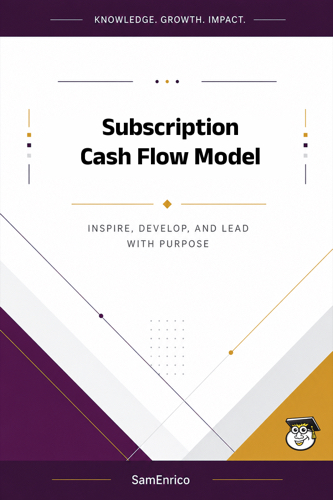
Non-FictionBusiness BriefRecurring Revenue
Subscription Cash Flow Model eBook
Leverage recurring revenue for predictable monthly
by Harry Mariko
Leverage recurring revenue for predictable monthly inflows.
Formats
Free sample
Chapter 1: The Feast-or-Famine Trap--Most entrepreneurs believe that growth solves everything. More customers, more sales, more revenue—these are the metrics that dominate boardroom discussions, investor pitch decks, and the sleepless nights of founders everywhere. But there is a silent killer hiding beneath the surface of almost every growing business, a problem that no amount of top-line revenue can fix. It is the feast-or-famine cycle, and it destroys more companies than outright failure ever does.The feast-or-famine cycle is deceptively simple. One month, sales are booming.
Cash is flowing. You hire two new team members, increase your marketing spend, and pre-order inventory for the expected surge. Then the next month arrives, and with it, silence. Deals that were "certain" have slipped. Customers who promised to buy have gone dark.
Your bank account, which looked healthy thirty days ago, is now hovering near zero. You cannot make payroll without dipping into a high-interest line of credit. The inventory you pre-ordered is sitting in a warehouse, paid for but not yet sold. The new hires are looking at you with concern, wondering if they made a mistake.This is the volatility tax. It is the hidden cost of unpredictability, and it extracts a heavy toll from businesses that rely on one-time sales.
The volatility tax shows up in three specific, measurable ways: inefficient inventory purchasing, hesitancy in hiring, and expensive, risky debt reliance. Together, these three drains can consume 20-40% of a company's potential profit margin, not because the business is unprofitable, but because the cash flow is unpredictable.The first and most obvious manifestation of the volatility tax is inefficient inventory purchasing. When you cannot predict how much you will sell in any given month, you face a brutal trade-off. Order too much inventory, and you tie up cash in unsold goods that may sit for months, accruing storage costs and risking obsolescence. Order too little, and you miss sales opportunities, frustrating customers who may never return.
Either path is costly, but the feast-or-famine cycle forces you to choose one or the other repeatedly, with no reliable data to guide you.Consider a typical e-commerce business selling a physical product. In a good month, they sell 5,000 units. In a bad month, they sell 500. How much inventory should they order from their manufacturer? If they order for the good month, they risk sitting on 4,500 units of unsold stock during the bad month—cash that could have been used for marketing, payroll, or product development.
If they order for the bad month, they risk running out of stock during the good month, losing sales and damaging customer trust. Most businesses split the difference, ordering somewhere in the middle, but this guarantees inefficiency in both directions. They will have too much inventory in bad months and too little in good months, paying the volatility tax regardless of which scenario plays out.The second manifestation of the volatility tax is hesitancy in hiring. People are the most expensive and most critical asset in almost any business. But hiring is also a long-term commitment.
When you bring on a new employee, you are committing to their salary, benefits, and training costs for months or years into the future. In a business with predictable cash flow, this commitment is manageable. You know that next month's revenue will cover next month's payroll. But in a feast-or-famine business, you never know. The same founder who confidently hired two new team members after a record-breaking month may be forced to lay them off three months later when the famine arrives.The result is chronic under-hiring.
Leaders delay adding critical staff even when the business is growing, because they cannot be sure the growth will last. A marketing manager who could double your customer acquisition sits unfilled for six months while you debate whether the revenue is "real." A customer support representative who could reduce churn by answering tickets faster is never hired because you are saving cash for the next drought. The volatility tax here is not just the cost of delayed hiring—it is the cost of the growth you never achieved because you were afraid to commit.The third manifestation of the volatility tax is risky debt reliance. When cash inflows are unpredictable, every business eventually faces a cash gap—a period when expenses exceed available cash, even though the business is profitable on an annual basis. The classic example is the business that lands a large contract in December but must pay its suppliers in November.
The revenue is coming, but it is not here yet. To bridge the gap, the business turns to debt: a line of credit, a merchant cash advance, or worse, a high-interest loan from a non-traditional lender.This debt is expensive. Interest rates of 20-40% APR are common for the types of short-term financing that volatile businesses rely on. And because the volatility never goes away, the debt becomes a permanent feature of the business. You borrow to cover the gap in November, repay in December, then borrow again in January when the next gap appears.
Over the course of a year, the interest payments on this revolving debt can consume 5-10% of your revenue—money that could have been profit, reinvestment, or founder income.Taken together, these three forms of the volatility tax create a powerful drag on business performance. But here is the crucial insight that changes everything: the volatility tax is not inevitable. It is not a natural law of business or an unavoidable cost of entrepreneurship. It is the direct result of a specific business model—the transactional model, where revenue comes in unpredictable lumps based on one-time sales. And there is an alternative.The Subscription Alternative The alternative is the subscription model, and its most powerful benefit is not recurring revenue itself, but what recurring revenue enables.
When customers pay you every month, automatically, without needing to be sold each time, you gain something more valuable than cash: you gain predictability. You gain the ability to see into the future, not with perfect clarity, but with enough confidence to make decisions that were previously impossible.This predictability creates what I call the Cash Flow Baseline. The Cash Flow Baseline is the minimum amount of recurring revenue you can expect to receive each month, based on your existing customer base, after accounting for normal churn (customers who cancel). If you have 1,000 customers paying $50 per month, and your historical churn rate is 3% per month, your Cash Flow Baseline is not $50,000—it is $48,500, because you know that approximately 30 customers will cancel. But that $48,500 is yours.
It will arrive next month regardless of how many new customers you acquire. It is the floor beneath your feet.The Cash Flow Baseline transforms every decision in your business. With a baseline of $48,500, you can now pre-order inventory with confidence. You know that even if you acquire zero new customers next month, you will still have $48,500 to pay for that inventory. You can hire that marketing manager because you know that the baseline covers their salary, independent of new sales.
You can avoid expensive debt because the baseline eliminates the need to borrow against uncertain future revenue. The volatility tax simply disappears.The 12% Discount: A…
This is the end of the free sample. Get the eBook to keep going. Buy now
About this book
Details
- Author
- Harry Mariko
- Publisher
- SamEnrico
- Language
- English
- Genre
- Non-Fiction, Business Brief, Recurring Revenue
- Released
- 2026-06-07
- Pages (approx.)
- 135
- Available as
- eBook, Audiobook

Read better in the ZLOADR app
Your eBooks on your phone or tablet. Sign in with your SamEnrico account and start reading.
More by Harry Mariko
 Restless Leg Syndrome Stretching RoutineHarry Mariko$11.99
 Messner Nanga Parbat TragedyHarry Mariko$11.99
 Deep Work Window SchedulingHarry Mariko$11.99
 Chiropractic Success StoriesHarry Mariko$11.99
 Twelve Step Home Group GuideHarry Mariko$11.99
 The EQ for Veterinarians GuideHarry Mariko$11.99
 Trance For Yoga PracticeHarry Mariko$11.99
 The Sefas Emes TeachingsHarry Mariko$11.99
 Breaking the Curse: How New Zealand's Tall Blacks Ended a 44-Year March Madness DroughtHarry Mariko$11.99
 The Poisoner’s Prescription: The Deadly Legacy of Dr. Harold ShipmanHarry Mariko$11.99
 The Crown in Crisis: When a King’s Coronation Almost Didn’t HappenHarry Mariko$11.99
 The Mineral Guide to UranophaneHarry Mariko$11.99
You may also like
 Hong Kong Handover 1997Dunn Johnnie$11.99
 Zumba For Postnatal Recovery CourseNeal Christian$11.99
 Zumba for BeginnersLadner Nikia$11.99
 YouTube Comment Mining GuideHumes Pandora$12.99
 Worry Box MeditationCarlin Rudy$11.99
 Workplace Stress MeditationNguyen Lynn$11.99
 Workplace Stress and Sleep RepairHawley Ivory$11.99
 Workplace Perfectionism CureDelaney Jeffry$11.99
 Workplace Injustice Anger GuideWallen Isabelle$11.99
 Work Addiction and Burnout LinkGreenwood Ester$11.99
 Women in Yoga and WellnessBeattie Galina$11.99
 Women in Stand Up ComedyChun Evangeline$11.99