
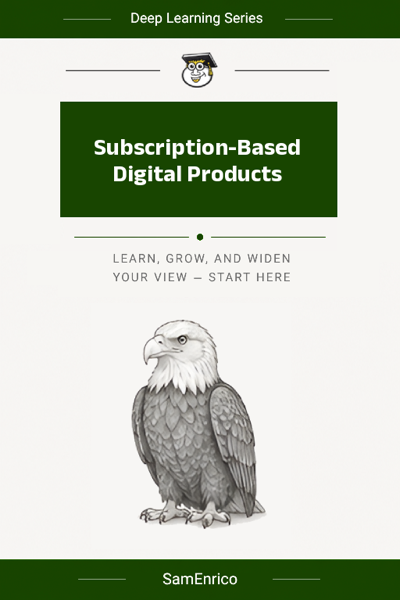
Non-FictionInformativeEducational
Subscription-Based Digital Products eBook
A Coursebook on Subscription-Based Digital Product
by Duff Magda
A Coursebook on Subscription-Based Digital Products
Formats
Free sample
Chapter 1: The Ownership Illusion--The most dangerous belief in business today is that you sell products. You do not. You sell outcomes, access, and relationships. The moment you wrap a piece of software, a document, or a tool in a box and hand it over for a single payment, you have ended your conversation with the customer. And in the digital age, ending the conversation is the same as ending your company.This chapter dismantles the most fundamental assumption of traditional commerce: that ownership is what customers want.
It is not. What customers want is continuous value without administrative burden. They want the problem solved, the access granted, the update delivered, the integration maintained. They do not want to manage license keys, track expiration dates, or wonder if they have the latest version. They want all of that to disappear into the background.
And subscription models are the only way to give it to them.Let me tell you about a company that nearly destroyed itself to learn this lesson. Its name is Adobe, and its story is the single most important case study in the history of the subscription economy.The $2.6 Billion Suicide Attempt In 2011, Adobe was on top of the world. Its Creative Suite software—Photoshop, Illustrator, In Design, and the rest—was the undisputed standard for creative professionals. A full license cost $2,600. Customers paid once, installed the software on their computers, and used it for years.
The company generated billions in reliable, predictable revenue. There was no urgent problem to solve.Except there was. Adobe's leadership noticed something troubling. The relationship with customers ended the moment the transaction completed. A designer who bought Photoshop in 2010 might not speak to Adobe again until 2012 or 2013.
In between, Adobe had no insight into how the software was being used, what features were valuable, or what frustrations were building. The company was flying blind, shipping new versions every 18 months based on guesses about what customers wanted.Worse, the upgrade cycle was punishing. Every 18 months, Adobe had to convince customers to pay hundreds of dollars for a new version. Many resisted. Some pirated.
Some stuck with old versions for years. The company's revenue was a series of spikes followed by long flat periods. It was profitable, but it was not sustainable in a world where cloud-based competitors were beginning to offer simpler, cheaper, always-updated alternatives.So Adobe made a decision that Wall Street called suicidal. It announced that it would kill Creative Suite forever. No more boxed software.
No more perpetual licenses. No more $2,600 upfront payments. In their place, Adobe introduced Creative Cloud: a subscription service costing $50 per month, every month, forever.The reaction was immediate and ferocious. Designers started online petitions with hundreds of thousands of signatures. Blog posts called it "rent-seeking," "corporate greed," and "a betrayal of loyal customers." One popular cartoon showed Adobe as a mafia boss demanding protection money.
The company's stock dropped 12% in a single week.But the worst was yet to come. In the first year of the transition, Adobe's revenue fell sharply. Customers who would have paid $2,600 for a license now paid $600 for a year of subscription. That is a 77% drop in revenue from each migrating customer. The company entered what I call the Fish Curve dip: a narrow neck of revenue collapse between the death of the old model and the scaling of the new one.For 18 months, Adobe bled.
It cut costs, laid off employees, and repeatedly explained to angry investors that this was temporary. And then, slowly, something changed. As the subscriber base grew, revenue stabilized. Then it grew. Then it accelerated.
Within four years, Adobe's valuation had quadrupled. Today, Adobe is worth nearly $200 billion, and Creative Cloud has over 20 million subscribers. The company that almost killed itself became the blueprint for every software company on Earth.What did Adobe understand that its critics did not? That the value was never in the software. The value was in the relationship.The Fish Curve: Anatomy of a Necessary Dip If you are building or transitioning a subscription product, you will face the Fish Curve.
Understanding its shape is the difference between surviving and failing.Imagine a fish swimming from left to right. Its head is wide, its neck is narrow, and its tail is wide again. That shape is your revenue during a subscription transition. Let me walk you through each phase.Phase 1: The Head. Your current one-time sales are strong.
You are profitable. You begin offering subscriptions alongside your traditional products, perhaps as an experiment. Revenue starts to plateau because some customers who would have bought the expensive perpetual license now choose the cheaper monthly option. You do not feel real pain yet, but the foundation is cracking. This phase can last six to twelve months.Phase 2: The Narrow Neck.
This is where most companies die. Your old revenue stream—one-time sales—collapses as customers realize the subscription is the future. They stop buying upfront licenses entirely. Your new revenue stream—subscriptions—has not yet scaled because you need time to accumulate enough monthly customers to match your previous annual revenue. For a period of twelve to twenty-four months, your total revenue will be lower than before.
Sometimes much lower.During this phase, you will experience intense pressure. Investors will demand you reverse course. Your board will question your strategy. Your team will grow tired of bad news. Competitors will use your weakness against you.
The companies that survive the narrow neck are those with cash reserves, patient capital, or a hybrid model that offers both options during the transition. Adobe had a $2 billion cash cushion from its previous success. Smaller companies cannot survive an eighteen-month dip without preparation.Phase 3: The Wide Tail. Once you accumulate enough subscribers, your Monthly Recurring Revenue (MRR) begins to compound. Each new subscriber adds to a base that does not reset to zero.
Revenue climbs faster than it ever did with one-time sales. Your business becomes more valuable because recurring revenue is predictable, and public markets value predictability. A company with $100 million in one-time revenue might be worth $300 million. A company with $100 million in recurring revenue might be worth $600 million to $800 million.The Fish Curve is not a bug. It is a feature.
It is the cost of building a more valuable business. But you must plan for it.The Forever Transaction What makes a subscription fundamentally different from a one-time sale? Most people think the answer is the payment frequency. It is not. The answer is the nature of the relationship.A one-time transaction is a handshake.
You give money. You receive a product. The relationship ends. Both parties walk away. The company's incentive is to maximize the price of that single exchange.
The customer's incentive is to extract as much value as possible without paying again. There is no alignment of interests. In fact, the interests are opposed: the company wants to be paid more for less, and the customer wants to pay less for more.A subscription, by contrast, is a marriage. Not a romantic one, but a contractual commitment to an ongoing relationship. You give access to your bank account.
The company promises continuous value. The relationship only ends when one party decides it is no longer worth it. The…
This is the end of the free sample. Get the eBook to keep going. Buy now
About this book
Details
- Author
- Duff Magda
- Publisher
- SamEnrico
- Language
- English
- Genre
- Non-Fiction, Informative, Educational
- Released
- 2026-06-02
- Pages (approx.)
- 135
- Available as
- eBook, Audiobook

Read better in the ZLOADR app
Your eBooks on your phone or tablet. Sign in with your SamEnrico account and start reading.
More by Duff Magda
 EQ Conflict Resolution GuideDuff Magda$11.99
 The Parent Caregiver Burnout PreventionDuff Magda$11.99
 The Namibia Dune GuideDuff Magda$11.99
 Sleep Meditation AssessmentDuff Magda$11.99
 Commercial Diver Stress ManagementDuff Magda$11.99
 The Last Oracle of Delphi: When the Gods Spoke in SilenceDuff Magda$11.99
 Democritus and the Atom: The First Glimpse of the Invisible UniverseDuff Magda$11.99
 Understanding Fibromuscular Dysplasia of ArteriesDuff Magda$17.99
 Ghana Startup Funding HandbookDuff Magda$12.99
 Promotion Business Case GuideDuff Magda$12.99
 A Beginners Guide to Bumper pool (Volume 1)Duff Magda$11.99
You may also like
 Hong Kong Handover 1997Dunn Johnnie$11.99
 Zumba For Postnatal Recovery CourseNeal Christian$11.99
 Zumba for BeginnersLadner Nikia$11.99
 YouTube Comment Mining GuideHumes Pandora$12.99
 Worry Box MeditationCarlin Rudy$11.99
 Workplace Stress MeditationNguyen Lynn$11.99
 Workplace Stress and Sleep RepairHawley Ivory$11.99
 Workplace Perfectionism CureDelaney Jeffry$11.99
 Workplace Injustice Anger GuideWallen Isabelle$11.99
 Work Addiction and Burnout LinkGreenwood Ester$11.99
 Women in Yoga and WellnessBeattie Galina$11.99
 Women in Stand Up ComedyChun Evangeline$11.99