
Non-FictionBiographyEngineering Memoir
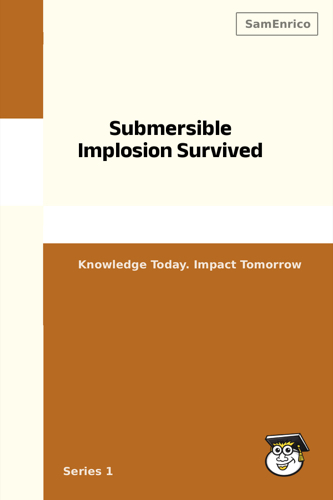
Submersible Implosion Survived eBook
A hairline crack in an acrylic viewport that mirac
by Steel Eldora
A hairline crack in an acrylic viewport that miraculously held at 6,000 feet.
Formats
Free sample
Chapter 1: The Blue Fracture...–- The deep does not warn you. It whispers once, then crushes.The DSCV Deep Horizon fell through the abyss like a coin dropped into a well. On the surface, twelve thousand feet above, the Atlantic had been churning with late-summer fury—thirty-foot swells that turned the support ship MV Supporter into a rocking horse. But down here, at four thousand feet and dropping, the ocean was a different dimension entirely. Here, the water was perpetually cold, perpetually dark, and perpetually still.
The only motion came from the submersible itself: a three-person, twelve-ton sphere of titanium and acrylic, descending at thirty feet per minute toward a target no human had ever seen.Inside the sphere, the air tasted of recycled rubber, stale coffee, and the faint metallic tang of fear.Commander Rick Fallon sat in the pilot’s cradle, his hands resting lightly on the thruster controls, his eyes fixed on the forward viewport. The acrylic dome was eight inches thick, machined from a twelve-inch cast block—a transparent fortress designed to hold back two thousand pounds per square inch of water pressure. Fallon had commanded deep dives for seventeen years, first in the Navy, then for private research firms. He had watched a man die of the bends on the deck of a sub tender. He had felt a battery fire melt the insulation around his feet while trapped at three hundred feet.
He knew what the deep could do.But he had never been to six thousand feet.“Four thousand nine hundred,” said a voice to his left. “Descent nominal. All systems green.”Kai Tanaka, the mission’s engineer, was a small, wiry man in his early forties with calloused hands and the kind of quiet competence that came from growing up in his father’s machine shop. His father had been a Japanese immigrant who worked for a specialty plastics plant in Ohio, casting acrylic blocks for deep-sea viewports. Kai had inherited the old man’s precision and his paranoia.
He checked every gauge twice, every weld three times. He was the reason the Deep Horizon had redundant scrubbers, backup batteries, and a manual release valve on every seal.“Pressure at the hull?” Fallon asked.“Four hundred and twenty PSI differential. Holding steady.”“Temperature?”“Thirty-eight degrees external. Sixty-two internal. CO₂ is point three percent.”Fallon nodded.
Standard numbers. Boring numbers. Boring was good. Boring meant they would reach the vent, collect their samples, and be back on the surface in eight hours. Boring meant nobody died.The third member of the crew was Dr.
Lena Voss, and she was not boring at all.She stood at the rear of the cabin, wedged between a rack of sampling canisters and the emergency airlock, her face pressed to a side viewport. She was forty-one, tall, with the lean build of a runner and the pale skin of someone who spent most of her life indoors. Her specialty was hydrothermal vents—the underwater geysers where superheated water erupted from the ocean floor, creating oases of life in the desert of the abyss. She had discovered three new species in the last five years. She had also, two years ago, been the senior officer on a dive that killed three men.The official report called it “equipment failure.” Lena called it what it was: her fault.
She had ignored a warning light on the ballast system because they were behind schedule. The sub had dropped faster than intended. The ascent had been too rapid. Three men had gotten the bends. Two survived.
One didn’t.She had not dived since. Until today.“You see anything yet?” Fallon asked.Lena shook her head without turning. “The vent is at five thousand eight hundred. We won’t see the plume until we’re within five hundred feet. But the sonar is picking up a thermal anomaly at six thousand two hundred.
It’s big, Rick. Maybe the biggest one in the trench.”Fallon glanced at Kai. Kai shrugged. “Sonar’s clean. No shear zones, no gas pockets.
The floor looks solid.”“Then let’s keep going.”The sub descended. The viewports showed nothing but blackness—the absolute, total black of water so deep that sunlight had never reached it. Fallon switched on the external lights. Twin beams of white light cut into the void, illuminating a curtain of marine snow: the endless, gentle fall of organic debris from the surface. It looked like ash falling on a battlefield.“Five thousand one hundred feet,” Kai said.And then they heard it.It was not a loud sound.
It was not the shriek of tearing metal or the explosive pop of a seal giving way. It was a single, sharp tick, like a frozen branch snapping under a boot. It came from directly in front of them.Fallon killed the thrusters instantly. The sub slowed to a halt, suspended in the water column like a pendulum at the end of its swing. The silence that followed was worse than the sound.
It was the silence of held breath, of waiting, of knowing that something had just gone wrong but not yet knowing how wrong.“What was that?” Lena whispered.Fallon didn’t answer. He was staring at the forward viewport.At first, he thought it was a hair. A single, fine line, three inches long, curving from the lower bezel toward the center of the acrylic. But hairs did not appear out of nowhere at five thousand feet. Hairs did not have branches.He leaned closer.
The line was not a hair. It was a crack. A hairline fracture, impossibly thin, spider-webbing outward from a point at the bottom edge of the viewport. The branches were barely visible—fractions of a millimeter wide—but they were there. And at the center of the crack, where the original fracture had begun, something glowed.It was faint, barely perceptible, a deep blue luminescence that pulsed slowly, like a heartbeat.“Kai,” Fallon said, his voice flat.
“Tell me that’s a reflection.”Kai was already out of his seat, pushing past Lena to get to the forward viewport. He pulled a small borescope from his vest—a fiber-optic camera thin as a drinking straw—and pressed its tip against the acrylic. The image on his handheld screen showed the crack in microscopic detail. The main fracture was three inches long, running along a casting flaw that had been invisible to the naked eye. The spiderweb branches extended another half-inch in each direction.
The acrylic around the crack was crazed—a network of tiny white stress lines that looked like frost on a windowpane.But the glow. The glow was not a reflection. It was coming from inside the crack, from the gap itself.“That’s not possible,” Kai said.“What’s not possible?” Lena asked. She had pushed past him and was now staring at the viewport, her face pale. “Is that—is that bioluminescence?”“It can’t be.
There’s nothing living in the acrylic. It’s cast polymer. It’s sterile.”“Then explain the light.”Kai had no explanation. He zoomed in further. The crack walls were not smooth.
They were coated with something—a dark, slimy film that was barely visible in the borescope’s harsh LED light. The film…
This is the end of the free sample. Get the eBook to keep going. Buy now
About this book
Details
- Author
- Steel Eldora
- Publisher
- SamEnrico
- Language
- English
- Genre
- Non-Fiction, Biography, Engineering Memoir
- Released
- 2026-06-09
- Pages (approx.)
- 121
- Available as
- eBook, Audiobook

Read better in the ZLOADR app
Your eBooks on your phone or tablet. Sign in with your SamEnrico account and start reading.
More by Steel Eldora
 Wedding Planner Stress GuideSteel Eldora$11.99
 Renewal and Notice Period AutomationSteel Eldora$11.99
 DBT for EmpathsSteel Eldora$11.99
 Morning Energy VisualizationSteel Eldora$11.99
 Egyptian Dance GuideSteel Eldora$11.99
 The Breath For GriefSteel Eldora$11.99
 Email Overload Stress SolutionsSteel Eldora$11.99
 Marital Rape SurvivorSteel Eldora$11.99
 The Last Alchemist of Paris: Secrets of the Philosopher's StoneSteel Eldora$11.99
 The Billionaire’s Gambit: How a Poker Pro Turned $100 into a FortuneSteel Eldora$11.99
 The Ballad of the Black Cowboy: Nat Love’s Wild WestSteel Eldora$11.99
 EU VAT Bad Debt Relief ProcessSteel Eldora$12.99
You may also like
 Hong Kong Handover 1997Dunn Johnnie$11.99
 Zumba For Postnatal Recovery CourseNeal Christian$11.99
 Zumba for BeginnersLadner Nikia$11.99
 YouTube Comment Mining GuideHumes Pandora$12.99
 Worry Box MeditationCarlin Rudy$11.99
 Workplace Stress MeditationNguyen Lynn$11.99
 Workplace Stress and Sleep RepairHawley Ivory$11.99
 Workplace Perfectionism CureDelaney Jeffry$11.99
 Workplace Injustice Anger GuideWallen Isabelle$11.99
 Work Addiction and Burnout LinkGreenwood Ester$11.99
 Women in Yoga and WellnessBeattie Galina$11.99
 Women in Stand Up ComedyChun Evangeline$11.99