
Non-FictionHealth & WellnessSubmarine Service
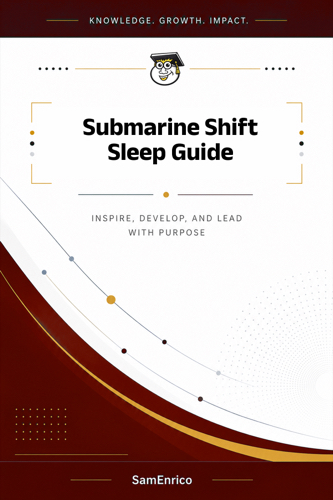
Submarine Shift Sleep Guide eBook
Manages 18-hour days and artificial light environm
by Gaddis Zelda
Manages 18-hour days and artificial light environments.
Formats
Free sample
Chapter 1: The Eighteen-Hour Lie--You have been lied to. Not maliciously, and not by any single person, but by an entire industry of sleep advice that assumes you live in a world with a sun that rises and sets, with weekends that arrive every seven days, and with a boss who does not expect you to operate heavy machinery at 3:00 AM. The lie is simple: that eight hours of uninterrupted sleep is the only path to health, and that any deviation from this pattern means you are broken, lazy, or somehow failing at being human. The truth is far stranger and far more forgiving. You are not failing.
You are trying to fit a twenty-four-hour biology into an eighteen-hour schedule, and the fact that you are still functioning at all is a miracle of human resilience, not evidence of your inadequacy.This book is not for the person who can close their laptop at 9:00 PM, read a novel by warm lamplight, and drift peacefully into eight hours of restorative sleep. That person does not need this book. This book is for the person who eats dinner at midnight, who has forgotten what natural light looks like, who sleeps in a room that never gets completely dark, and who has learned to hate the phrase "just go to bed earlier" with the white-hot intensity of a thousand sleepless nights. This book is for the submariner, the emergency room physician, the oil rig worker, the long-haul trucker, the factory shift supervisor, the parent of a newborn who has not seen a full night's sleep in eighteen months, and anyone else whose relationship with the sun has become, at best, complicated.Let me tell you about the first time I understood that standard sleep advice was useless. I was not on a submarine.
I was in a brightly lit emergency department at 2:00 AM, staring at a cup of cold coffee and a patient chart that I had read three times without retaining a single word. A well-meaning colleague had sent me an article about "sleep hygiene" that recommended, among other things, keeping a consistent bedtime and avoiding screens before sleep. I wanted to throw my phone across the room. Consistent bedtime? My bedtime that week had been 8:00 AM, then 10:00 AM, then 6:00 AM, then not at all.
Avoid screens? My entire job was screens. The advice was not wrong. It was just written for someone who lived in a different universe. That is when I started looking for answers that actually worked for people whose schedules looked nothing like the nine-to-five ideal.The good news is that those answers exist.
They come from an unlikely source: the United States Navy's submarine fleet, where sailors have been surviving and thriving on eighteen-hour days for decades. Submariners do not get to complain about their schedules. They do not get to request accommodations. They do not get to quit and find a day job. What they get is a set of brutally practical, scientifically grounded protocols for forcing a human body to perform when everything about its biology is screaming that it should be asleep.
These protocols work not because submariners are superhuman—they are not—but because the protocols are designed for the real world of artificial light, compressed schedules, and environments that do not care about your circadian rhythm.The "Sixes" Schedule The standard submarine watch schedule is called the "Sixes" for a reason that will become painfully clear. You work for six hours. Then you have twelve hours "off." That sounds generous until you understand what those twelve hours actually contain. Transit from your watch station to your berthing area takes time. Changing out of your work clothes takes time.
Eating a meal takes time. Hygiene—showering, brushing teeth, using the head—takes time. And then, if you are lucky, you have six or seven hours remaining to sleep before the cycle begins again. But here is the cruel math: six or seven hours of opportunity does not equal six or seven hours of sleep. Sleep latency—the time it takes to actually fall asleep—consumes another twenty to forty minutes per attempt.
Nighttime awakenings, whether from noise, temperature changes, or the need to urinate, consume more. The result is that a submariner who spends seven hours in their rack typically achieves four to five hours of actual sleep.This gap between "time in rack" and "actual sleep" is the central, defining problem of the eighteen-hour day. If you have ever woken up feeling worse than when you went to bed, or if you have ever lain in the dark for hours knowing that every minute of wakefulness is stealing from your limited sleep window, you know exactly what this feels like. The standard advice—"just sleep eight hours"—is not merely unhelpful. It is actively destructive because it sets an impossible standard that makes you feel like a failure for something that is fundamentally not your fault.Let me be absolutely clear about the numbers because they matter for everything that follows.
On a standard twenty-four-hour schedule, a healthy adult has approximately sixteen hours of wakefulness followed by eight hours of sleep opportunity, of which they typically achieve seven to seven and a half hours of actual sleep. On an eighteen-hour submarine schedule, you have twelve hours "off" but only six to seven hours of sleep opportunity, of which you typically achieve four to five hours of actual sleep. That is a deficit of two to three hours per "night." Multiply that by the length of a deployment—weeks or months—and you are looking at a cumulative sleep debt measured in dozens or hundreds of hours.The Eighteen-Hour Problem Now we arrive at the biological impossibility at the heart of this book. The human brain contains a small cluster of neurons called the Suprachiasmatic Nucleus, or SCN. This is your master clock.
It is located in the hypothalamus, just above where your optic nerves cross, and it is responsible for synchronizing every other clock in your body. The SCN is not a metaphor. It is a physical structure that has been mapped, measured, and studied in thousands of scientific papers. And here is the thing about the SCN that changes everything: it is genetically hardwired to run on a cycle of approximately twenty-four hours and twelve minutes.Not eighteen hours. Not twenty hours.
Not any other duration that might be convenient for your work schedule. Twenty-four hours and twelve minutes, give or take a few minutes depending on your genetics. This is not a habit you can change or a preference you can override. This is fundamental biology, as immutable as the fact that your heart has four chambers or that your blood contains iron. The SCN cannot entrain to an eighteen-hour cycle.
It will not. It cannot. It is physically incapable of doing so.What happens when you try to force an eighteen-hour schedule onto a twenty-four-hour clock is called Circadian Desynchrony. Your internal biology drifts out of phase with your external environment. Your brain thinks it is one time.
Your liver thinks it is another. Your gut thinks it is a third. The result is a state of perpetual jet lag…
This is the end of the free sample. Get the eBook to keep going. Buy now
About this book
Details
- Author
- Gaddis Zelda
- Publisher
- SamEnrico
- Language
- English
- Genre
- Non-Fiction, Health & Wellness, Submarine Service
- Released
- 2026-06-06
- Pages (approx.)
- 136
- Available as
- eBook, Audiobook

Read better in the ZLOADR app
Your eBooks on your phone or tablet. Sign in with your SamEnrico account and start reading.
More by Gaddis Zelda
 Purpose After IllnessGaddis Zelda$11.99
 Gut Directed Hypnotherapy For IBSGaddis Zelda$11.99
 Workaholics Anonymous ExplainedGaddis Zelda$11.99
 Parent Weekly Review RitualGaddis Zelda$11.99Parent Weekly Review RitualGaddis Zelda$11.99
 Snack Fueled BrainstormGaddis Zelda$11.99
 Pressure DressingGaddis Zelda$11.99
 NVC for Caregivers GuideGaddis Zelda$11.99
 The Silent Resilience of María de los Ángeles: Surviving Argentina's 1940s Forced DisappearancesGaddis Zelda$11.99
 The Architect Kings of Aksum: Building an Empire in Stone and FaithGaddis Zelda$11.99
 How to Produce an Insley Manufacturing CompanyGaddis Zelda$11.99
 Service Providers Guide to Adult DaycareGaddis Zelda$11.99
You may also like
 Hong Kong Handover 1997Dunn Johnnie$11.99
 Zumba For Postnatal Recovery CourseNeal Christian$11.99
 Zumba for BeginnersLadner Nikia$11.99
 YouTube Comment Mining GuideHumes Pandora$12.99
 Worry Box MeditationCarlin Rudy$11.99
 Workplace Stress MeditationNguyen Lynn$11.99
 Workplace Stress and Sleep RepairHawley Ivory$11.99
 Workplace Perfectionism CureDelaney Jeffry$11.99
 Workplace Injustice Anger GuideWallen Isabelle$11.99
 Work Addiction and Burnout LinkGreenwood Ester$11.99
 Women in Yoga and WellnessBeattie Galina$11.99
 Women in Stand Up ComedyChun Evangeline$11.99