
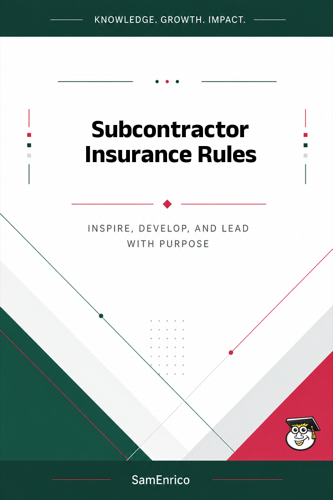
Non-FictionBusiness BriefSubcontractor
Subcontractor Insurance Rules eBook
Explains verifying coverage for 1099 workers and a
by Cullen Enid
Explains verifying coverage for 1099 workers and avoiding vicarious liability.
Formats
Free sample
Chapter 1: The $2.7 Million Lie--–- The first time I met Mike, he was showing me a photo of his fishing boat. The second time I met Mike, he was showing me a bankruptcy notice. Six months separated the two meetings. What happened in between? He hired a subcontractor named Rick, handed Rick a 1099 form, and watched Rick fall off a ladder.The judge didn't care about the 1099.
The jury didn't care about the contract Mike had Rick sign. They cared about one thing: who was running the job site. And the evidence showed that Mike had told Rick what time to start, which ladder to use, and how to secure his equipment. In the eyes of the court, Rick was not an independent contractor. Rick was an employee.
A temporary, uninsured, now-paralyzed employee whose medical bills and lost wages would exceed $2.7 million.Mike's insurance company paid $1 million of that. Mike paid the remaining $1.7 million from his personal savings, his business accounts, and finally the equity in his house. The fishing boat was sold six months after the accident. The business closed nine months after that.This book exists because of Mike. And because of the thousands of business owners just like him who believe the single most dangerous myth in modern commerce: that issuing a 1099 tax form protects you from liability when a subcontractor gets hurt or causes harm.That myth is a lie.
It has always been a lie. And the purpose of this chapter is to prove it to you so completely that you never make Mike's mistake.The 1099 does not protect you in court. It never has. It never will. What it does do is create a false sense of security that has bankrupted more small and medium-sized businesses than any other single misunderstanding in risk management.Let me be precise about what this chapter covers and, just as importantly, what it does not cover.
This chapter will establish the foundational distinction between tax liability and tort liability—two completely separate legal universes that most business owners wrongly assume are connected. It will introduce the landmark legal rule that governs subcontractor liability in most American jurisdictions. It will walk you through real case studies of businesses that lost everything because they trusted a 1099. And it will give you a simple, brutal exercise to calculate exactly how much risk you are carrying right now.What this chapter will not do is tell you how to verify certificates of insurance, how to become an additional insured, or how to survive an audit. Those topics belong to later chapters.
This chapter is about why you need those later chapters. It is about the cost of ignoring them. And it is about the legal reality that no piece of tax paperwork will ever save you from a jury.Let us begin with the most important distinction you will ever learn about subcontractor risk.The Two Legal Universes: Tax Liability vs. Tort Liability The Internal Revenue Service and a civil court judge operate under completely different sets of rules. They ask different questions.
They seek different answers. And most importantly, they are not required to agree with each other.Tax liability is what you owe the government. The IRS cares about one thing: did you properly classify the worker for the purpose of collecting payroll taxes, Social Security, and Medicare? If you issued a 1099 to someone who should have received a W-2, you owe back taxes, penalties, and interest. That is it.
The IRS does not care who gets sued when that worker causes an accident. The IRS does not care about medical bills or property damage. The IRS cares about tax revenue.Tort liability is what you owe an injured person or damaged party. A civil court cares about one thing: who is responsible for the harm? The court's question is not "what tax form did you use?" The court's question is "did you control the worker's activities?" If the answer is yes, you can be held liable for millions of dollars regardless of what the IRS thinks about your classification.These two systems run on parallel tracks.
They never intersect. You can pass an IRS audit with flying colors—every 1099 properly issued, every W-9 on file, every TIN matched correctly—and still lose everything in a civil lawsuit filed by an injured subcontractor.I have seen this happen more times than I can count. Business owners walk into my office with a thick file of perfect tax documentation, convinced they are bulletproof. They are always shocked when I explain that the IRS paperwork is irrelevant to the question of liability. The tax code and the common law of torts are not siblings.
They are not even distant cousins. They are strangers who happen to share a word—"independent contractor"—while meaning completely different things.The IRS definition of an independent contractor focuses on behavioral control, financial control, and the relationship of the parties. The common law definition focuses on the right to control the details of the work. These definitions overlap in some places and diverge in others. But the critical point is this: a court is not bound by the IRS determination.
You can have a signed letter from the IRS affirming your 1099 classification, and a jury can still decide that you exercised enough control over the worker to make you liable for their negligence.One of my consulting clients learned this lesson the hard way. She ran a regional delivery service and classified all her drivers as 1099 independent contractors. She had a professional employer organization handle her tax compliance. She passed three consecutive IRS audits. Then one of her drivers ran a red light and caused a catastrophic collision.
The injured party sued not just the driver but her company. Her defense was simple: the driver was a 1099 contractor, not an employee.The jury deliberated for four hours. They returned a verdict against her for $1.9 million. The judge's instructions to the jury had not mentioned tax forms once. The instructions focused entirely on control: did she set the drivers' schedules?
Did she provide the vehicles? Did she tell them which routes to take? The evidence showed that she did all three. The 1099s were irrelevant.This is the first and most important truth you must internalize: the 1099 is a tax document, not a liability shield. It protects you from the IRS.
It does nothing to protect you from a plaintiff's attorney.The Quarman Rule and Its Exceptions The common law has a default position on the liability of hiring firms for the actions of independent contractors. That default position is known as the Quarman rule, named after the 19th-century English case Quarman v. Burnett that first articulated it clearly.The rule states: a principal is generally not liable for the torts (civil wrongs) of an independent contractor. The rationale is straightforward. An independent contractor is a separate business entity.
They control their own work methods. They are responsible for their own negligence. You hired them to produce a result, not to follow your instructions on how to produce it. If they cause harm while doing their work, they should bear the cost.That is the rule. It sounds clean.…
This is the end of the free sample. Get the eBook to keep going. Buy now
About this book
Details
- Author
- Cullen Enid
- Publisher
- SamEnrico
- Language
- English
- Genre
- Non-Fiction, Business Brief, Subcontractor
- Released
- 2026-06-05
- Pages (approx.)
- 156
- Available as
- eBook, Audiobook

Read better in the ZLOADR app
Your eBooks on your phone or tablet. Sign in with your SamEnrico account and start reading.
More by Cullen Enid
 CRSD and Depression LinkCullen Enid$11.99
 Self Esteem Verbal Abuse RecoveryCullen Enid$11.99
 Personal Brand Website GuideCullen Enid$11.99
 Detox Hypertension ManagementCullen Enid$11.99
 Accelerated Resolution TherapyCullen Enid$11.99
 Social Worker ImposterCullen Enid$11.99
 Working Memory For Public SpeakersCullen Enid$11.99
 The Great Artistic Divorce: How Pre-Raphaelite Painters Split and Shaped Modern ArtCullen Enid$11.99
 The Copycat Code: How a Serial Killer’s Obsession with Movies Became His DownfallCullen Enid$11.99
 Miniature American Eskimo Dog: Clever & VocalCullen Enid$11.99
 JEE Revision Schedule TemplateCullen Enid$12.99
 Pay What You Want Inflation ManualCullen Enid$12.99
You may also like
 Hong Kong Handover 1997Dunn Johnnie$11.99
 Zumba For Postnatal Recovery CourseNeal Christian$11.99
 Zumba for BeginnersLadner Nikia$11.99
 YouTube Comment Mining GuideHumes Pandora$12.99
 Worry Box MeditationCarlin Rudy$11.99
 Workplace Stress MeditationNguyen Lynn$11.99
 Workplace Stress and Sleep RepairHawley Ivory$11.99
 Workplace Perfectionism CureDelaney Jeffry$11.99
 Workplace Injustice Anger GuideWallen Isabelle$11.99
 Work Addiction and Burnout LinkGreenwood Ester$11.99
 Women in Yoga and WellnessBeattie Galina$11.99
 Women in Stand Up ComedyChun Evangeline$11.99