
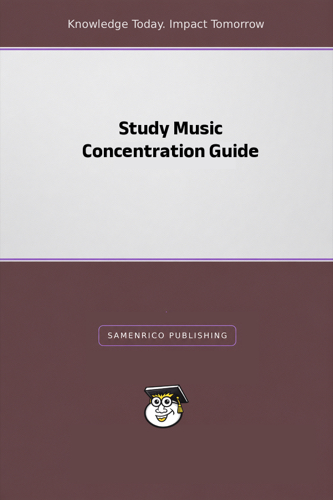
Study Music Concentration Guide Audiobook
Choose ambient, classical, or binaural beats to en
Choose ambient, classical, or binaural beats to enhance focus without distraction.
Formats
Free sample
Chapter 1: The Mozart Lie--–- I once spent an entire semester listening to a “Classical Music for Studying” playlist on repeat. I was convinced it was working. I told my friends about it. I even bought a pair of expensive noise-canceling headphones specifically for the purpose. The problem was not the music.
The problem was that I was failing. Not dramatically—I was not the kind of student who gets a polite letter from the dean. I was failing in the quiet, expensive way that happens when you try very hard at the wrong thing. My grades were mediocre. My reading comprehension was slow.
I would sit down for a three-hour study session, press play on Vivaldi, and emerge three hours later having retained approximately forty-five minutes worth of material. The other two hours and fifteen minutes were spent in a fog of pleasant distraction, my brain happily following the violins while my textbook lay open to the same page.This is the confession that opens this book: I believed the Mozart Effect. Not literally—I did not think my infant nephew would become a quantum physicist if we played him enough sonatas. But I believed the softer, more insidious version of the myth. I believed that classical music was good for studying in some general, unexamined way.
I believed that any classical music was better than silence, which felt empty and pressuring. I believed that the more “intelligent” the music sounded, the more intelligent my studying would become.I was wrong. And the research was there all along, hiding in plain sight, waiting for me to stop feeling sophisticated and start paying attention.The Myth That Refuses to Die Let us start with the origin story, because it tells us something important about how bad ideas become unchallenged assumptions. In 1993, a small study was published in the journal Nature by researchers Frances Rauscher, Gordon Shaw, and Catherine Ky. They tested thirty-six college students on a series of spatial reasoning tasks—the kind of mental rotation problems that appear on IQ tests.
Before the tasks, some students listened to ten minutes of Mozart’s Sonata for Two Pianos in D Major. Some listened to relaxation instructions. Some sat in silence.The results: the students who listened to Mozart scored about eight to nine points higher on the spatial reasoning test than the other two groups. That is it. That is the entire…
This is the end of the free sample. Get the Audiobook to keep going. Buy now
About this book
Details
- Author
- Pauley Gabriela
- Publisher
- SamEnrico
- Language
- English
- Genre
- Non-Fiction, Self-Help, Music
- Released
- 2026-06-09
- Pages (approx.)
- 130
- Available as
- eBook, Audiobook

Listen in the VoxFlicks app
Audiobooks and audio dramas wherever you go. Sign in with your SamEnrico account and press play.
More by Pauley Gabriela
 Family Guide to MDDPauley Gabriela$11.99
 The Finals Week Survival KitPauley Gabriela$11.99
 Resentment Toward LandlordPauley Gabriela$11.99
 Online Casino Addiction GuidePauley Gabriela$11.99
 Step Eight Willingness to AmendPauley Gabriela$11.99
 Actigraphy For Circadian DiagnosisPauley Gabriela$11.99
 Invalidated Child Healing MemoirPauley Gabriela$11.99
 P-38 Lightning Twin-Boom DesignPauley Gabriela$11.99
 Frozen Whispers: The Last Expedition of the *Kronos*Pauley Gabriela$11.99
 The Van Gogh Heist: How a Forger Outsmarted the WorldPauley Gabriela$11.99
 Iron Tide: The Battle of Cape Esperance and the Pacific's Forgotten NightPauley Gabriela$11.99
 How to Start a Polish and Other Sanitation Good Manufacturing BusinessPauley Gabriela$11.99
You may also like
 Hong Kong Handover 1997Dunn Johnnie$11.99
 Zumba For Postnatal Recovery CourseNeal Christian$11.99
 Zumba for BeginnersLadner Nikia$11.99
 YouTube Comment Mining GuideHumes Pandora$12.99
 Worry Box MeditationCarlin Rudy$11.99
 Workplace Stress MeditationNguyen Lynn$11.99
 Workplace Stress and Sleep RepairHawley Ivory$11.99
 Workplace Perfectionism CureDelaney Jeffry$11.99
 Workplace Injustice Anger GuideWallen Isabelle$11.99
 Work Addiction and Burnout LinkGreenwood Ester$11.99
 Women in Yoga and WellnessBeattie Galina$11.99
 Women in Stand Up ComedyChun Evangeline$11.99