
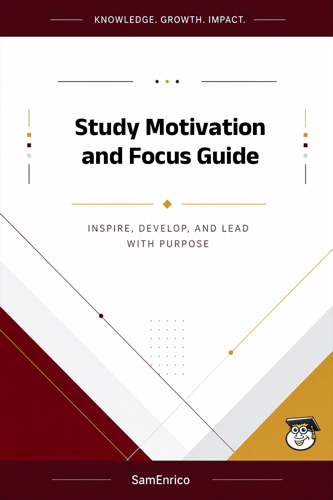
Non-FictionSelf-HelpAcademic Motivation
Study Motivation and Focus Guide eBook
Overcome procrastination and maintain concentratio
Overcome procrastination and maintain concentration during long sessions.
Formats
Free sample
Chapter 1: The Procrastination Equation--–- The screen is blue. The cursor blinks. Your textbook is open to page one, and somehow, forty-five minutes have passed. You have read the same sentence seven times. You have checked your phone twelve times.
You have watched a video about restoring vintage furniture, a topic you do not care about, have never cared about, and will never care about again. And yet, here you are. The exam is in eleven days. You know you should study. You want to study.
But you are not studying. You are doing everything except studying. And the voice in your head is saying the same thing it always says: What is wrong with me?Nothing is wrong with you. That is the first and most important sentence in this book.You are not lazy. You are not broken.
You are not secretly destined to fail. You are the owner of a human brain that evolved under completely different conditions than the ones you are asking it to operate in right now. That brain was designed to hunt, gather, seek safety, and conserve energy for survival. It was not designed to sit still for four hours and memorize the Krebs cycle or the dates of the French Revolution or the elements of the periodic table. Every time you choose Tik Tok over your textbook, you are not failing a moral test.
You are experiencing a predictable biological response to a mismatch between your environment and your evolution. The good news is that a predictable response can be predicted, and a predictable enemy can be defeated.This chapter is called The Procrastination Equation because procrastination is not a mystery. It is not a curse. It is not a character flaw handed down by your ancestors or baked into your DNA forever. It is a formula.
Once you understand the variables in that formula, you can rewrite it. Once you rewrite it, you own it. And once you own it, you never have to sit in front of a blinking cursor for forty-five minutes again, wondering what is wrong with you.The Present Self Versus the Future Self Let us begin with a simple question. Who is going to take the exam?The answer seems obvious. You are.
The same you who is reading this sentence right now. But your brain does not see it that way. Neuroscientists and behavioral economists have spent decades studying a phenomenon called temporal discounting, which is a fancy way of saying that your brain discounts the value of future rewards. A lot. Here is how it works.When you imagine studying for an exam that is eleven days away, your brain processes that future event as if it is happening to someone else.
Not entirely someone else, but not entirely you, either. The emotional weight is lighter. The urgency is muffled. The consequences feel abstract. This version of you—the one who will sit in the exam room, pen in hand, facing questions you cannot answer—is called the Future Self.
And your brain treats the Future Self like a distant cousin you have met twice. You care about them, sort of, but you are not going to cancel your plans for them.Now consider the alternative. You open Tik Tok. A video plays. Fifteen seconds later, another video plays.
Each one delivers a small, unpredictable hit of dopamine—the brain's reward chemical. Your brain loves unpredictability. A reward that might come is more exciting than a reward that definitely will come. This is why slot machines are addictive and salary is not. Your brain says: Maybe the next video will be even better.
This is the Present Self in action. The Present Self wants comfort, novelty, and immediate relief from the mild discomfort of not knowing what to do next.The Present Self is not evil. The Present Self is just doing its job. Its job is to keep you alive and comfortable right now. The problem is that the Present Self has a vote, the Future Self has a vote, and the Present Self always wins.
Always. This is not a failure of your character. This is a feature of your neurobiology. Every human being on earth has a Present Self that overrules the Future Self in moments of conflict. The only difference between people who procrastinate and people who do not is that the second group has learned how to make the Present Self and the Future Self want the same thing.This book is about how to do that.Dopamine: The Puppet Master You Never Hired To understand why the Present Self always wins, you need to understand dopamine.
And because this chapter is the only place in this book where we are going to do a deep dive into the neuroscience, pay close attention here. Every other chapter will simply remind you to "recall the dopamine trap from Chapter One." So let us make this count.Dopamine is not the pleasure chemical. That is a common misunderstanding. Dopamine is the anticipation chemical. It is released when you expect a reward, not just when you receive one.
This is a crucial distinction. When you see a notification icon on your phone, your brain releases a small pulse of dopamine. When you open the app and see that someone has liked your post, you get another pulse. But here is the trap: unpredictable rewards produce more dopamine than predictable ones. If you knew exactly when a reward was coming, your brain would adapt and the dopamine would fade.
But because you never know which scroll will deliver the funny video, the interesting comment, the message from a friend, your brain keeps releasing dopamine every time you check.Studying does not work this way. Studying offers delayed, predictable rewards. You study for hours. You take the exam. You wait days or weeks.
Then you receive a grade. That is a long loop. Your brain did not evolve to sustain effort across a loop that long. Your brain evolved to respond to immediate feedback—the rustle in the grass that might be a predator, the berry that might be ripe, the social signal that might mean acceptance or rejection. Studying is an unnatural act for the human brain.
That does not mean you cannot do it. It means you need to build scaffolding around it.Let us put some numbers on this. A typical student checks their phone an average of 96 times per day. That is once every ten waking minutes. Each check triggers a small dopamine pulse.
Over the course of a day, that is 96 small rewards. Compare that to studying, which might produce one reward (a completed assignment, a moment of understanding, a good grade) every few hours or days. Your brain is not making a fair comparison. It is choosing the 96 small rewards because they are there, they are frequent, and they are unpredictable. The studying reward is distant, certain, and delayed.
The brain always chooses the former. Always.But here is the secret: you cannot remove the dopamine response. It is biological. You can, however, change the environment so that the dopamine response works for you instead of against you. The…
This is the end of the free sample. Get the eBook to keep going. Buy now
About this book
Details
- Author
- Perreault Joe
- Publisher
- SamEnrico
- Language
- English
- Genre
- Non-Fiction, Self-Help, Academic Motivation
- Released
- 2026-06-09
- Pages (approx.)
- 125
- Available as
- eBook, Audiobook

Read better in the ZLOADR app
Your eBooks on your phone or tablet. Sign in with your SamEnrico account and start reading.
More by Perreault Joe
 Meeting Reduction for Deep WorkPerreault Joe$11.99
 Remote Retreats for Engineering TeamsPerreault Joe$11.99
 Probate and Heirs Property BriefPerreault Joe$11.99
 French Resistance Maquis GuidePerreault Joe$11.99
 The Ballot That Broke the InternetPerreault Joe$11.99
 The Ancestral Code: Unlocking Australia’s Deep Genetic PastPerreault Joe$11.99
 Plan Chest CraftPerreault Joe$11.99
 JEE Calculus Mastery GuidePerreault Joe$12.99
 Budget Approval Workflow GuidePerreault Joe$12.99
 How to Become a Mobile-lounge DriverPerreault Joe$11.99
 Understanding Choroid Plexus NeoplasmsPerreault Joe$17.99
You may also like
 Hong Kong Handover 1997Dunn Johnnie$11.99
 Zumba For Postnatal Recovery CourseNeal Christian$11.99
 Zumba for BeginnersLadner Nikia$11.99
 YouTube Comment Mining GuideHumes Pandora$12.99
 Worry Box MeditationCarlin Rudy$11.99
 Workplace Stress MeditationNguyen Lynn$11.99
 Workplace Stress and Sleep RepairHawley Ivory$11.99
 Workplace Perfectionism CureDelaney Jeffry$11.99
 Workplace Injustice Anger GuideWallen Isabelle$11.99
 Work Addiction and Burnout LinkGreenwood Ester$11.99
 Women in Yoga and WellnessBeattie Galina$11.99
 Women in Stand Up ComedyChun Evangeline$11.99