
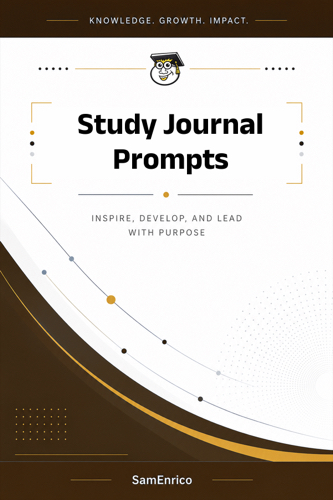
Free sample
Chapter 1: The Case File Shift...--You have been lied to about journaling. Not by anyone malicious. By an entire culture that treats diaries like security cameras. The assumption is simple: you write down what happened. The more accurate the recording, the better the journal.
But here is the problem with security cameras. They capture everything, which means they capture nothing. A hundred hours of empty hallway. A thousand pages of "woke up, ate breakfast, checked email, felt fine." No wonder you have abandoned every journal you have ever started. No wonder the blank pages feel like accusations.
No wonder you thought you were bad at this.You are not bad at this. You were just given the wrong job description.This chapter is going to fire you from that job and hire you for a new one. The old job: clerk. Transcriber. Human tape recorder.
The new job: detective. Investigator. Meaning-maker. The shift is small in words but enormous in practice. A detective does not record everything.
A detective looks for what is out of place. What is ignored. What has a secret history. A detective knows that the most important evidence is not the loud event but the quiet detail that everyone else walked past.Your journal is about to become a case file. Let me show you what that means.The Security Camera Trap Open any popular journaling advice column or bestselling prompt book.
What do you find? The same instruction dressed in different fonts. "Write three things you are grateful for." "Record your daily highlights." "Document your feelings." These are not wrong. They are just shallow. They assume that the truth is on the surface, waiting to be copied down like dictation.
But the truth is never on the surface. The truth is in the crack in the sidewalk that you step over every morning without seeing. The truth is in the coffee stain on a stranger's sleeve that you register and forget in the same half-second. The truth is in the silence between two sentences of a conversation you thought you remembered perfectly.Transactional writing asks: what happened? When did it happen?
Who was there? These are the questions of a police report, not an investigation. A police report closes the case. An investigation opens it.Transformational writing asks different questions. Why did that detail catch my attention?
What if this ordinary moment has a hidden story? What else could this mean? These questions require distance from the…
This is the end of the free sample. Get the Audiobook to keep going. Buy now
About this book
Details
- Author
- Emery Yong
- Publisher
- SamEnrico
- Language
- English
- Genre
- Non-Fiction, Self-Help
- Released
- 2026-06-11
- Pages (approx.)
- 129
- Available as
- eBook, Audiobook

Listen in the VoxFlicks app
Audiobooks and audio dramas wherever you go. Sign in with your SamEnrico account and press play.
More by Emery Yong
 Parent Loss and Milestone EventsEmery Yong$11.99
 Cafe Remote Work Distraction GuideEmery Yong$11.99
 Bipolar Antidepressant RisksEmery Yong$11.99
 Spin Motivation SecretsEmery Yong$11.99
 Bipolar And Migraine LinkEmery Yong$11.99
 Quizlet Reminder GuideEmery Yong$11.99
 Customer Service EQ HandbookEmery Yong$11.99
 Letters Across the BorderEmery Yong$11.99
 The Lost Colony That Time Forgot: Roanoke's Vanishing ActEmery Yong$11.99
 The Silk Road Illuminator: Al-Idrisi and the Lost Maps of ParadiseEmery Yong$11.99
 The Battle of Diu: Portugal's Naval Dominion in the Indian Ocean (1509)Emery Yong$11.99
 Volume Discounts From China For Both MarketsEmery Yong$12.99
You may also like
 Hong Kong Handover 1997Dunn Johnnie$11.99
 Zumba For Postnatal Recovery CourseNeal Christian$11.99
 Zumba for BeginnersLadner Nikia$11.99
 YouTube Comment Mining GuideHumes Pandora$12.99
 Worry Box MeditationCarlin Rudy$11.99
 Workplace Stress MeditationNguyen Lynn$11.99
 Workplace Stress and Sleep RepairHawley Ivory$11.99
 Workplace Perfectionism CureDelaney Jeffry$11.99
 Workplace Injustice Anger GuideWallen Isabelle$11.99
 Work Addiction and Burnout LinkGreenwood Ester$11.99
 Women in Yoga and WellnessBeattie Galina$11.99
 Women in Stand Up ComedyChun Evangeline$11.99