
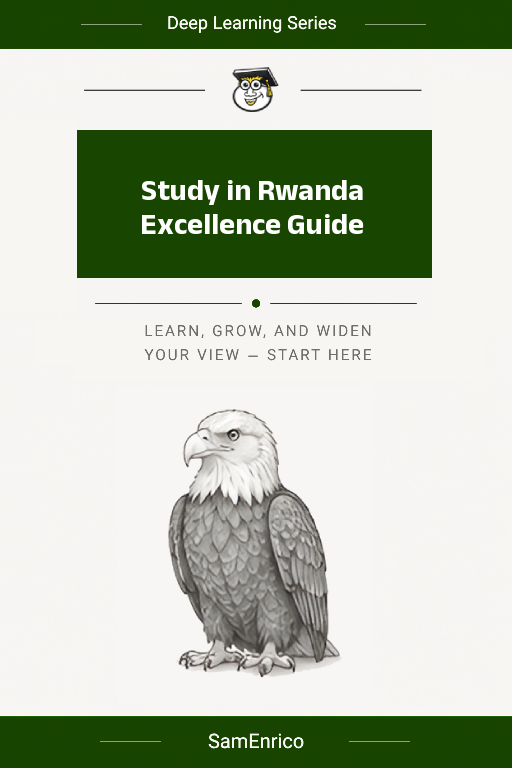
Non-FictionStudent's ShortcutPan-African Education
Study in Rwanda Excellence Guide eBook
Explores Rwanda's African Centers of Excellence in
by Queen Stacee
Explores Rwanda's African Centers of Excellence in STEM, climate science, and public health, offering world-class education at affordable costs.
Formats
Free sample
Chapter 1: The Brain Drain Reversal--–- For most of the twentieth and early twenty-first centuries, a young African scientist or public health professional faced a brutal arithmetic. The equation was simple: stay home and struggle with underfunded labs, overcrowded lecture halls, and research equipment held together by electrical tape, or leave for Europe, North America, or the Gulf and gain access to world-class facilities, international networks, and salaries that could support an entire extended family. The choice, for those who could secure visas and scholarships, was almost automatic. They left. And most never came back.This phenomenon, given the clinical name "brain drain" by economists in the 1960s, has been described as a quiet catastrophe.
Between 1990 and 2015, the number of highly educated African professionals living in OECD countries more than doubled, from 1.2 million to over 3.3 million. By 2020, sub-Saharan Africa had the highest rate of tertiary-educated emigration of any region in the world. An estimated one in nine university graduates born in Africa worked in a wealthy country, and for certain critical fields—medicine, engineering, computer science—the ratio was even steeper. Nigeria alone lost an estimated $2 billion annually in human capital investment each year as its doctors, nurses, and engineers boarded planes for London, Houston, or Riyadh.But beneath this familiar narrative of loss, a quieter, more radical transformation has been unfolding. Beginning in the mid-2010s, a small group of African governments, multilateral development banks, and university consortia began asking a provocative question: What if the infrastructure for world-class graduate education could be built inside Africa, at a fraction of the cost of sending students abroad?
What if a student could earn a Master's degree in climate science, vaccine logistics, or sustainable cooling for one-tenth the price of a European program, while working on problems that directly affected their neighbors? What if the brain drain could be reversed—not through moral appeals or visa restrictions, but by creating institutions so compelling that talented students would actively choose to stay?This book is the answer to that question. And the story begins in a small, mountainous nation in East Africa that most of the world still associates with one of the worst tragedies of the late twentieth century. That nation is Rwanda. And the institution that catalyzed its transformation into a higher education hub is called the Africa Centers of Excellence, or ACE.The Architecture of a Revolution The Africa Centers of Excellence project was never intended to be a small experiment.
Launched by the World Bank in 2014 as a $150 million initiative, ACE was designed to address a specific structural problem: Sub-Saharan Africa had a rapidly growing youth population, a desperate need for specialized technical skills, and a graduate education system that was simultaneously underfunded and misaligned with labor market demands. Traditional universities produced large numbers of graduates in the humanities and social sciences—fields that are valuable but do not directly build a cold chain, design a vaccine trial, or model climate resilience. Meanwhile, the few Master's and Ph D programs in STEM fields often suffered from aging curricula, minimal research budgets, and little connection to private sector employers.The ACE model was elegantly simple. Instead of spreading thin funding across hundreds of departments, the World Bank would invite universities to compete for specialized centers of excellence, each focused on a narrowly defined field with clear economic relevance. Winning centers would receive funding for infrastructure, equipment, faculty development, and student scholarships.
But there was a catch. Each center had to be regionally focused, meaning it would train students not just from its home country but from neighboring nations. And each center had to demonstrate concrete partnerships with industry, government, and international research networks.Phase I of ACE launched in 2014 with 19 centers spread across West and Central Africa, hosted by universities in Nigeria, Ghana, Senegal, Benin, Cameroon, and Burkina Faso. The results were promising. Centers focused on oil and gas engineering, infectious disease genomics, and agricultural biotechnology began producing graduates who were immediately employable.
But Phase I also revealed a limitation: the centers were distributed across many countries, which made regional coordination difficult and sometimes duplicated efforts.This is where Phase II, launched in 2016 with an additional $80 million in funding, took a different approach. Rather than spreading centers across many nations, Phase II—known as ACE Impact—concentrated a cluster of highly specialized centers in three or four regional hubs, each designed to serve a distinct economic corridor. East Africa's hub would be Rwanda.Why Rwanda Became the Unexpected Laboratory When the World Bank and its partner governments sat down to select the host for East Africa's cluster of centers of excellence, Rwanda was not the obvious candidate. Uganda had Makerere University, one of the continent's oldest and most prestigious institutions. Kenya had the University of Nairobi and a robust private sector.
Tanzania had the University of Dar es Salaam and significant natural resources. Rwanda, by contrast, had been nearly destroyed by genocide just two decades earlier. Its university system had been decimated. Its research output was minimal. Its economy was small and landlocked.But Rwanda had something that its larger neighbors lacked: a government that treated higher education as a national security priority.
In the aftermath of the 1994 genocide against the Tutsi, Rwanda's new leadership made a calculated bet that human capital—not minerals, not agriculture, not tourism alone—would be the country's primary economic engine. The vision, articulated in successive national development plans and crystallized in the long-term strategy called Vision 2050, was to transform Rwanda from a low-income, aid-dependent agrarian economy into a middle-income, knowledge-based service economy.This was not empty rhetoric. The Rwandan government backed its ambitions with policy changes that, in retrospect, look almost unnervingly deliberate. English was introduced as the medium of instruction in all schools and universities, replacing French and aligning Rwanda with the East African Community's lingua franca. Visa processes for students, researchers, and business travelers were streamlined to the point where Rwanda became one of the easiest countries in Africa to enter.
The national fiber-optic backbone was laid across the entire country, connecting even remote districts to high-speed internet. A national identification system and digital payment infrastructure were built from scratch, leapfrogging the fragmented systems of wealthier nations.By the time the ACE Impact project was scouting locations, Rwanda had become a functional, safe, English-speaking, digitally connected country with a government that could make decisions quickly and implement them reliably. When the World Bank asked, "Can you guarantee that scholarship funds will be disbursed on time? Can you ensure that international faculty can obtain work permits within weeks? Can you provide laboratory space that meets international biosafety standards?" the Rwandan answer was not a hopeful "we'll try" but a confident "yes, and here is the documentation."The contrast with some of the region's older, more prestigious universities was stark.
In several neighboring countries, faculty strikes over unpaid salaries were routine. Laboratory equipment purchased with donor funds sat unopened in shipping containers for years due to customs disputes. Administrative processes that should have taken days stretched into months. Rwanda was not yet producing the highest-quality research, but it had solved the enabling environment problem that had crippled so many other African universities. And…
This is the end of the free sample. Get the eBook to keep going. Buy now
About this book
Details
- Author
- Queen Stacee
- Publisher
- SamEnrico
- Language
- English
- Genre
- Non-Fiction, Student's Shortcut, Pan-African Education
- Released
- 2026-06-01
- Pages (approx.)
- 132
- Available as
- eBook, Audiobook

Read better in the ZLOADR app
Your eBooks on your phone or tablet. Sign in with your SamEnrico account and start reading.
More by Queen Stacee
 Mindful Walking For CreativityQueen Stacee$11.99
 International Franchise Currency HedgingQueen Stacee$11.99
 Sleepon Ring GuideQueen Stacee$11.99
 ABCDE Goal Setting IntegrationQueen Stacee$11.99
 The Black Dahlia Medical Examiner ReportsQueen Stacee$11.99
 Quetzalcoatl’s Feathered Serpent: The Fifth Sun’s AwakeningQueen Stacee$11.99
 Understanding Rheumatoid VasculitisQueen Stacee$17.99
 Marketing and Sales CoordinatorQueen Stacee$11.99
 OSS EU VAT System GuideQueen Stacee$12.99
 How to Become a DumperQueen Stacee$11.99
You may also like
 Hong Kong Handover 1997Dunn Johnnie$11.99
 Zumba For Postnatal Recovery CourseNeal Christian$11.99
 Zumba for BeginnersLadner Nikia$11.99
 YouTube Comment Mining GuideHumes Pandora$12.99
 Worry Box MeditationCarlin Rudy$11.99
 Workplace Stress MeditationNguyen Lynn$11.99
 Workplace Stress and Sleep RepairHawley Ivory$11.99
 Workplace Perfectionism CureDelaney Jeffry$11.99
 Workplace Injustice Anger GuideWallen Isabelle$11.99
 Work Addiction and Burnout LinkGreenwood Ester$11.99
 Women in Yoga and WellnessBeattie Galina$11.99
 Women in Stand Up ComedyChun Evangeline$11.99