
Non-FictionSelf-HelpCollaboration
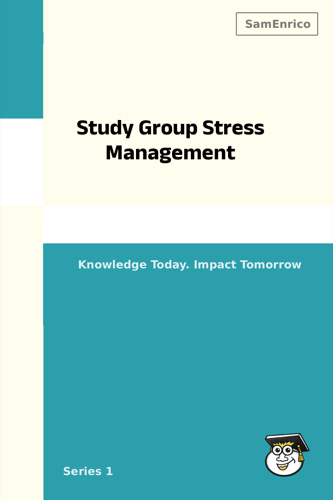
Study Group Stress Management eBook
Collaborate effectively without social anxiety or
by Dietz Marg
Collaborate effectively without social anxiety or free-rider frustration.
Formats
Free sample
Chapter 1: The Setup Generation--You have been set up to fail at group work. Not by your professors, not by your classmates, and not by some flaw in your personality. You have been set up by every silent desk, every solitary homework assignment, every whispered warning that asking for help is a sign of weakness, and every standardized test you ever took alone in a room where talking was forbidden.Think back. From the moment you entered formal education, you were trained to be a solo scholar. Reading?
Silent and alone. Essays? Your own words, your own ideas, your own citations. Exams? Pencils down, eyes on your own paper, no collaboration.
The message was drilled into you year after year: Your success is your responsibility. Your failure is your fault. Other people are either distractions or competitors.And then, sometime around your second year of university or your first semester of graduate school, a professor said something that should have been impossible: "For this project, you'll be working in groups."Just like that, the rules changed. Everything you were taught—every habit, every coping strategy, every definition of success—became worthless. You were thrown into a study group with three to five strangers and told to "collaborate." But no one taught you how.
No one gave you a script for disagreement. No one explained how to divide labor fairly. No one told you what to do when someone didn't pull their weight or when your own anxiety made you want to disappear.And now you're stressed. Not because you're broken. Because you were trained for a different game.The Great Contradiction Let me name something you have probably felt but never articulated: The modern student lives in a contradiction between solo training and collaborative demand.Your entire academic life has been a series of solo performances.
Even when you sat in a lecture hall with two hundred other people, the message was clear: You are here to absorb information individually. You will be tested individually. Your grade is yours alone. The physical architecture of education reinforces this—rows of desks facing forward, not each other. Libraries with silence policies.
Online learning platforms that track individual progress down to the second.Then comes the group project. Suddenly, everything flips. You are told to "share ideas," "build consensus," and "leverage collective intelligence." But you have zero training in any of these skills. You have never taken Communication 101 or Small Group Dynamics or How To Not Hate The Person Who Hasn't Responded To Your Last Three Messages.This contradiction creates a specific kind of stress that is different from exam anxiety or paper deadlines. Collaborative stress lives in the space between what you were taught and what is now required.
It is the feeling of being asked to speak a language you have never learned, in front of people whose opinions matter, with a grade hanging in the balance.And here is the cruelest part: because everyone else in your group was trained exactly the same way, you are all walking into the same trap. Each of you is secretly terrified. Each of you is faking confidence. Each of you is waiting for someone else to take the lead so you can hide.The Cost of Being a Lone Wolf When students are asked to describe their worst group experience, a specific archetype emerges again and again. I call it the Lone Wolf.The Lone Wolf is not lazy.
The Lone Wolf is not antisocial. The Lone Wolf is someone who has learned—through years of reinforcement—that the only reliable path to a good grade is to do everything themselves. They have been burned before. They have watched teammates submit work late, or not at all. They have begged for contributions and received silence.
They have stayed up until 3 AM rewriting entire sections that someone else promised to write but didn't.And so they make a decision: I'll just do it myself.On the surface, this seems rational. The Lone Wolf gets a good grade. The Lone Wolf controls the outcome. The Lone Wolf avoids the frustration of waiting for others.But here is what the Lone Wolf does not see: the cost.First, there is the exhaustion cost. Doing the work of three or four people is not sustainable.
It leads to burnout, resentment, and a growing conviction that every future group will be just as useless. The Lone Wolf becomes a self-fulfilling prophecy—they assume no one will help, so they don't ask, so no one helps, so they are proven right.Second, there is the learning cost. Collaboration is not just about dividing labor. It is about testing your ideas against others, discovering blind spots in your reasoning, and learning how to explain concepts in multiple ways. When the Lone Wolf works alone, they lose all of that.
They get the grade but miss the education.Third, there is the social cost. The Lone Wolf becomes known as the person who doesn't trust anyone. Groupmates feel dismissed. Future collaborators hesitate to join forces. The Lone Wolf's reputation precedes them—competent, yes, but also exhausting to be around.If you recognize yourself in this description, I want you to hear something: You are not wrong to be frustrated.
But your strategy is not working. The Lone Wolf path leads to burnout, not success.The Other Extreme: The Over-Sharer At the opposite end of the spectrum is the Over-Sharer. This is the student who craves collaboration so deeply that they cannot function alone. They need constant validation. They send fourteen messages in the group chat before breakfast.
They want to video call for every small decision. They interpret silence as rejection.The Over-Sharer has also been set up by the educational system, but in a different way. They were starved of connection for so long—silent desks, solo assignments, competitive grading—that they now overcorrect. Collaboration becomes an emotional need, not a strategic tool.The Over-Sharer frustrates their groupmates not because they are lazy but because they are too present. Every question becomes a conversation.
Every task becomes a committee. Boundaries blur. The group feels less like a team and more like a therapy session.If you recognize yourself here, I want you to hear something equally important: Your desire for connection is not a flaw. But your inability to work independently is holding you back. The goal is not to become a Lone Wolf.
The goal is to find the middle ground.Introducing Cooperative Independence There is a third way. I call it Cooperative Independence.Cooperative Independence is the paradoxical skill of maintaining your intellectual autonomy while actively relying on others. It means knowing what you can do alone, knowing what you need from a group, and knowing how to move between those modes without anxiety or resentment.Here is what Cooperative Independence looks like in practice:You can study alone productively, without feeling lonely or abandoned.You can join a study group without losing your own voice or hiding from others.You can ask for help without feeling like a burden.You can say "I don't know" without shame.You can hold others accountable without becoming the group's police officer.You can disagree without destroying relationships.You can walk away…
This is the end of the free sample. Get the eBook to keep going. Buy now
About this book
Details
- Author
- Dietz Marg
- Publisher
- SamEnrico
- Language
- English
- Genre
- Non-Fiction, Self-Help, Collaboration
- Released
- 2026-06-07
- Pages (approx.)
- 132
- Available as
- eBook, Audiobook

Read better in the ZLOADR app
Your eBooks on your phone or tablet. Sign in with your SamEnrico account and start reading.
More by Dietz Marg
 Chunking for Exam SuccessDietz Marg$11.99
 Cortisol and Immune SuppressionDietz Marg$11.99
 Food Addiction Recovery Journal CourseDietz Marg$11.99
 Bones and Badges: The Hound of TroyDietz Marg$11.99
 The Celestial Cartographers: Ancient Babylon and the Birth of AstronomyDietz Marg$11.99
 Understanding ElephantiasisDietz Marg$17.99
 How to Become a Radiation-protection EngineerDietz Marg$11.99
 Russian Logistics DirectoryDietz Marg$12.99
 Bookkeeping Tax DeductionsDietz Marg$12.99
 Facilities Management TechnicianDietz Marg$11.99
You may also like
 Hong Kong Handover 1997Dunn Johnnie$11.99
 Zumba For Postnatal Recovery CourseNeal Christian$11.99
 Zumba for BeginnersLadner Nikia$11.99
 YouTube Comment Mining GuideHumes Pandora$12.99
 Worry Box MeditationCarlin Rudy$11.99
 Workplace Stress MeditationNguyen Lynn$11.99
 Workplace Stress and Sleep RepairHawley Ivory$11.99
 Workplace Perfectionism CureDelaney Jeffry$11.99
 Workplace Injustice Anger GuideWallen Isabelle$11.99
 Work Addiction and Burnout LinkGreenwood Ester$11.99
 Women in Yoga and WellnessBeattie Galina$11.99
 Women in Stand Up ComedyChun Evangeline$11.99