
Study Environment Optimization Guide eBook
Shows how lighting, noise, temperature, and ergono
Shows how lighting, noise, temperature, and ergonomics affect concentration.
Formats
Free sample
Chapter 1: The Attention Thieves--You have likely blamed yourself for a lack of focus at some point in the past week. Perhaps you sat down to study or work, only to find your mind wandering after fifteen minutes. You scolded yourself for weak willpower. You resolved to try harder next time. You promised to be more disciplined.Here is the truth that the productivity industry does not want you to admit: willpower is almost never the problem.
Your environment is.The room where you study is not a neutral container. It is an active participant in every cognitive process you perform. Every object, every sound, every degree of temperature, every wavelength of light entering your eyes is either supporting your concentration or silently undermining it. And most of these influences operate entirely beneath your conscious awareness.This chapter reveals the invisible architecture of concentration. You will learn why your environment matters more than your motivation.
You will discover the difference between obvious distractions and hidden drains on your energy. You will complete a self-assessment that identifies exactly what is stealing your attention right now. And you will walk away with a clear framework—the LSTE model—that will guide every optimization you make throughout the rest of this book.The Myth of the Weak-Willed Student Let us begin by dismantling a harmful belief. The idea that focus is primarily a matter of character or willpower is not only wrong—it is actively destructive. When you blame yourself for environmental failures, you direct your energy toward shaming yourself instead of fixing the actual problem.Consider a landmark study from Carnegie Mellon University.
Researchers placed two groups of students in different environments and asked them to complete identical cognitive tasks. The first group worked in a quiet, well-lit, comfortably cool room with ergonomic seating. The second group worked in a room with moderate ambient noise, slightly dim lighting, a temperature of 78 degrees Fahrenheit, and chairs that slouched slightly forward. The first group outperformed the second by a margin of 48 percent. Neither group knew they were in different conditions.
Both groups believed they were simply taking a test of their abilities. The students in the poor environment blamed themselves for their lower scores. They had no idea that the room was working against them.This finding has been replicated across dozens of studies. Temperature affects cognitive throughput. Lighting affects alertness.
Noise affects recall. Posture affects blood flow to the brain. These are not minor factors. They are not optional extras for perfectionists. They are the difference between effective studying and frustrated exhaustion.Your brain is a biological organ.
It requires specific conditions to function optimally. Deprive it of those conditions, and no amount of grit or determination will compensate. You cannot out-willpower a room that is fighting you.Environmental Distraction versus Environmental Drag To understand how your environment affects you, you must learn a crucial distinction. Some environmental problems announce themselves loudly. Others work in silence.Environmental distractions are obvious disruptors.
A roommate shouting on the phone. A flickering fluorescent light. A chair that hurts your back immediately. You notice these problems instantly. Your brain flags them as threats or annoyances.
They demand your attention, and you consciously decide to ignore them or address them. These are real problems, but they are not the most dangerous ones.Environmental drag is the silent killer of concentration. These are subtle conditions that you do not consciously notice but that cumulatively drain your cognitive reserves. Slightly low humidity that dries your eyes and nasal passages. Dim lighting that forces your visual system to work harder than it should.
A room temperature that is just two degrees warmer than optimal. Background noise that does not quite reach the threshold of awareness but still occupies processing resources. Poor ergonomics that cause micro-tensions across your body, each one too small to notice but adding up to significant fatigue over hours of study.Environmental drag is insidious because you never attribute your exhaustion to it. You finish a study session feeling tired and unfocused, and you assume you simply lack stamina or interest. You do not realize that your room stole your energy in tiny, undetectable increments.The most successful students and professionals are not the ones with superhuman willpower.
They are the ones who have eliminated environmental drag from their workspaces. They have created conditions that do not require willpower to overcome. Their environments work for them, not against them.The LSTE Framework: Your Roadmap to Focus This book organizes environmental optimization around four pillars. Together, they form the LSTE framework—Lighting, Sound, Thermal conditions, and Ergonomics. Each pillar will receive its own detailed treatment in later chapters.
Here, we introduce each one and explain how they interact.Lighting Lighting affects your brain more directly than almost any other environmental variable. Light enters your eyes and travels along the retinohypothalamic tract to your suprachiasmatic nucleus—the master clock of your circadian rhythm. Different wavelengths of light trigger different neurochemical responses. Blue-enriched light suppresses melatonin and increases alertness. Warm light signals the approach of evening and prepares your brain for memory consolidation during sleep.Poor lighting forces your visual system into compensatory overdrive.
Dim light causes your pupils to dilate, reducing depth of field and forcing your eyes to work harder to maintain focus. Flickering lights—even at frequencies too high for conscious perception—trigger micro-saccades that exhaust the ocular muscles. Single-source lighting creates harsh shadows and uneven illumination, forcing your brain to constantly readjust as your gaze moves across your workspace.Chapter 2 provides the complete guide to artificial lighting, including color temperature, layering strategies, and bulb selection. Chapter 3 addresses natural light, window placement, and glare management.Sound Sound is the most emotionally charged environmental variable. Different people have dramatically different responses to the same acoustic environment.
Some cannot focus without complete silence. Others thrive in busy coffee shops. Most fall somewhere in between.The science of acoustic cognition reveals a clear hierarchy of sound types. Intermittent human speech is the most destructive—your brain is evolutionarily hardwired to attend to voices, especially unexpected ones. Continuous speech is less disruptive than intermittent speech.
Non-vocal ambient noise is less disruptive than speech. And certain types of noise—white, pink, and brown—can actually enhance focus by masking more distracting sounds.Chapter 4 provides a complete treatment of sound optimization, including the 70 decibel threshold, the pros and cons of different noise colors, and a self-test to identify your optimal noise zone. You will also learn the three-layer acoustic defense system: absorption, blocking, and masking.Thermal Conditions Temperature and humidity affect cognitive performance through multiple physiological pathways. The inverted-U curve of thermal comfort shows that performance peaks in a narrow range and declines on either side. Too cold, and your body diverts energy toward shivering and muscle tension.
Too hot, and your cardiovascular system works harder to cool you, leading to lethargy and mental slowing.Humidity is the hidden variable in thermal comfort. Dry air dehydrates your mucous membranes, increases respiratory effort, and irritates sensory nerves. Damp air promotes fatigue and reduces the efficiency of evaporative cooling. The optimal range of 40 to 60 percent relative humidity maximizes oxygen uptake and neural firing rates.Chapter 5 covers…
This is the end of the free sample. Get the eBook to keep going. Buy now
About this book
Details
- Author
- Solis Allegra
- Publisher
- SamEnrico
- Language
- English
- Genre
- Non-Fiction, Self-Help, Environmental Psychology
- Released
- 2026-06-07
- Pages (approx.)
- 148
- Available as
- eBook, Audiobook

Read better in the ZLOADR app
Your eBooks on your phone or tablet. Sign in with your SamEnrico account and start reading.
More by Solis Allegra
 Pet Loss Grief GuideSolis Allegra$11.99
 Mindful Walking for PregnancySolis Allegra$11.99
 Pre Sleep Memory CueSolis Allegra$11.99
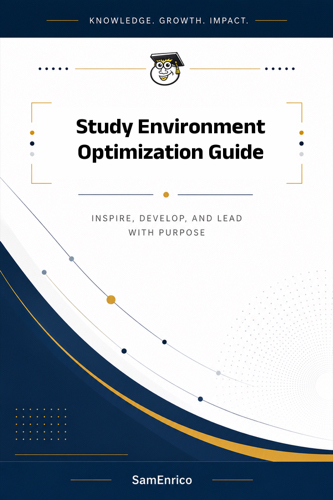 Study Environment Optimization GuideSolis Allegra$11.99
 Compulsive Spending Recovery CoachSolis Allegra$11.99
 The Pomodoro Study MethodSolis Allegra$11.99
 Difficult Customer TalksSolis Allegra$11.99
 SMART Goals for VolunteeringSolis Allegra$11.99
 The Silk Road Kingpin: The Untold Story of Paul Le RouxSolis Allegra$11.99
 The Iron Will of the Arctic: Nansen’s Impossible JourneySolis Allegra$11.99
 Service Providers Guide to Special EventsSolis Allegra$11.99
 How to Produce a KitSolis Allegra$11.99
You may also like
 The Deep Work Fortress ManualLockwood Lynwood$11.99
 Environmental Design for GoalsNaylor Daisey$11.99
 Proxemics Personal Space HandbookPaulson Kenda$11.99
 Workplace Environmental DesignToney Willow$11.99
 The Environment Design WorkbookThomsen Leatha$11.99
 Alcohol Recovery Feng Shui GuideVargas Ricky$11.99
 Room Color PersuasionSpring Billi$11.99
 Cocaine Relapse Home Environment GuideZook Gonzalo$11.99
 Deep Focus Environment Design CourseLuciano Kimber$11.99
 Smoking Trigger Avoidance MapChampagne Edwardo$11.99Study Environment Optimization GuideSolis Allegra$11.99
 Smoke Free Home Environment GuideSommer Shanell$11.99