
Non-FictionSelf-HelpStudy AbroadCultural Adjustment
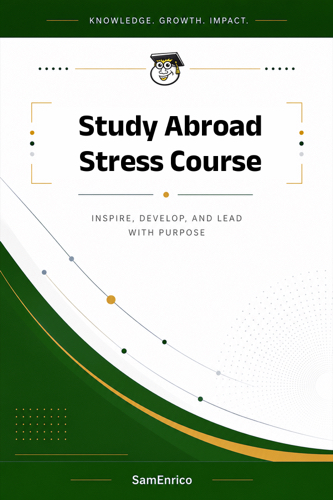
Study Abroad Stress Course eBook
Navigate academic differences, language barriers,
by Geary Lorine
Navigate academic differences, language barriers, and culture shock while overseas.
Formats
Free sample
Chapter 1: The Comparison Trap--–- Three weeks into my semester in Tokyo, I cried in a 7-Eleven because I couldn't find soy sauce.Not because the store didn't have it. Not because I was hungry. Not because I was homesick in the way I had expected to be homesick. I cried because I had spent ten minutes walking up and down the condiment aisle, scanning row after row of bottles, and I could not remember the Japanese word for "soy sauce." I had studied for six months before arriving. I had passed my language placement exam.
And standing there, under fluorescent lights, with a basket of instant ramen and onigiri in my hand, my mind was completely blank.The cashier smiled at me—a patient, gentle smile that made everything worse—and I panicked. I mumbled something that was neither English nor Japanese, grabbed the first bottle my hand touched, paid, and ran outside. I sat on the curb, my konbini dinner sweating in its plastic bag, and I sobbed.I was a "successful" study abroad student. My grades were good. My photos were beautiful.
My parents bragged about me back home. I had posted a picture of myself at the Shibuya crossing just three hours earlier, captioned "Living the dream 🌸." And there I was, on a sidewalk in Tokyo, crying over condiments.That night, I scrolled through Instagram and saw my classmates posting photos of izakaya dinners, study groups in coffee shops, weekend trips to Kyoto. Everyone looked like they were thriving. Everyone looked like they had figured out something I had not. I felt like a fraud.
I felt like I was the only one struggling.I was wrong.The Most Dangerous Lie You Will Hear Abroad There is a myth that circulates among study abroad students, whispered in orientation sessions and broadcast on social media. It is never stated directly, but it is everywhere. The myth says: Everyone else is thriving. If you are struggling, something is wrong with you.This chapter is designed to destroy that myth.The first thing you need to understand is that your internal experience and your external presentation are almost never the same. The student who posted that beautiful photo of a sunset over the Seine?
She spent the previous two hours arguing with her landlord in broken French about a leaky faucet. The student who looks so engaged in that seminar discussion photo? He understood about forty percent of what was said and spent the rest of the time praying the professor wouldn't call on him. The student whose Instagram grid looks like a magazine spread? She has not slept more than five hours in a week and has cried in three different public bathrooms since Tuesday.You are not seeing their reality.
You are seeing their highlight reel.This is not a moral failing on their part. Humans are wired to present ourselves well. We post the wins, not the losses. We share the sunset, not the argument with our parents about money. We curate.
But when you compare your behind-the-scenes chaos to everyone else's carefully edited final cut, you will always come up short.Social Comparison Theory: Why We Can't Stop Comparing The psychologist Leon Festinger first proposed social comparison theory in 1954. His insight was simple but profound: humans have an innate drive to evaluate themselves, and in the absence of objective measures, we compare ourselves to others. We look sideways to see how we are doing.Under normal circumstances, this is a neutral tool. You compare your performance on a test to a classmate's to gauge where you stand. You compare your running speed to a friend's to see if you are improving.
But study abroad is not a normal circumstance. Study abroad strips away most of your familiar reference points. You cannot compare your current self to your past self easily, because everything has changed. So your brain does the only thing it knows how to do: it compares you to the people immediately around you.The problem is that the people immediately around you are also struggling. They are just hiding it better.This is the 3:1 Ratio—a concept we will return to throughout this book.
For every three stress-free, beautiful, "everything is fine" posts you see on social media, there is approximately one hidden breakdown that went unposted. That ratio is not scientific; it is a heuristic, a rule of thumb to remind you that the ratio of visible success to invisible struggle is never one to one. You are not behind. You are just seeing a biased sample.The Biology of Disorientation: Why You Are Not Weak Let us be very clear about something: the anxiety, confusion, and exhaustion you are feeling are not character flaws. They are not signs of weakness.
They are not evidence that you made a mistake by coming here.They are biological responses to the removal of familiar cues.Your brain is a prediction machine. It constantly scans your environment, identifies patterns, and makes predictions about what will happen next. When you are in a familiar environment—your home, your university, your city—your brain runs on autopilot. You do not have to think about how to order coffee, how to greet a professor, how to navigate public transit. Your brain has built mental models for all of these things.When you move to a new country, those mental models break.
Suddenly, you cannot predict anything. The coffee shop works differently. The classroom norms are different. The way people queue, the way they say hello, the way they indicate agreement or disagreement—all of it is different. Your brain has to process every single interaction as if it were happening for the first time.This is exhausting.
And it triggers your body's stress response.Your sympathetic nervous system—the "fight or flight" system—activates when your brain detects unpredictability or threat. Your cortisol levels rise. Your heart rate increases. Your muscles tense. This is not a psychological problem; it is a physiological reality.
You are not weak. You are not broken. You are having a normal human response to a genuinely disorienting situation.The students who seem to be handling it better are not necessarily stronger. They may simply have arrived with different preparation, different support systems, or different luck. Or they may be hiding their struggles as effectively as you are hiding yours.The Stress Audit: Naming the Monster One of the most dangerous aspects of study abroad stress is that it feels global.
You do not feel like you have a language problem, or an academic problem, or a social problem. You feel like you have a you problem. The stress wraps around everything, and you cannot tell where one issue ends and another begins.The Stress Audit is a tool designed to solve that problem.Here is how it works. The next time you feel overwhelmed—not in a crisis moment, but in a quieter moment when you have five minutes to yourself—sit down with a piece of paper or a notes app and ask yourself four questions. Do not answer in generalities.
Answer specifically.Question One: Is this a language problem?Are you struggling to understand your professor? To keep up in conversation? To…
This is the end of the free sample. Get the eBook to keep going. Buy now
About this book
Details
- Author
- Geary Lorine
- Publisher
- SamEnrico
- Language
- English
- Genre
- Non-Fiction, Self-Help, Study Abroad, Cultural Adjustment
- Released
- 2026-06-07
- Pages (approx.)
- 130
- Available as
- eBook, Audiobook

Read better in the ZLOADR app
Your eBooks on your phone or tablet. Sign in with your SamEnrico account and start reading.
More by Geary Lorine
 Restoring Identity Beyond WorkGeary Lorine$11.99
 Failure Fear in MinistryGeary Lorine$11.99
 Eric Church Chief Heart MemoirGeary Lorine$11.99
 Word Finding Difficulty InterventionGeary Lorine$11.99
 The Dragonhearted Maiden: A Love Forged in FireGeary Lorine$11.99
 The Frozen Visionaries: Ancient Antarctic Bone Healers and the Birth of Medical ImagingGeary Lorine$11.99
 How to Become a Nail-making-machine TenderGeary Lorine$11.99
 Amazon Two Pizza Team PrimerGeary Lorine$12.99
 AI Predictive MaintenanceGeary Lorine$12.99
 Youtube Content Partnerships RepresentativeGeary Lorine$11.99
 Understanding Frenkel–russe SyndromeGeary Lorine$17.99
You may also like
 Hong Kong Handover 1997Dunn Johnnie$11.99
 Zumba For Postnatal Recovery CourseNeal Christian$11.99
 Zumba for BeginnersLadner Nikia$11.99
 YouTube Comment Mining GuideHumes Pandora$12.99
 Worry Box MeditationCarlin Rudy$11.99
 Workplace Stress MeditationNguyen Lynn$11.99
 Workplace Stress and Sleep RepairHawley Ivory$11.99
 Workplace Perfectionism CureDelaney Jeffry$11.99
 Workplace Injustice Anger GuideWallen Isabelle$11.99
 Work Addiction and Burnout LinkGreenwood Ester$11.99
 Women in Yoga and WellnessBeattie Galina$11.99
 Women in Stand Up ComedyChun Evangeline$11.99