
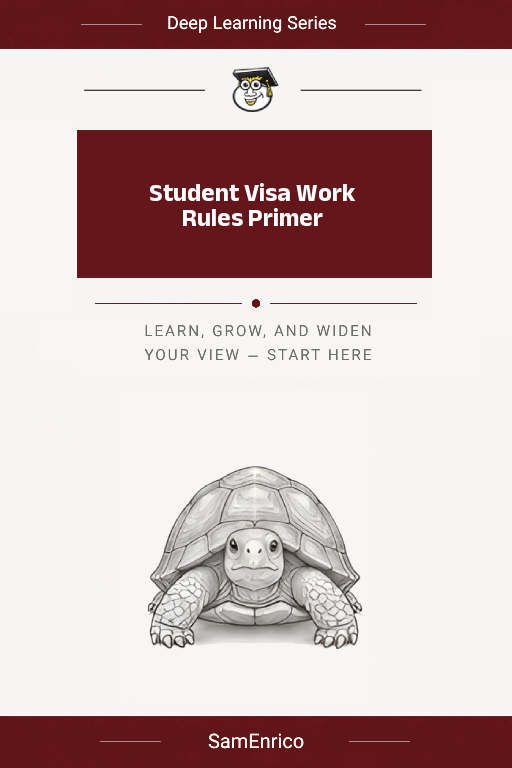
Non-FictionStudent's ShortcutVisa Compliance
Student Visa Work Rules Primer eBook
Understand hourly limits, tax obligations, and per
Understand hourly limits, tax obligations, and permitted sectors for non EU students in Europe.
Formats
Free sample
Chapter 1: The Twenty-Hour Lie--Every year, tens of thousands of non-EU students arrive in Europe carrying the same dangerous misconception. They believe that a universal “20-hour work week” applies uniformly across Germany, France, the Netherlands, Belgium, Sweden, Spain, and Italy. They believe this because their university’s international office told them so. They believe this because they read it on a government website’s FAQ page. They believe this because every other student they have spoken to repeats it like a prayer.And they are wrong.
Not partially wrong. Not wrong in a technicality-that-doesn’t-matter way. They are wrong in a way that costs them thousands of euros, forces them into survival jobs instead of career-building roles, and in some cases, gets their visas revoked.The “20-hour week” is not a law. It is not a directive from the European Commission. It is a convenient simplification—a lowest-common-denominator warning that universities and immigration offices repeat because it is easier than explaining the truth.
The truth is that every country counts hours differently. Some use weekly limits. Some use annualized models. Some count days, not hours. Some differentiate between “full days” and “half-days.” Some permit unlimited work during breaks.
Some require employers to apply for permits. Some do not.This chapter demolishes the twenty-hour lie. It replaces confusion with a clear framework for understanding your specific country’s rules. By the end of this chapter, you will know exactly how many hours you can work legally, when you can work more, and which countries require paperwork before you start.Why the “20-Hour Rule” Persists (Even Though It’s Wrong)Before diving into country-specific rules, it is worth understanding why the twenty-hour myth is so widespread. The answer lies in a combination of historical precedent, bureaucratic laziness, and well-intentioned simplification.In the 1990s and early 2000s, several European countries independently settled on 20 hours per week as a reasonable limit for student workers.
The logic was straightforward: a full-time student should spend approximately 40 hours per week on lectures, studying, and assignments. Adding 20 hours of work creates a 60-hour week—strenuous but possible. Any more than that, the thinking went, and academic performance would suffer.Over time, these individual national policies congealed into an informal standard. Universities began telling students “20 hours per week” because it was true for most countries most of the time. Immigration officers repeated it because it was easier than explaining the nuances of annualized models.
Student forums amplified it because students trust other students more than they trust official documents.But the standard is not universal. And in the countries where the rules differ, the differences are not minor. They are structural differences that can double or triple your legal work capacity.Consider Germany. A student who believes the twenty-hour myth will work 20 hours per week, 52 weeks per year, for a total of 1,040 hours. But Germany does not have a weekly limit.
Germany has an annualized limit of 140 full days or 280 half-days. A student who understands this can work 40 hours per week during semester breaks, significantly increasing annual earnings while staying perfectly legal. That same student could work full-time for three months—June, July, and August—and earn the same amount as a twenty-hour-per-week student working an entire year.The difference is not marginal. It is the difference between scraping by and building savings. It is the difference between saying “no” to a career-relevant internship because you cannot afford to reduce your hours and saying “yes” because you have already banked your hours during break.The Three Counting Methods: Weekly, Annualized, and Hybrid European countries use three distinct methods to count student work hours.
Understanding which method your host country uses is the single most important step in planning your work strategy.Method One: The Weekly Limit The simplest method is a straight weekly cap. Your visa permits you to work up to X hours per week during the academic term. Any work beyond that is a violation, regardless of whether you work fewer hours in other weeks.Countries using weekly limits include France (20 hours per week during the academic term), Sweden (20 hours per week, though enforcement is lax), and Belgium (20 hours per week under the standard student contract, though Belgium also offers the 650-hour annualized contract discussed in Chapter 8).The advantage of the weekly limit is clarity. You know exactly where you stand every week. The disadvantage is inflexibility.
If you work 20 hours every week, you cannot bank hours for a future full-time week. You cannot work 30 hours during a light exam week and 10 hours during a heavy one. The limit is a hard ceiling.Method Two: The Annualized Limit The annualized method is more flexible but more confusing. Instead of a weekly cap, your visa permits a certain number of working days or hours per year. How you distribute those days or hours across the year is largely up to you, as long as you do not exceed the annual total and you do not violate any secondary limits (such as a maximum per week during the academic term).Germany is the clearest example.
German student visas permit 140 full working days or 280 half working days per year. A full working day is any day you work more than four hours. A half working day is any day you work up to four hours. This distinction is critical. If you work six hours on Monday, that counts as one full day against your 140-day limit.
If you work three hours on Tuesday, that counts as one half day against your 280-day limit.The genius of this system is that it rewards students who work short shifts. Two three-hour shifts count as one full day (two half days). One six-hour shift also counts as one full day. Under the half-day system, you can work more total hours within the same day limit by keeping each shift under four hours.The Netherlands uses a variation of the annualized model. Dutch student visas permit full-time work only in June, July, and August.
During the academic term (September through May), the limit is 16 hours per week. This hybrid model is discussed below.Method Three: The Hybrid Model Several countries combine weekly and annualized limits. The Netherlands permits 16 hours per week during the academic term, with no weekly limit during June, July, and August. This gives students the flexibility to work full-time during summer while maintaining a manageable workload during the academic year.France offers a similar hybrid: 20 hours per week during the academic term, with the annual total capped at 964 hours. A student working 20 hours per week for 48 weeks would hit 960 hours—almost exactly the annual cap.
This means the weekly limit and the annual limit are designed to align. The annual cap primarily prevents students from working 20 hours every week plus full-time during breaks.Italy uses a different hybrid: 20 hours per week during the academic term, with no annual cap but a separate limit on total earnings (approximately €5,000–6,000 per year before tax implications change). This earnings cap is discussed in Chapter 6.Country-by-Country Breakdown: Hour Limits, Permits, and Breaks The following breakdown covers the seven core countries in this book. For each country, you will learn the hourly limit, the counting method…
This is the end of the free sample. Get the eBook to keep going. Buy now
About this book
Details
- Author
- Hardwick Dreama
- Publisher
- SamEnrico
- Language
- English
- Genre
- Non-Fiction, Student's Shortcut, Visa Compliance
- Released
- 2026-06-01
- Pages (approx.)
- 148
- Available as
- eBook, Audiobook

Read better in the ZLOADR app
Your eBooks on your phone or tablet. Sign in with your SamEnrico account and start reading.
More by Hardwick Dreama
 Self Esteem for Empty Nest CouplesHardwick Dreama$11.99
 Constipation Relief ExercisesHardwick Dreama$11.99
 Emotion Regulation For AutoimmuneHardwick Dreama$11.99
 Rental Property ROI CalculationHardwick Dreama$11.99
 Belgian Diamond PoliceHardwick Dreama$11.99
 Pap Smear GuideHardwick Dreama$11.99
 Experiencing Mental FormationsHardwick Dreama$11.99
 Sylvia Browne AfterlifeHardwick Dreama$11.99
 The Rune-Bound Knight: Sigurd’s Forgotten OathHardwick Dreama$11.99
 The Flying Scotsman: The Train That Broke All RecordsHardwick Dreama$11.99
 Mastering The Art of Judo (柔道)Hardwick Dreama$11.99
 A Collector's Handbook to the Dodge Senior SixHardwick Dreama$11.99
You may also like
 Hong Kong Handover 1997Dunn Johnnie$11.99
 Zumba For Postnatal Recovery CourseNeal Christian$11.99
 Zumba for BeginnersLadner Nikia$11.99
 YouTube Comment Mining GuideHumes Pandora$12.99
 Worry Box MeditationCarlin Rudy$11.99
 Workplace Stress MeditationNguyen Lynn$11.99
 Workplace Stress and Sleep RepairHawley Ivory$11.99
 Workplace Perfectionism CureDelaney Jeffry$11.99
 Workplace Injustice Anger GuideWallen Isabelle$11.99
 Work Addiction and Burnout LinkGreenwood Ester$11.99
 Women in Yoga and WellnessBeattie Galina$11.99
 Women in Stand Up ComedyChun Evangeline$11.99