
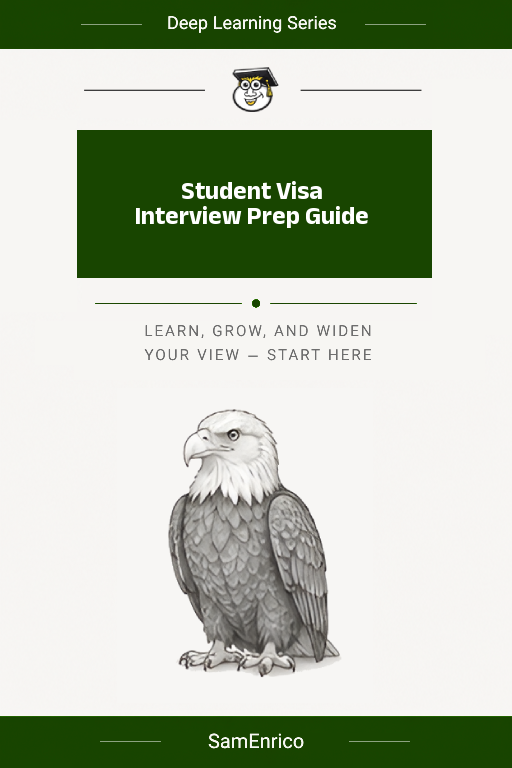
Student Visa Interview Prep Guide eBook
Master F-1 (US), Tier 4 (UK), and Schengen student
by Ely Minerva
Master F-1 (US), Tier 4 (UK), and Schengen student visa interviews with country-specific question banks.
Formats
Free sample
Chapter 1: The Seven-Second Verdict--–- The moment you step into the visa interview room, the officer has already begun evaluating you. Not when you sit down. Not when you speak your first word. The moment you walk through that door. Your posture, your eye contact, your breathing, the way you hold your documents – all of it is being processed within seven seconds.
This chapter will teach you what happens in those seven seconds and how to control them completely. You will learn why most students fail before they open their mouths, and you will learn the single mindset shift that separates approved applicants from those who walk out with a refusal slip. By the end of this chapter, you will never walk into an embassy the same way again.The Seven Seconds That Decide Everything Let me tell you about two students. Both applied for the same university. Both had identical GPAs.
Both had the same financial documents. One was approved. One was refused. The difference? Seven seconds.Amina, from Lagos, arrived at the US embassy forty-five minutes early.
She wore a wrinkled blouse because her suitcase had been lost. She stood in line shifting her weight from foot to foot, checking her phone repeatedly. When her number was called, she walked to the window with her shoulders hunched, clutching a thick binder to her chest like a shield. She placed her documents on the counter with trembling hands. Before she said a single word, the officer had already formed an impression: nervous, unprepared, possibly hiding something.Carlos, from São Paulo, arrived early as well.
He wore a pressed collared shirt. He stood calmly, breathing slowly, reviewing his three core answers in his head – not memorizing, just refreshing. When his number was called, he walked to the window with his shoulders back, his folder held at his side, not in front of his body. He made brief eye contact with the officer, nodded slightly, and placed his documents on the counter in a neat, organized stack. Before he said a single word, the officer had already formed an impression: confident, prepared, trustworthy.Same qualifications.
Different outcomes.This is not speculation. Research on thin-slicing – the phenomenon where people make rapid judgments based on limited information – shows that within seven seconds, humans form lasting impressions about trustworthiness, competence, and confidence. Visa officers are humans. They are trained to look for deception, but they are also subject to the same cognitive biases as everyone else. The student who appears anxious and disorganized triggers the officer's suspicion reflex.
The student who appears calm and organized triggers the officer's approval reflex.The visa interview does not begin with "Good morning." It begins the moment you enter the embassy parking lot.The Three Myths That Get Students Refused Before we dive into what you should do, let me clear away the three most dangerous myths circulating on student forums, Whats App groups, and You Tube comment sections. Believing these myths will hurt your chances more than any gap year or low grade ever could.Myth #1: "Don't show any interest in working abroad"This is the most widespread and harmful myth. Students are told to say they will return home immediately after graduation and never, ever mention the possibility of working in the destination country. This advice is not just wrong – it is actively dangerous.Here is the truth. US visa officers know about Optional Practical Training.
They know most STEM students use their full 36 months of OPT. They expect you to know this too. When you say "I will return home the day after graduation" without mentioning OPT, you sound either uninformed or dishonest. Both are bad.The correct approach, which we will cover in detail in Chapter 5, is to acknowledge temporary work authorization as part of your educational journey while firmly anchoring your long-term future in your home country. For the US: "I plan to use my 12 months of OPT to gain practical experience in my field, as permitted by F-1 regulations, and then return to Brazil to join my father's engineering firm." For the UK: "I understand the Graduate Route allows two years of post-study work, but my long-term plan is to return to India and apply the skills I learn to the renewable energy sector there."The officer is not trying to catch you.
The officer is trying to determine if you understand the rules and intend to follow them.Myth #2: "Memorize your answers perfectly"Some consultants make students rehearse answers until they sound like robots. This is a disaster. A memorized answer sounds rehearsed because it is rehearsed. Officers hear hundreds of students a week. They can spot a script from the first sentence.The goal is not memorization.
The goal is internalization. You should know your core messages – why this country, why this university, why this major, who pays, what you will do after – so well that you can express them naturally in any order, with any phrasing, without sounding like you are reading from a teleprompter.Think of it this way. If someone asks you your name, you do not memorize an answer. You just know it. Your visa answers should feel the same way.Myth #3: "Bring every document you have ever touched"Some students bring three-inch-thick binders filled with every bank statement, property deed, birth certificate, and school transcript from the past decade.
This signals anxiety. A student with nothing to hide brings exactly what is required and nothing more.The optimal document strategy, which we cover fully in Chapter 3, is a single organized folder with fewer than twenty pages. Quality over quantity. Every document should serve a clear purpose. If you cannot explain why a document is in your folder, remove it.The Legal Framework: Non-Immigrant Intent vs.
Genuine Student Status To understand how to answer any visa question, you must first understand the legal standard you are being judged against. This standard is different for the United States than it is for the United Kingdom and the Schengen countries. Mixing them up is a common and costly mistake.The United States: Non-Immigrant Intent US immigration law, specifically the Immigration and Nationality Act Section 214(b), creates a presumption that every person seeking admission to the United States is an intending immigrant. That means you are assumed to want to move permanently to the US unless you prove otherwise. The burden of proof is on you.For student visa applicants, you must prove that you have a residence abroad that you have no intention of abandoning.
This does not mean you cannot have any ties to the US. You can have relatives in the US. You can have friends. You can even have a future job offer from a US company that is conditional on completing your degree. But you must have stronger ties to your home country.The key word is "non-immigrant intent" – intent.
You are not swearing a blood oath to leave forever. You are stating your current, good-faith intention to complete your studies and return home. If your plans change later, that is a matter for a different visa category.The United Kingdom: Genuine Student Status The UK uses a different standard. There is no presumption…
This is the end of the free sample. Get the eBook to keep going. Buy now
About this book
Details
- Author
- Ely Minerva
- Publisher
- SamEnrico
- Language
- English
- Genre
- Non-Fiction, Student's Shortcut, Visa Strategy
- Released
- 2026-05-30
- Pages (approx.)
- 156
- Available as
- eBook, Audiobook

Read better in the ZLOADR app
Your eBooks on your phone or tablet. Sign in with your SamEnrico account and start reading.
More by Ely Minerva
 Career Affirmations GuideEly Minerva$11.99
 US Small Business Credit FixEly Minerva$11.99
 Distraction Log ReviewEly Minerva$11.99
 Oren Lyons Onondaga FaithkeeperEly Minerva$11.99
 Drug Addiction and DepressionEly Minerva$11.99
 The Child Emotional RegulationEly Minerva$11.99
 Road Rage and CaffeineEly Minerva$11.99
 Habit Formation for FreelancersEly Minerva$11.99
 The Cairo Phantom: Egypt's Elusive Serial KillerEly Minerva$11.99
 Lancelot and the Lady of the Lake: A Love Forged in SorrowEly Minerva$11.99
 How to Produce a TransplanterEly Minerva$11.99
 How to Become a Mannequin Wig MakerEly Minerva$11.99