
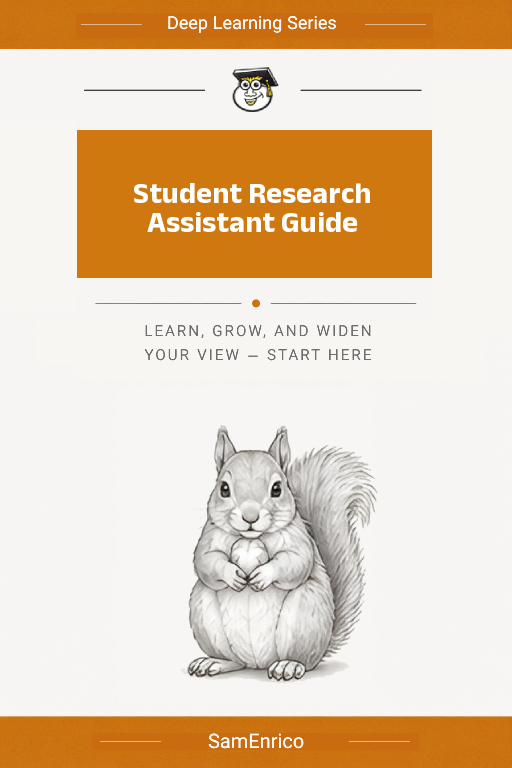
Student Research Assistant Guide eBook
Work as paid research assistant for professors in
Work as paid research assistant for professors in European universities including tax free stipends.
Formats
Free sample
Chapter 1: The Tax Mirage--–- Maria had been in Berlin for eleven months. She was a sharp, hardworking master's student from Colombia, and she had done everything right. She found a research assistant position with a professor at the Free University, helping to code qualitative interview data for a European Research Council project. Her contract said "Wissenschaftliche Hilfskraft" – student research assistant. Her offer letter mentioned a gross salary of €1,800 per month.
Her friends in the international student Whats App group told her, with absolute confidence, that research assistant income was tax-free in Germany. "It's a stipend," they said. "Scholarships aren't taxed."On her first paycheck, Maria saw a deduction of €342 for income tax, plus another €167 for social security and pension contributions. She panicked. She went to her professor, who shrugged and referred her to HR.
HR told her, "You are an employee, not a scholarship holder. You must pay tax." But they could not explain why her friends seemed to pay nothing while she paid hundreds every month.Eighteen months later, after Maria had finished her degree and moved back to Bogotá, she received a letter from the Finanzamt – the German tax office. They had reviewed her case and determined that she had overpaid her taxes by €2,100. But to claim the refund, she needed to file a tax return within four weeks. She missed the deadline.
That money – which would have covered two months of rent in Berlin – was gone forever.Maria's story is not an exception. It is the rule. Every year, thousands of student research assistants across Europe overpay taxes, miss refund deadlines, accept the wrong contract type, or wrongly believe they are tax-exempt when they are not. The confusion is not their fault. The system is genuinely complex, university HR departments are often unhelpful, and most online advice is either outdated, country-specific without saying so, or flat-out wrong.This chapter exists to ensure that you never become Maria.The Three Words That Determine Your Financial Future Before you read another sentence, find your employment contract or offer letter.
Look for one of three German words (or their equivalents in French, Italian, or Dutch). These three words will tell you, more than any other factor, whether you will pay tax, how much, and what rights you have.1. "Stipendium" (Scholarship)If your contract says Stipendium, you may – and this is a heavy may – have tax-exempt income. Scholarships are typically awarded by foundations (DAAD, Alexander von Humboldt, Marie Curie actions) and are intended to support your living costs while you study or conduct research. The critical legal distinction, drawn from HMRC Manual EIM06271 in the UK and similar provisions across Europe, is that a scholarship must be for maintaining your status as a student or researcher, not as payment for services rendered.
If you have to submit timesheets, attend mandatory meetings, produce deliverables on a schedule, or report to a supervisor, you are almost certainly an employee, not a scholarship holder – regardless of what the document is called.Tax-exempt scholarships come with trade-offs. You will not accrue pension credits. You will not be eligible for unemployment benefits. In many countries, you cannot use a scholarship as proof of income for a mortgage or a rental application (more on that in Chapter 12). And crucially, a tax-exempt scholarship does not count toward your basic tax-free allowance – it is simply invisible to the tax system.
This sounds good, but it also means you cannot deduct expenses against it. If you buy a €2,000 laptop for your research, you cannot claim it against a tax-exempt scholarship.2. "Arbeitsvertrag" (Employment Contract)If your contract says Arbeitsvertrag, you are an employee. Period. Your income is taxable employment income.
You will pay income tax, social security contributions, and pension contributions – though as you will learn in Chapter 3, the Grundfreibetrag (basic tax-free allowance) of €11,700 per year means that many student employees pay zero income tax even though they are technically in the taxable system. This is the "taxable income below the allowance" category we defined earlier.Employment contracts give you rights: paid sick leave, vacation days, protection from dismissal, and eligibility for unemployment benefits after your contract ends. They also require paperwork – specifically, a tax number (Steuernummer in Germany, NIF in Italy), which Chapter 9 will walk you through step by step.3. "Dienstvertrag" (Service Contract)This is the rarest and trickiest category. A Dienstvertrag is a contract for independent services – essentially, you are a freelancer working for the university.
This status is rare for student research assistants but does occur, particularly for short-term projects or one-off tasks like translating a paper or creating a dataset. Under a service contract, you are responsible for your own taxes and social security contributions. You will receive the full gross amount and must file your own tax return, pay your own social security, and potentially register as self-employed. Most student research assistants should avoid this status unless they have professional advice, because the administrative burden is high and the risk of misclassification (and subsequent fines) is real.If your contract does not contain any of these words, or if it is in a language you do not understand, stop. Do not sign.
Ask for a translation or a clarification in writing. The single biggest predictor of a tax disaster is signing a contract you do not fully understand.The Great Confusion: Why "Tax-Free" Means Three Different Things The phrase "tax-free stipend" is one of the most misleading in all of academic employment. In online forums, on Reddit, and in Whats App groups, students use it to describe three completely different situations. By the end of this section, you will be able to spot which is which – and more importantly, which applies to you.Situation A: Truly Tax-Exempt Income This is rare. It applies to certain Ph D fellowships from recognized foundations, some Marie Curie actions under Horizon Europe, and a handful of other specific programs.
The income is not reported to tax authorities, does not appear on any tax return, and does not count toward any allowance. The downside, as noted above, is that you have no employment rights, no pension accrual, and no proof of income for loans or rentals. In Germany, fewer than 5% of student research assistant positions fall into this category – but in online forums, you would think it was 50%.Situation B: Taxable Income Below the Allowance This is the most common situation for student research assistants, and it is the source of endless confusion. Your income is technically taxable employment income. You have an Arbeitsvertrag.
You receive a payslip with tax deductions listed. However, because your annual income is below the Grundfreibetrag – €11,700 in Germany for 2026, with similar allowances in other countries – the actual tax you owe is €0. You will see deductions on your payslip, but you will get them back when you file your tax return at the end of the year. Many students see those deductions, panic, and wrongly conclude they have been misclassified. In fact, they are in the correct category – they just have not filed their return yet.Situation C: Illegal Misclassification This is the nightmare scenario.
An employer classifies you as a "scholarship holder" or "intern" to avoid paying employer social security contributions, but in practice you…
This is the end of the free sample. Get the eBook to keep going. Buy now
About this book
Details
- Author
- Causey Odessa
- Publisher
- SamEnrico
- Language
- English
- Genre
- research, Student's Shortcut
- Released
- 2026-05-26
- Pages (approx.)
- 148
- Available as
- eBook, Audiobook

Read better in the ZLOADR app
Your eBooks on your phone or tablet. Sign in with your SamEnrico account and start reading.
More by Causey Odessa
 Invent Options Mutual Gain GuideCausey Odessa$11.99
 Gambling Addiction and Anxiety DisordersCausey Odessa$11.99
 Adolescent Detox GuideCausey Odessa$11.99
 Child Loss and GuiltCausey Odessa$11.99
 Parenting Without GuiltCausey Odessa$11.99
 Gambling Addiction And Disordered EatingCausey Odessa$11.99
 Phone Call DistractionCausey Odessa$11.99
 Divorce Recovery WorkbookCausey Odessa$11.99
 Whispers of the Silk Road: The Lost Caravans of the Forgotten MerchantsCausey Odessa$11.99
 The Asura's Gambit: A Spy in the Court of RavanaCausey Odessa$11.99
 How to Start a Meters for Petrol Pumps (electronic) Business (Beginners Guide)Causey Odessa$11.99
 Freemium Community Offline SyncCausey Odessa$12.99
You may also like
 Scientific Research On TM GuideMartens Nathanial$11.99
 Research Proposal Methodology Section MasteryPauley Debroah$11.99
 Research Proposal Appendix CompilationRaines Tyisha$11.99
 Academic Researcher Distraction GuideFord Virgil$11.99
 TM Research and ScienceCovert Nicki$11.99
 Social Anxiety Research ReviewRoberge Cole$11.99
 Research Proposal Significance Section GuideBock Tory$12.99
 Research Proposal Reviewer PsychologyLugo Tawanda$11.99
 Research Proposal Research Questions DesignLara Robbi$11.99
 Research Proposal References and CitationsPatten Shanice$11.99
 Research Proposal Mixed Methods DesignCameron Omega$11.99
 Research Proposal Data Management PlanAnderson Roberto$12.99