
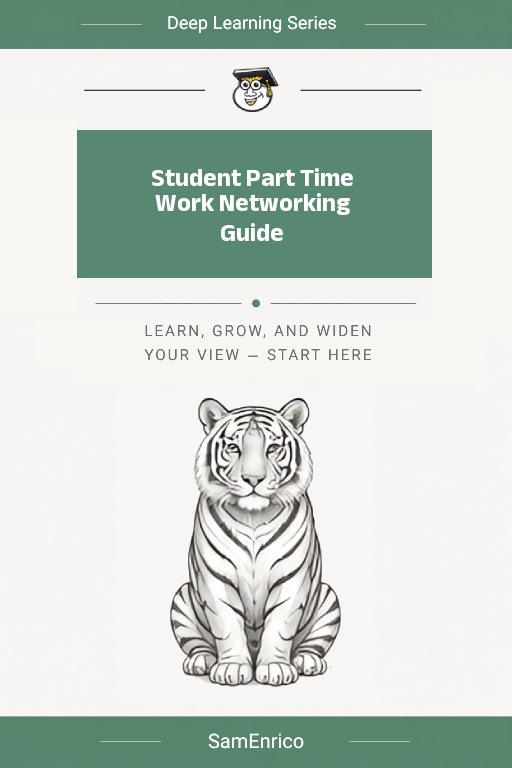
Student Part Time Work Networking Guide eBook
Join Erasmus student networks and LinkedIn groups
Join Erasmus student networks and LinkedIn groups to hear about unposted part time opportunities.
Formats
Free sample
Chapter 1: The 80% Lie--Most students wake up on a Tuesday morning, open their laptops, and begin the slow, painful ritual that will define their next four months: scrolling through job boards. Indeed, Glassdoor, Linked In Jobs, Student Job, Erasmus Intern – they click through page after page, uploading the same carefully crafted resume to twenty-seven different portals. They write cover letters that nobody will read. They answer questions like “Why do you want to work here?” for a coffee shop they have never entered. They do this for hours.
They do this for weeks. Sometimes, they do this for an entire semester without a single interview.Then they give up. They tell themselves the market is bad. They tell themselves they are not qualified. They tell themselves that every other student is struggling too, so the problem must be systemic.Here is the truth they do not know: seventy-nine percent of those jobs were never real.
Not in the way they thought. The postings existed, yes. But the positions were filled before the “Apply Now” button ever went live.This is not speculation. This is not motivational-speaker exaggeration. This is the documented reality of the hidden job market.
According to the US Bureau of Labor Statistics and replicated across European labor market studies, between 70% and 85% of all jobs are filled through referrals, internal transfers, or direct outreach – never through public postings. For part-time student work in competitive cities like Berlin, Amsterdam, Barcelona, and Lisbon, the number climbs even higher. Some estimates put it at 90%.Ninety percent of part-time jobs never appear on the platform where you are spending ninety percent of your time.You have been lied to – not maliciously, but systematically. The entire online job application economy is built on a fiction: that employers actually want to read resumes from strangers. They do not.
What employers want is certainty. They want to know that the person showing up on Monday morning is reliable, safe, and likely to stay longer than six weeks. A referral from someone they trust gives them that certainty. A resume from a stranger gives them paperwork.This chapter is not about convincing you to try harder at the old game. This chapter is about convincing you to stop playing it entirely.
By the time you finish reading, you will understand why your resume is nearly worthless, why the 80/20 rule is actually too optimistic, and why being an international student – with all its complications of visas, language barriers, and cultural unfamiliarity – is not your weakness. It is your hidden superpower.The Mathematics of Wasted Effort Let us run the numbers honestly. A typical student applying for part-time work through online portals will submit between fifty and one hundred applications before receiving a single offer. That is the average across multiple university career center studies. For international students, the average is higher – sometimes double – because employers filter by visa status before reading the first line of a cover letter.Now consider what those fifty applications cost you.
Each application takes an average of eight minutes for part-time roles (less for quick-apply features, more for roles requiring customized answers). Fifty applications at eight minutes each equals four hundred minutes. That is six point seven hours. That is a full day of your life spent on activities that yield, in the majority of cases, absolutely nothing.But the time cost is not the worst part. The worst part is the psychological cost.
Each rejection – or more commonly, each non-response – chips away at your sense of agency. After twenty applications with no reply, you start to doubt your qualifications. After forty, you start to doubt your worth. After sixty, you stop applying altogether, convinced that the system is rigged against you.Here is the radical reframe: the system is rigged against you, but not in the way you think. It is not rigged to favor the most qualified candidates.
It is rigged to favor the candidates who are already inside the network. And you are not inside the network – yet.The good news is that getting inside the network requires almost none of the skills that online applications test. It does not require a perfect GPA. It does not require a beautifully formatted resume. It does not require five years of experience for an entry-level role.
What it requires is a completely different set of behaviors: curiosity, follow-through, and the willingness to ask strangers for advice rather than jobs.The Case Study That Changed Everything In 2018, a career development study tracked two groups of students searching for part-time work in Lisbon. Both groups had similar qualifications: second-year university students, moderate Portuguese language skills, no prior work experience in the country. The first group was instructed to use traditional methods: online applications, career center postings, and campus job boards. The second group was instructed to use a different method: they were told to identify twenty local businesses they wanted to work for, find the email address of a manager or team lead at each business, and send a message asking for fifteen minutes of advice – not a job.The results were not close. The first group submitted an average of sixty-two applications over eight weeks.
Seventeen percent received a single interview. Eight percent received a job offer. The second group sent an average of eighteen advice-seeking emails. Sixty-one percent received a reply. Thirty-three percent received a job offer within the same eight-week period – nearly four times the success rate, with one-third of the effort.The most striking finding came from the follow-up interviews.
Employers who hired from the second group were asked why they chose those candidates. The most common answer was not about skills or experience. It was: “They seemed like someone I could work with. They were curious. They asked good questions.
They didn’t just send me a resume.”One manager put it more bluntly: “The students who email me asking for a job go into a folder I never open. The students who email me asking for advice about my industry – those are the ones I want to help. And sometimes, helping them means hiring them.”This is the central insight of this book, and it is worth repeating: asking for a job closes doors. Asking for advice opens them.Why Your Resume Is Almost Useless Let me be clear: resumes are not completely useless. They serve a function in the final stages of hiring – verifying skills, providing a record of employment, satisfying HR compliance.
But in the early stages of finding opportunities, resumes are among the least effective tools available to you.Here is why.First, resumes are backward-looking. They tell an employer what you have already done. But for part-time student work, employers do not care about your past as much as they care about your future reliability. A resume cannot communicate that you will show up on time, that you will not steal from the register, that you will treat customers with respect. A referral from someone the employer trusts can communicate all of those things in three seconds.Second, resumes are filtered by algorithms before they reach human eyes.
Most online application systems use Applicant Tracking Systems (ATS) that scan resumes for keywords. If your resume does not contain…
This is the end of the free sample. Get the eBook to keep going. Buy now
About this book
Details
- Author
- Chism Faustino
- Publisher
- SamEnrico
- Language
- English
- Genre
- Non-Fiction, Student's Shortcut
- Released
- 2026-05-29
- Pages (approx.)
- 141
- Available as
- eBook, Audiobook

Read better in the ZLOADR app
Your eBooks on your phone or tablet. Sign in with your SamEnrico account and start reading.
More by Chism Faustino
 Educational Difference Self EsteemChism Faustino$11.99
 Exploding Head SyndromeChism Faustino$11.99
 The TM Cool Down SessionChism Faustino$11.99
 Strength Training For BeginnersChism Faustino$11.99
 Metta Journal Prompts GuideChism Faustino$11.99
 Soil Based ProbioticsChism Faustino$11.99
 No Birthday Parties EverChism Faustino$11.99
 Parent Dying Grief GuideChism Faustino$11.99
 Subscription Box Compulsive CycleChism Faustino$11.99
 Whispers of the Forgotten: The Lost Colony of Roanoke’s Final SecretChism Faustino$11.99
 The Miracle on Ice: The Underdogs Who Stole the GoldChism Faustino$11.99
 The Last King of the Moon: How Neil Armstrong’s Secret Mission Changed HistoryChism Faustino$11.99
You may also like
 Hong Kong Handover 1997Dunn Johnnie$11.99
 Zumba For Postnatal Recovery CourseNeal Christian$11.99
 Zumba for BeginnersLadner Nikia$11.99
 YouTube Comment Mining GuideHumes Pandora$12.99
 Worry Box MeditationCarlin Rudy$11.99
 Workplace Stress MeditationNguyen Lynn$11.99
 Workplace Stress and Sleep RepairHawley Ivory$11.99
 Workplace Perfectionism CureDelaney Jeffry$11.99
 Workplace Injustice Anger GuideWallen Isabelle$11.99
 Work Addiction and Burnout LinkGreenwood Ester$11.99
 Women in Yoga and WellnessBeattie Galina$11.99
 Women in Stand Up ComedyChun Evangeline$11.99