
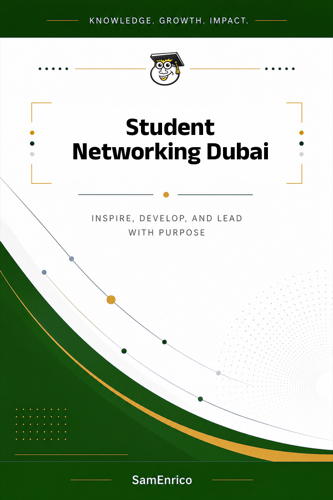
Non-FictionStudent's ShortcutNetworking
Student Networking Dubai eBook
Build professional connections at university event
Build professional connections at university events and career fairs.
Formats
Free sample
Chapter 1: The 85% Rule...--You have probably been told your entire academic career that if you get good grades, build a polished résumé, and apply to enough jobs online, you will eventually land a great internship or graduate role. That is a lie. Not a small exaggeration. A dangerous, career-limiting lie.Here is the truth that career fairs won't advertise, that professors rarely mention, and that your parents probably do not know: between 70 and 85 percent of jobs are never publicly posted. They are filled through what economists and hiring managers call the "hidden job market" – positions that are filled by referral, internal recommendation, or word-of-mouth before they ever reach a job board.In Dubai, that number leans toward the higher end.
In a city where over 85 percent of the population are expatriates, where people move between companies every eighteen to twenty-four months, and where trust is the currency that transcends borders, the hidden job market is not a fringe phenomenon. It is the main event.This chapter will dismantle everything you thought you knew about job hunting. It will introduce you to the single most important concept in this entire book – a concept we call The Value-First Rule – and it will give you a new lens through which to see every career fair, every guest lecture, and every coffee meeting you will ever attend as a student in Dubai.The Myth of the Open Application Let us start with a simple experiment. Open a new browser window and go to any job search website – Linked In, Bayt, Indeed, Gulf Talent. Search for "marketing intern Dubai" or "finance graduate program UAE." You will see dozens, maybe hundreds, of listings.
This feels encouraging. It feels like opportunity.Now, call a friend who works at one of those companies. Ask them, quietly and off the record, how many of those positions were filled by someone who submitted a cold application through the website. The answer, in most cases, will be somewhere between zero and a very small number.Why? Because hiring is risky.
When a manager posts a job publicly, they receive hundreds of applications. Most are from unqualified candidates. Many are from people who used a generic template and changed only the company name. Sorting through this pile takes time, energy, and attention – resources that managers do not have. So they do what any rational person would do: they ask their team, their colleagues, and their professional network, "Do you know anyone good for this role?"A name gets mentioned.
A résumé gets forwarded. A coffee meeting gets scheduled. And the job gets filled before the public posting ever goes live – if it goes live at all.This is not corruption. This is not "wasta" in the negative sense. This is efficiency.
And it is the reality of every professional market in the world, amplified in Dubai's relationship-driven economy.The Dubai Multiplier Effect Dubai is not a typical city. It is a city where someone can move from associate to director in three years, then switch companies, then start their own consultancy, then become a board advisor – all within a decade. This velocity of career movement creates a unique ecosystem: networks matter more than résumés because the people reading your résumé probably worked with your future boss two jobs ago.Consider these three characteristics of the Dubai professional landscape:First, high expatriate concentration. Because nearly everyone is from somewhere else, there is no deep, multi-generational family network to rely on. This levels the playing field.
A student from India, a student from the United Kingdom, and a student from Lebanon all arrive with roughly the same starting point: zero local family connections. The difference is made by who builds professional relationships faster.Second, high turnover. The average tenure at a Dubai company is significantly shorter than in London, New York, or Singapore. People move. They change sectors.
They launch startups. This means that a contact you make today at a career fair might be the hiring manager at a different company six months from now. Your network is not static. It is portable career insurance.Third, trust-based referrals. In a high-turnover environment, companies cannot afford to spend three months vetting a candidate through formal processes alone.
They need shortcuts. The most efficient shortcut is a trusted employee saying, "I know a student from my university who did a project exactly like what we need." That single sentence is worth more than a perfect GPA.So when we say that a coffee meeting in DIFC or Dubai Internet City can be more valuable than ten online applications, we are not being metaphorical. We are describing the actual mechanics of how hiring works in this city.Introducing The Value-First Rule Most students approach networking backwards. They walk into a career fair, approach a recruiter, and think, "What can I get from this person? An interview?
A referral? A job?" This is what we call a need-based mindset. And it fails because it is transparent. Recruiters meet fifty students a day who want something. They can smell need from across the room.The Value-First Rule flips this entirely.
Before every interaction – whether it is a career fair, a guest lecture, a club meeting, or a coffee chat – you ask yourself a single question: "What can I offer this person?"This sounds counterintuitive. You are a student. You have no power, no budget, no authority. What could you possibly offer a senior executive?More than you think. Here are five things that every student can offer, starting tomorrow:One, campus insights.
Companies want to know what students are thinking, what trends are emerging, what technologies are being discussed in classrooms. You are a real-time sensor on a campus that they cannot easily access.Two, social media help. Many professionals are terrible at Linked In, Instagram, or Tik Tok. If you understand how to write a post, tag someone effectively, or summarize an event, you have a skill they need.Three, research assistance. A professional writing a white paper or preparing a presentation might need someone to compile data, summarize articles, or fact-check claims.
You can do that.Four, fresh perspective. Senior professionals have been in their industry for a decade or more. They have blind spots. A student asking "Why do you do it that way?" can surface assumptions they have not examined in years.Five, gratitude and recognition. A simple, specific, sincere thank-you note is a form of value.
It makes the recipient feel seen and appreciated. Never underestimate this.The Value-First Rule is not a trick. It is not a manipulation. It is a genuine orientation toward other people. When you lead with generosity, people remember you.
When you lead with need, they avoid you.The 50/50 Listening Rule If The Value-First Rule is the philosophy of this book, the 50/50 Listening Rule is its primary technique. Here it is: in any professional conversation, aim to listen for 50 percent of the time and talk for 50 percent of the time.This may sound obvious. It is not. The average student, when nervous, talks too much. They rehearse their pitch in their head while the other person is speaking.
They interrupt. They fill silence with nervous chatter. They leave the conversation having learned nothing about the other person.The 50/50…
This is the end of the free sample. Get the eBook to keep going. Buy now
About this book
Details
- Author
- Gaddy Celinda
- Publisher
- SamEnrico
- Language
- English
- Genre
- Non-Fiction, Student's Shortcut, Networking
- Released
- 2026-06-09
- Pages (approx.)
- 143
- Available as
- eBook, Audiobook

Read better in the ZLOADR app
Your eBooks on your phone or tablet. Sign in with your SamEnrico account and start reading.
More by Gaddy Celinda
 Reverse Brainstorming Group GuideGaddy Celinda$11.99
 Weightlifting Hypnosis WorkbookGaddy Celinda$11.99
 Dental Evidence in CourtGaddy Celinda$11.99
 One Touch RuleGaddy Celinda$11.99
 Self Hypnosis for Climate AnxietyGaddy Celinda$11.99
 Acupuncture for Women's HealthGaddy Celinda$11.99
 Massage For HeadachesGaddy Celinda$11.99
 The Mathematicians of Timbuktu: Unveiling Africa's Forgotten GeniusesGaddy Celinda$11.99
 The Lion and the Eagle: Henry V and the Forge of EnglandGaddy Celinda$11.99
 One Page Marketing Playbook for MoversGaddy Celinda$12.99
 Filipino Content Writing GuideGaddy Celinda$12.99
 Seahorses: Unique FishGaddy Celinda$11.99
You may also like
 Hong Kong Handover 1997Dunn Johnnie$11.99
 Zumba For Postnatal Recovery CourseNeal Christian$11.99
 Zumba for BeginnersLadner Nikia$11.99
 YouTube Comment Mining GuideHumes Pandora$12.99
 Worry Box MeditationCarlin Rudy$11.99
 Workplace Stress MeditationNguyen Lynn$11.99
 Workplace Stress and Sleep RepairHawley Ivory$11.99
 Workplace Perfectionism CureDelaney Jeffry$11.99
 Workplace Injustice Anger GuideWallen Isabelle$11.99
 Work Addiction and Burnout LinkGreenwood Ester$11.99
 Women in Yoga and WellnessBeattie Galina$11.99
 Women in Stand Up ComedyChun Evangeline$11.99