
Non-FictionHealth & WellnessTest Taking
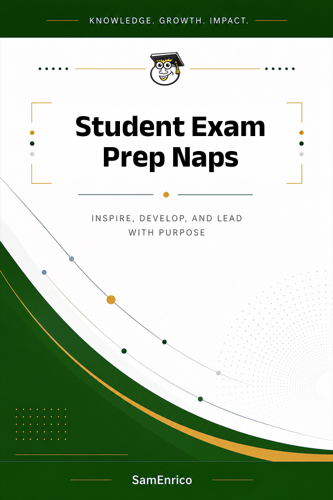
Student Exam Prep Naps eBook
Enhances retention before tests.
Enhances retention before tests.
Formats
Free sample
Chapter 1: The Leaky Bucket--–- The fluorescent lights of the university library buzzed at 2:00 AM, casting a sickly yellow glow over rows of hunched figures. Energy drinks stood like soldiers on wooden desks. Highlighters bled through pages. Eyes, red and unfocused, scanned the same paragraph for the fifth time without comprehension. This was finals week, and this was the ritual.
Somewhere in the building, a student named Marcus had been studying for eleven consecutive hours. He had not slept in thirty-eight. He was certain this was the path to success. Twenty-four hours later, Marcus sat in his psychology final staring at a question about the stages of memory formation. He had reviewed this exact concept six times during his all-nighter.
He could picture the page it was on. He could remember the color of the highlighter he had used. He could not, for the life of him, recall the difference between semantic and episodic memory. The information had been there. Now it was gone.This is the tragedy of the modern student.
Not the lack of effort, but the misdirection of it. Marcus did not fail because he was lazy. He failed because he was working against the fundamental architecture of his own brain. He was pouring water into a bucket with a hole in the bottom, convinced that if he just poured faster, the bucket would eventually stay full. It will not.
It cannot. And the cruelest irony is that the very solution to his problem—the one thing that would have locked that information into his long-term memory—was the one thing he had sacrificed on the altar of hustle culture. He needed to sleep. He needed to nap. And he had no idea.This book exists because the education system has failed to teach students the single most important study skill they will ever learn.
Schools teach you what to study. They teach you when to study. They almost never teach you how your brain actually turns studying into knowing. And without that knowledge, you are studying blind. You are guessing.
You are Marcus. The science of sleep and memory is not new. It has been replicated in hundreds of peer-reviewed studies across decades of research. And yet, on every college campus in America, students continue to pull all-nighters as if sleep deprivation were a badge of honor rather than a cognitive catastrophe. This chapter will reframe everything you think you know about napping.
It will show you why the "grind" is failing you. And it will give you permission to do something that feels like the opposite of studying—but is actually the most powerful study technique in existence.The Myth of the All-Nighter Let us begin with a simple question. Why do students pull all-nighters? The answer appears obvious: because they have too much to learn and not enough time. The logic seems unassailable.
If an exam covers ten chapters and you have only two days, you must use every available hour, including the hours normally reserved for sleep. This is simple arithmetic. More hours equals more studying. More studying equals better grades. This logic is so intuitive that it feels like common sense.
It is also completely wrong.The flaw in this reasoning is the hidden assumption that studying and learning are the same thing. They are not. Studying is the act of inputting information. Learning is the act of retaining and being able to retrieve that information later. You can study for twenty hours and learn almost nothing if your brain is not in a state to consolidate that information into long-term memory.
And the brain is not in that state when it is sleep-deprived, stressed, and running on caffeine and adrenaline. The all-nighter is not a shortcut to learning. It is a shortcut to forgetting.Consider what actually happens during an all-nighter. You sit down at 8:00 PM with a stack of notes. For the first two hours, your focus is sharp.
You highlight key terms. You write flashcards. You feel productive. Around 11:00 PM, your attention begins to wander. You read the same sentence twice.
You check your phone. You get a second coffee. By 1:00 AM, your hippocampus—the part of your brain responsible for taking in new information—is exhausted. It has been working all day. It has a limited capacity, like an inbox that can only hold so many emails before it stops accepting new ones.
But you keep studying anyway, because you believe that more hours equal more learning. By 3:00 AM, you are not learning. You are just moving your eyes across pages while your brain processes almost nothing. By 6:00 AM, you have spent ten hours studying and retained perhaps two hours' worth of information. The other eight hours were theater.
You were performing the role of a studious person without any of the actual cognitive benefit.And here is the worst part. While you were awake, your brain was not just failing to consolidate new memories. It was actively losing old ones. The metabolic waste products that accumulate in your brain throughout the day—substances like beta-amyloid, which have been linked to cognitive decline—are normally flushed out during deep sleep. When you skip sleep, those toxins build up.
They physically interfere with the connections between your neurons. They make it harder for your brain to access the information you studied earlier in the day. The all-nighter does not just fail to help you learn new material. It actively degrades your ability to remember what you already knew. You are not treading water.
You are sinking.The Leaky Bucket Metaphor To understand why sleep is essential for learning, imagine that your memory is a bucket. Every hour you spend studying is like pouring water into that bucket. You can see the water level rising. You feel productive. You feel like you are making progress.
But here is the problem that no one tells you about. Your bucket has a hole in the bottom. Information leaks out constantly. Within one hour of learning something new, you will forget approximately fifty percent of it if you do nothing to consolidate it. Within twenty-four hours, you will forget seventy to eighty percent.
This is not a personal failing. This is the normal forgetting curve discovered by German psychologist Hermann Ebbinghaus in the 1880s and replicated thousands of times since. Your brain is designed to discard most of what you experience each day. Only the information that your brain deems important enough to keep survives.So how does your brain decide what to keep? It does not make this decision while you are awake.
While you are awake, your brain is in "input mode." It is busy processing sensory information, responding to stimuli, and keeping you alive. It does not have the bandwidth to sort through the day's experiences and decide what to save for later. That work happens during sleep. Sleep is when your brain takes the temporary files stored in your hippocampus—the day's studying, the new vocabulary words, the historical dates, the calculus formulas—and decides which ones to transfer to your neocortex for long-term storage. Sleep is the editor.
Sleep is the archivist. Sleep is the process that turns studying into knowing.When you pull an all-nighter, you are not…
This is the end of the free sample. Get the eBook to keep going. Buy now
About this book
Details
- Author
- Irwin Josette
- Publisher
- SamEnrico
- Language
- English
- Genre
- Non-Fiction, Health & Wellness, Test Taking
- Released
- 2026-06-10
- Pages (approx.)
- 143
- Available as
- eBook, Audiobook

Read better in the ZLOADR app
Your eBooks on your phone or tablet. Sign in with your SamEnrico account and start reading.
More by Irwin Josette
 Self Hypnosis for ME CFSIrwin Josette$11.99
 Anger and Fear ConnectionIrwin Josette$11.99
 Workload Distribution FrameworkIrwin Josette$11.99
 Outsourcing Maintenance WorkIrwin Josette$11.99
 Caregiver Nursing Home TransitionIrwin Josette$11.99
 The Legal Presentation GuideIrwin Josette$11.99
 Imposter Syndrome For Medical ProfessionalsIrwin Josette$11.99
 Fibromyalgia Opioid Risks GuideIrwin Josette$11.99
 The Silk Road Sky: Abbas Ibn Firnas and the Dream of FlightIrwin Josette$11.99
 The Battle of the Teutoburg Forest: Rome's Greatest DefeatIrwin Josette$11.99
 Silicon Secrets: The Billion-Dollar Blackmail of TheranosIrwin Josette$11.99
 The Strategist's Guide to Nano-campaigningIrwin Josette$11.99
You may also like
 Hong Kong Handover 1997Dunn Johnnie$11.99
 Zumba For Postnatal Recovery CourseNeal Christian$11.99
 Zumba for BeginnersLadner Nikia$11.99
 YouTube Comment Mining GuideHumes Pandora$12.99
 Worry Box MeditationCarlin Rudy$11.99
 Workplace Stress MeditationNguyen Lynn$11.99
 Workplace Stress and Sleep RepairHawley Ivory$11.99
 Workplace Perfectionism CureDelaney Jeffry$11.99
 Workplace Injustice Anger GuideWallen Isabelle$11.99
 Work Addiction and Burnout LinkGreenwood Ester$11.99
 Women in Yoga and WellnessBeattie Galina$11.99
 Women in Stand Up ComedyChun Evangeline$11.99