
Non-FictionSelf-HelpStudy Skills
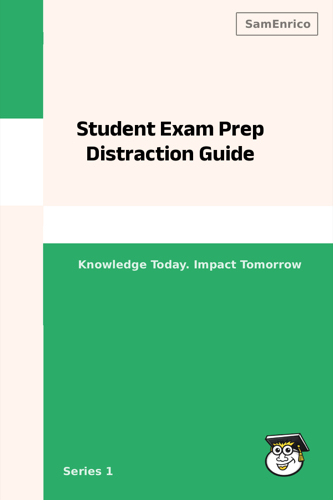
Student Exam Prep Distraction Guide eBook
Focuses during intense study sessions.
Focuses during intense study sessions.
Formats
Free sample
Chapter 1: The Willpower Trap--–- Sarah was a third-year medical student who did everything right. She woke up at 5:30 AM, drank a single cup of black coffee, and walked to the library before sunrise. She had color-coded notes, a laminated study schedule, and a family who bragged about her work ethic. She also failed her board exams. Not because she didn't study—she logged 487 hours that semester—but because she couldn't stay focused for more than twelve minutes at a stretch.
Her phone sat silently in her backpack, notifications off, but her hand reached for it every few minutes like a nervous tic. Between those reaches, her mind wandered to patient cases she hadn't seen, emails she hadn't sent, and a growing sense that something was wrong with her. She told herself to try harder. She promised to focus. She woke up earlier the next day and did the same thing.
This is not a story about laziness. This is a story about the most expensive lie in education: the belief that distraction is a moral failure and willpower is the cure.The Myth of the Lazy Student Every year, thousands of students answer the same question: "Why do you get distracted?" The responses follow a predictable script. "I'm lazy." "I don't have discipline." "I'm just not a focused person." These answers come from honor roll students, graduate school candidates, and struggling freshmen alike. They have been taught—by parents, teachers, and a culture that worships grit—that distraction is a character flaw. The solution, they believe, is to try harder.This belief is not only wrong; it is actively destructive.
When you label yourself as lazy, you close the door to real solutions. You stop asking why distraction happens and start punishing yourself for failing to overcome it. The shame spiral begins: you get distracted, you feel guilty, the guilt drains your energy, you get more distracted, you feel more guilty. By the end of the day, you have accomplished nothing except a deep conviction that you are broken.You are not broken. You are normal.The research on willpower and distraction has undergone a revolution in the past decade.
What we now know contradicts almost everything you have been told about focus. Willpower is not a character trait. Distraction is not a choice. And trying harder is one of the least effective strategies available to you.To understand why, we need to look inside your skull.The Neuroscience of Task-Switching Your brain did not evolve to study for exams. It evolved to survive on the savanna.
This mismatch is the source of nearly every distraction you experience.The human brain weighs about three pounds and consumes twenty percent of your body's energy, despite being only two percent of your mass. It is an expensive organ to run, and evolution is ruthlessly efficient. Your brain is constantly asking one question: "Is this worth the energy?" Reading a textbook chapter on organic chemistry pathways does not trigger an immediate survival threat or reward. A notification buzz? That could be social information, mating opportunity, or threat detection.
Your brain prioritizes the notification every time.This is not a design flaw. It is the reason our species survived. The problem is that modern technology has hijacked this ancient circuitry.When you sit down to study, your brain faces a conflict. The task before you offers delayed, abstract rewards (a good grade, a degree, a career). The potential distraction—your phone, a thought about dinner, a noise in the hallway—offers immediate, concrete stimulation.
Your brain, built for immediate threats and rewards, will always lean toward the distraction unless you have built systems to override that impulse.But here is the critical insight: willpower is the wrong tool for that override.The Neuroimaging Evidence Functional magnetic resonance imaging (f MRI) studies have given us a clear picture of what happens in your brain during task-switching. When you focus on a single task, your prefrontal cortex—the executive control center—maintains a stable pattern of activation. Think of it as a narrow beam of light illuminating one area.When you switch tasks, your brain must perform a sequence of operations: disengage from the previous task (the "set-shifting" cost), activate the rules for the new task (the "goal reactivation" cost), and suppress the lingering activation of the old task (the "proactive interference" cost). Each of these operations consumes glucose and takes time.The most cited study in this field, conducted by Gloria Mark at the University of California, Irvine, found that the average office worker switches tasks every three minutes and five seconds. More importantly, the study measured the "resumption lag"—the time required to return to full focus after an interruption.
That lag averages nearly fifteen minutes.Let me repeat that: after a three-second interruption, it takes approximately fifteen minutes to regain deep focus.Now do the math. If you check your phone for thirty seconds—just a quick glance at a notification—you have lost a quarter-hour of productive cognitive work. A three-hour study session with four phone checks loses an hour to resumption lag. You are not studying for three hours. You are studying for two hours and spending one hour recovering from interruptions.This is the hidden cost of distraction.
You do not feel it because the recovery happens beneath conscious awareness. Your brain slowly ramps back up to full activation, and you experience that ramp-up as "getting back into it." But the clock is running the entire time.Automaticity: How Your Brain Learns Distraction Here is where the situation goes from bad to worse. Your brain is a prediction engine. It constantly learns from your behavior and automates whatever you do most often. This is called automaticity, and it is the reason you can drive a car while talking or type without looking at the keyboard.Automaticity applies to distraction as well as skill.If you habitually study with your phone face-up on the desk, your brain learns that studying and phone-checking are paired activities.
Over time, the act of opening a textbook triggers an urge to check your phone. You do not decide to check it; you just reach. That is automaticity.If you study while watching Netflix in the background, your brain learns that academic text and narrative video are processed simultaneously. But they are not processed simultaneously—you are task-switching every few seconds, burning glucose, and training your brain to expect constant novelty. When you sit down to an exam with none of that novelty, your brain experiences deprivation.
It searches for the missing stimulation. That searching feels like anxiety, boredom, and the overwhelming urge to look away from the test.The Practice Paradox This brings us to the most important concept in this book: the Practice Paradox.Every study session is practice. You are either practicing focused attention or practicing distraction. There is no neutral. Your brain does not distinguish between "real work" and "just checking something quickly." It only distinguishes between patterns of activation.
Whatever pattern you repeat becomes stronger.The student who studies for six hours but checks Instagram forty times has spent six hours practicing the following sequence: start, interrupt, recover, start, interrupt, recover.…
This is the end of the free sample. Get the eBook to keep going. Buy now
About this book
Details
- Author
- Massey Santos
- Publisher
- SamEnrico
- Language
- English
- Genre
- Non-Fiction, Self-Help, Study Skills
- Released
- 2026-06-09
- Pages (approx.)
- 141
- Available as
- eBook, Audiobook

Read better in the ZLOADR app
Your eBooks on your phone or tablet. Sign in with your SamEnrico account and start reading.
More by Massey Santos
 Performance Stress Relationship GuideMassey Santos$11.99
 The Restaurant BasementMassey Santos$11.99
 Listening In Mentoring GuideMassey Santos$11.99
 The Quit Smoking Secondhand KidsMassey Santos$11.99
 Psychological First Aid GuideMassey Santos$11.99
 The Brazilian CousinMassey Santos$11.99
 EQ for Empty Nest ParentsMassey Santos$11.99
 Dream Drawing Journal GuideMassey Santos$11.99
 The Virtuoso and the Court: Chevalier de Saint-Georges and the EnlightenmentMassey Santos$11.99
 The Snow Warriors: How Extreme Skiing Conquered the Mountains (1960s-1970s)Massey Santos$11.99
 The Blackout: When the Lights Went Out ForeverMassey Santos$11.99
 The Mineral Guide to LansforditeMassey Santos$11.99
You may also like
 Hong Kong Handover 1997Dunn Johnnie$11.99
 Zumba For Postnatal Recovery CourseNeal Christian$11.99
 Zumba for BeginnersLadner Nikia$11.99
 YouTube Comment Mining GuideHumes Pandora$12.99
 Worry Box MeditationCarlin Rudy$11.99
 Workplace Stress MeditationNguyen Lynn$11.99
 Workplace Stress and Sleep RepairHawley Ivory$11.99
 Workplace Perfectionism CureDelaney Jeffry$11.99
 Workplace Injustice Anger GuideWallen Isabelle$11.99
 Work Addiction and Burnout LinkGreenwood Ester$11.99
 Women in Yoga and WellnessBeattie Galina$11.99
 Women in Stand Up ComedyChun Evangeline$11.99