
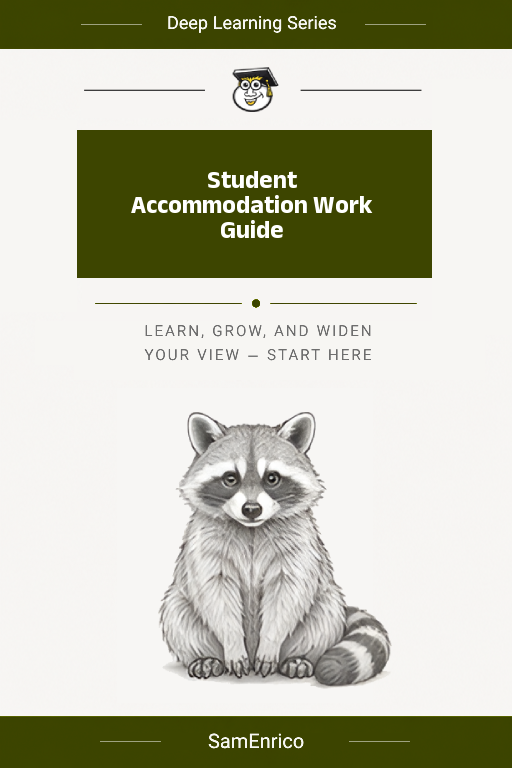
Student Accommodation Work Guide eBook
Work as residence assistant or building manager in
Work as residence assistant or building manager in exchange for reduced rent or stipend.
Formats
Free sample
Chapter 1: The $15,000 Question--–- Every fall, thousands of students sign housing contracts that will save them more money than they will earn in any campus job—yet most have no idea how to calculate what they are actually worth. They walk into interviews underprepared, accept the first offer that comes their way, and spend an academic year exhausted, confused, and wondering why nobody told them the rules of the game. This book is that missing instruction manual.You are about to make one of the most financially significant decisions of your college career. Not because you are choosing between two dorms or deciding whether to live off-campus. Because you are considering a transaction that most students never even realize exists: trading your time, emotional energy, and availability for a roof over your head.The live-in student staff role—whether called Resident Assistant, Community Advisor, Hall Manager, or Resident Tutor—is not a job in the traditional sense.
It is a hybrid creature, part employment, part housing agreement, part social experiment. And like any hybrid, it carries both extraordinary advantages and hidden dangers.This chapter answers the single most important question you need to ask before you apply for any live-in role: What is this actually worth, and is it worth it for me?We will dismantle the myths that keep students from understanding their own value. We will map the landscape of roles available to you, from the entry-level floor RA to the senior Hall Manager who supervises an entire building. We will introduce the three compensation models—tuition remission, rent reduction, and stipend—and show you why the difference between them can mean thousands of dollars in your pocket or a surprise tax bill. And we will end with a self-assessment that forces you to choose: are you doing this for the money, or for the resume?By the time you finish this chapter, you will know exactly which roles to target, what questions to ask in every interview, and whether you belong in the cash-strapped camp or the leadership-seeking camp.
The rest of the book will build on this foundation. But first, you need to understand what you are actually signing up for.The Two Myths That Keep Students Broke and Burned Out Before we define what a live-in role actually is, we need to clear away what it is not. Popular culture and campus gossip have created two competing myths about RA work, and both are dangerous.Myth One: The Powerless Hall Monitor This myth says that RAs are glorified babysitters with clipboards—students who have been given a tiny amount of authority and no real power to use it. In this version, you spend your nights knocking on doors to tell people to be quiet, filing pointless reports that nobody reads, and being ignored by everyone on your floor. The compensation is barely worth mentioning, and the experience adds nothing to your resume.This myth keeps smart, ambitious students from applying.
They assume the role is beneath them, that they would be wasting their time on trivialities when they could be building real skills elsewhere.Here is the truth: The powerless hall monitor is a fiction created by RAs who never learned to use the authority they actually had. Yes, you will knock on doors. Yes, you will file reports. But those reports go to Housing administrators who make disciplinary decisions that affect whether residents can stay in university housing. Your observations carry weight.
Your recommendations matter. And the skills you develop—crisis management, policy enforcement, documentation, boundary-setting—are the exact same skills that entry-level managers in corporate housing, residential treatment centers, and university student affairs use every day.The powerless hall monitor is not a description of the job. It is a description of a person who never learned to do the job well.Myth Two: The Self-Sacrificing Martyr This myth is the mirror image of the first. It says that RAs are heroes who sacrifice their privacy, their social lives, and their mental health for the good of their communities. In this version, you are always on call, always available, and always putting residents first.
The compensation is generous, but you earn every penny through sleepless nights and emotional exhaustion.This myth keeps students from setting boundaries. They assume that burnout is inevitable, that saying no to a resident's 2 AM knock is a moral failure, and that their own well-being is secondary to the job.Here is the truth: The self-sacrificing martyr is a fiction created by RAs who never learned to protect their own time and energy. Yes, you will have duty rotations. Yes, you will be woken up occasionally. But a well-structured live-in role includes defined duty hours, backup systems, and supervisors who (if they are competent) will tell you to prioritize your studies and your sleep.
The job is demanding, but it is not supposed to destroy you. If it does, something has gone wrong—either with your boundaries or with the program you joined.The real live-in role sits between these two myths. You have genuine authority, but you must learn to use it. You will make real sacrifices, but you must learn to limit them. The rest of this chapter—and this entire book—is about finding that balance.The Spectrum of Live-In Roles: Four Jobs That Look Alike but Pay Very Differently Not all live-in roles are created equal.
In fact, the title on your offer letter matters less than the specific combination of duties, hours, and compensation attached to it. Across universities and private student housing companies, four core roles appear again and again. Understanding the differences between them is your first step toward making a smart decision.Resident Assistant (RA)The Resident Assistant is the most common live-in role, found at virtually every university that operates residence halls. You are assigned to a floor or section of a building, typically housing 30 to 60 residents. Your primary responsibilities are community building (floor meetings, social events, conflict mediation), duty rotations (evening and weekend hours during which you carry a phone and respond to incidents), and policy enforcement (noise complaints, guest violations, safety checks).You report to a professional Hall Director or a senior student staff member.
Compensation usually includes 50 to 100 percent reduction on your housing costs, sometimes plus a small stipend of 500to500 to 500to2,000 per semester. Meal plan coverage varies widely—some programs include it, others do not.The RA role is ideal for students who want a moderate level of responsibility and are primarily motivated by rent savings. It is also the most competitive role because it offers the best balance of compensation and time commitment at most universities.Community Advisor (CA)The Community Advisor role exists primarily in private student housing complexes—buildings owned by companies like American Campus Communities, Greystar, or Landmark Properties rather than by the university itself. These are often the large, amenity-rich buildings located just off campus.As a CA, you are responsible for a floor or building of residents who are leaseholders, not dormitory occupants. This changes the dynamic significantly.
Your residents have signed legal leases, which means your enforcement of policies (noise, guests, parking) has more legal weight but also…
This is the end of the free sample. Get the eBook to keep going. Buy now
About this book
Details
- Author
- Hendrick Jenifer
- Publisher
- SamEnrico
- Language
- English
- Genre
- Non-Fiction, Student's Shortcut, Housing
- Released
- 2026-05-30
- Pages (approx.)
- 146
- Available as
- eBook, Audiobook

Read better in the ZLOADR app
Your eBooks on your phone or tablet. Sign in with your SamEnrico account and start reading.
More by Hendrick Jenifer
 Franchising Your Local Brand Across Borders Anti Money LaunderingHendrick Jenifer$11.99
 Poker Addiction Recovery HandbookHendrick Jenifer$11.99
 Testosterone Journal LogHendrick Jenifer$11.99
 Alcoholism and Pancreatitis RecoveryHendrick Jenifer$11.99
 Running HIIT WorkoutsHendrick Jenifer$11.99
 Food Addiction and BipolarHendrick Jenifer$11.99
 RV Full Time Living GuideHendrick Jenifer$11.99
 Memory For Standardized TestsHendrick Jenifer$11.99
 The Star Chart of the Dogon: Africa’s Celestial GeniusHendrick Jenifer$11.99
 The Vampire of Dusseldorf: Germany's Blood-Curdling 19th-Century MysteryHendrick Jenifer$11.99
 How to Start a off Licence (not Public House) (retail) Business (Beginners Guide)Hendrick Jenifer$11.99
 How to Produce Stain and FinishHendrick Jenifer$11.99
You may also like
 Student Housing Dubai GuideMoffett Lilia$11.99
 The German Student Accommodation GuideBenevides Liliana$11.99
 Student Accommodation TurkeyKincaid Isobel$12.99
 Rwanda Student Accommodation TipsDaugherty Krystyna$12.99
 Accommodation ComparisonTravis Flor$12.99
 Student Housing Argentina GuideBoland Lilian$12.99
 Accommodation Options GuideHogan Mike$12.99
 Accommodation for Students ChinaJoy Marna$12.99
 Student Housing Brazil GuideRhodes Carmen$12.99