

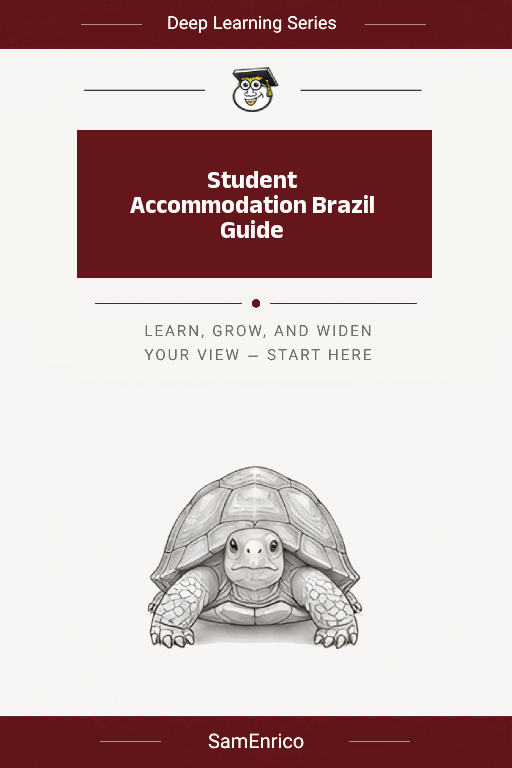
Non-FictionStudent's ShortcutBrazil Housing
Student Accommodation Brazil Guide eBook
Find housing near USP, UNICAMP, or UFRJ as an inte
by Roach Eldora
Find housing near USP, UNICAMP, or UFRJ as an international student.
Formats
Free sample
Chapter 1: The Fiador Abyss...--You have just been accepted into one of Brazil’s most prestigious universities—USP in São Paulo, UNICAMP in Campinas, or UFRJ in Rio de Janeiro. The excitement is real. You imagine sun-drenched study sessions, vibrant street parties, and the kind of cultural immersion that changes a person forever. But there is a silent killer of Brazilian dreams, and it has nothing to do with academics, language barriers, or homesickness. It is a four-syllable word that has destroyed more exchange semesters than missed flight connections: fiador.If you arrive in Brazil without understanding the fiador system, you are walking blindfolded into a maze.
Landlords will smile at you, shake your hand, and then ask for a document you cannot possibly provide. You will watch perfect apartments slip away while local students sign leases without breaking a sweat. You will begin to wonder if you made a terrible mistake.You did not make a mistake. You simply did not know the rules of the game. This chapter is your rulebook.Here is the unfiltered truth: Brazil is not the United States, Germany, or Japan.
It does not have centralized university dormitories waiting for you. It does not have a culture of all-inclusive student housing packages. What it has is a landlord-driven, highly fragmented, deeply informal market where connections matter more than credit scores, and where the concept of a fiador (guarantor) is the golden key to every rental door.By the end of this chapter, you will understand why approximately thirty percent of Brazilian students live away from home yet still struggle to find housing. You will master the three housing archetypes—repúblicas, kitnets, and pensões—and know exactly which one aligns with your budget, personality, and risk tolerance. Most importantly, you will learn how to navigate the fiador abyss using a tactical decision tree that turns an impossible requirement into a negotiable detail.Let us begin.The 30% Illusion: Why Everyone Struggles Before we discuss your unique challenges as an international student, let us establish a baseline.
Roughly thirty percent of Brazilian university students live away from their family home during their studies. This percentage is similar to the United States, where approximately thirty-five percent of four-year university students live on or near campus, and Germany, where the rate hovers around twenty-eight percent.The difference is not the number of students. The difference is the infrastructure.In the United States, major universities guarantee on-campus housing for first-year students. Resident advisors, meal plans, and maintenance request portals are standard. In Germany, the Studentenwerk system provides subsidized dormitories with transparent waiting lists.
In Brazil, none of that exists at scale.Consider USP, Brazil’s largest and most prestigious university. Its main campus, the Cidade Universitária, serves approximately sixty thousand undergraduate students. Its on-campus housing system, CRUSP (Conjunto Residencial da Universidade de São Paulo), offers roughly sixteen hundred vacancies. That is approximately 2.6 percent of the student population. UNICAMP performs slightly better, housing about one thousand students out of roughly nineteen thousand undergraduates—still only about 5 percent.
UFRJ’s on-campus housing is even more constrained.The remaining ninety-five percent of students—Brazilian and international alike—must find housing in the private market.This is not because Brazilian universities are negligent. It is a historical artifact. Brazil’s public universities were designed as commuter institutions in the mid-twentieth century, when most students lived with their families in the same city. The explosion of university enrollment over the past thirty years, combined with the migration of students from smaller cities to major academic centers, has dramatically outpaced the construction of university-owned housing.What this means for you is simple and brutal: you are entering a competitive, landlord-driven market where you have no natural advantage over local students. In fact, you have several disadvantages.
You have no Brazilian credit history. You have no local guarantor. You are not fluent in the language of real estate contracts. And you are racing against thousands of Brazilian students who have been navigating this system since their first week of undergraduate orientation.The purpose of this chapter—indeed, this entire book—is to turn those disadvantages into negotiable points rather than deal-breakers. You will never out-local a local.
But you can out-prepare them.The Three Housing Archetypes: República, Kitnet, and Pensão Brazilian student housing falls into three distinct categories. Each has its own culture, cost structure, and legal framework. Understanding the differences is not academic trivia. It will determine whether you spend your semester studying peacefully or fighting with roommates over dirty dishes at 2 AM.Repúblicas: The Self-Governing Collective The word república in Brazilian Portuguese does not mean "republic" in the political sense. It comes from the idea of a self-governing community—a group of students who collectively rent a house or large apartment and manage everything themselves.Repúblicas are the most common form of student housing in Brazil, particularly in cities with large university populations like São Paulo (USP), Campinas (UNICAMP), and Rio de Janeiro (UFRJ).
They range in size from three to twenty students, though the most common size is between four and eight residents.The Governance Spectrum Many guidebooks treat all repúblicas as identical party houses or, conversely, as perfectly organized cooperatives. The reality is that repúblicas exist on a spectrum, and you must ask which type you are joining before you move in.At one end of the spectrum are informal repúblicas. These operate on unwritten social contracts. Chores are handled by goodwill. Quiet hours are negotiated in the moment.
Rent is collected by whichever student happens to have the landlord’s bank account information. These repúblicas work well when the residents are close friends or share identical lifestyles. They fall apart spectacularly when a new international student arrives with different expectations about noise, cleanliness, or personal space.At the other end of the spectrum are formalized repúblicas. These have written governance documents—sometimes called regimento interno (internal rules)—that specify everything from chore rotations (rotas de limpeza) to financial penalties for missed tasks (multas). These repúblicas often hold monthly house meetings (reuniões da república), maintain a shared bank account for household expenses, and have clearly defined roles such as treasurer, cleaning coordinator, and social organizer.Most repúblicas fall somewhere in the middle.
They have informal rules that have been repeated so often they function as traditions, but no one has ever written them down. The key is that you, as an incoming resident, have the right to ask for clarity before you commit.Your pre-move-in question: "Is this a formal or informal república? Do you have written rules? Is there a multa system for missed chores?" The answers will tell you everything about whether you will fit in.Why Repúblicas Are Invisible on Formal Platforms You will not find most repúblicas on Quinto Andar or Zap Imóveis. Landlords typically rent entire houses to a single responsible student—often a senior or graduate student—who then sublets individual rooms to others.
This means the best república listings are never publicly advertised. They spread through Whats App groups, Facebook communities, and word…
This is the end of the free sample. Get the eBook to keep going. Buy now
About this book
Details
- Author
- Roach Eldora
- Publisher
- SamEnrico
- Language
- English
- Genre
- Non-Fiction, Student's Shortcut, Brazil Housing
- Released
- 2026-05-29
- Pages (approx.)
- 140
- Available as
- eBook, Audiobook

Read better in the ZLOADR app
Your eBooks on your phone or tablet. Sign in with your SamEnrico account and start reading.
More by Roach Eldora
 Divorce Shame RecoveryRoach Eldora$11.99
 Road Rage Self Defense LawsRoach Eldora$11.99
 Breast Cancer Pathology ReportRoach Eldora$11.99
 Remote Work Policy NoteRoach Eldora$11.99
 Meditation for Existential AnxietyRoach Eldora$11.99
 Authority Persuasion TechniquesRoach Eldora$11.99
 Anticipatory Grief Nature TherapyRoach Eldora$11.99
 Constraints for ActorsRoach Eldora$11.99
 The Forgotten Champions: How Ottoman Footballers Defied the Empire (1870s-1890s)Roach Eldora$11.99
 The Candaces of Kush: Queens Who Ruled an EmpireRoach Eldora$11.99
 How to Produce Paint EquipmentRoach Eldora$11.99
 A Collector's Handbook to the Triumph Dolomite 14Roach Eldora$11.99
You may also like
 Hong Kong Handover 1997Dunn Johnnie$11.99
 Zumba For Postnatal Recovery CourseNeal Christian$11.99
 Zumba for BeginnersLadner Nikia$11.99
 YouTube Comment Mining GuideHumes Pandora$12.99
 Worry Box MeditationCarlin Rudy$11.99
 Workplace Stress MeditationNguyen Lynn$11.99
 Workplace Stress and Sleep RepairHawley Ivory$11.99
 Workplace Perfectionism CureDelaney Jeffry$11.99
 Workplace Injustice Anger GuideWallen Isabelle$11.99
 Work Addiction and Burnout LinkGreenwood Ester$11.99
 Women in Yoga and WellnessBeattie Galina$11.99
 Women in Stand Up ComedyChun Evangeline$11.99