
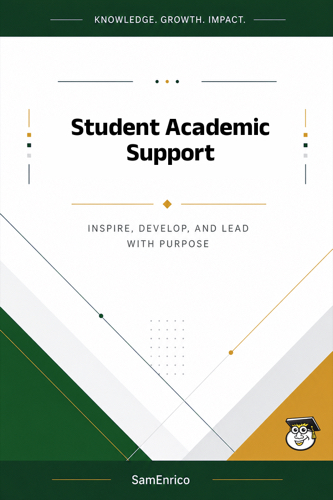
Non-FictionStudent's ShortcutAcademics
Student Academic Support eBook
Use tutoring centers and writing labs effectively.
by Duran Sylvie
Use tutoring centers and writing labs effectively.
Formats
Free sample
Chapter 1: The Shame Spiral--–- The email arrived at 11:47 PM on a Sunday. Rachel, a first-year pre-med student, had been staring at her organic chemistry textbook for four hours. She had read the same paragraph about nucleophilic aromatic substitution at least six times. The words blurred together. Her vision pulsed with the beginnings of a stress headache.
She had not eaten dinner. She had not texted her roommate back. She had not moved from her desk except to refill her water bottle, which now sat empty beside three crushed energy drink cans.The email was from her professor. Subject line: “Exam 1 Grades Posted.” Rachel’s heart hammered as she clicked the link to the learning management system. She had studied for twelve hours.
She had made flashcards. She had highlighted nearly every sentence in the textbook. She had done everything right. The grade loaded: 54 percent. F.Rachel closed her laptop, walked to the bathroom, and sat on the cold tile floor.
She did not cry. She felt something worse than sadness. She felt shame. Hot, pulsing, suffocating shame. She thought about her parents, who had taken out a second mortgage to pay for her tuition.
She thought about her high school valedictorian speech, where she had talked about “rising to any challenge.” She thought about the tutoring center flyer posted on the bulletin board outside her chemistry lecture hall, the one with the cheerful graphic of a lightbulb and the words “We Can Help!” She had walked past that flyer every day for three weeks. Each time, she told herself the same thing: “I don’t need help. I’m not that kind of student.”Rachel’s story is not unusual. It is, in fact, the most common story on college campuses across America. Thousands of students—perhaps you are one of them—are trapped in what psychologists call the “shame spiral.” It works like this: you struggle with a subject.
You tell yourself you should be able to figure it out alone. You try harder. You fail. You interpret that failure as proof that you are not smart enough. You feel ashamed.
Shame makes you hide. Hiding means you do not seek help. Without help, you struggle more. The spiral tightens. Each loop makes the shame worse and the possibility of asking for help more terrifying.This chapter exists to break that spiral.
Not with vague encouragement, but with hard data, psychological insight, and a practical framework that has worked for tens of thousands of students. The truth—the real truth, not the comforting lie—is that the shame spiral is built on a foundation of myths. Myths about intelligence. Myths about struggle. Myths about what it means to need help.
Once you see those myths for what they are, the spiral loses its power.The Myth of Effortless Genius Let us start with the most damaging myth of all: the belief that truly smart people do not have to try very hard. This myth is everywhere. It lives in movies where the genius solves complex equations in seconds, barely looking at the page. It lives in classrooms where the student who raises their hand first is celebrated as the brightest. It lives in the private thoughts of almost every college student: “If I were really smart, this would come easily to me.”This myth has a name in psychology: entity theory of intelligence.
It is the belief that intelligence is a fixed trait—something you are born with, like eye color or height. People who hold entity theory believe that effort is a sign of inadequacy. If you have to study, you are not naturally gifted. If you have to go to the tutoring center, you are not really smart. If you struggle, you are a fraud.The opposite belief is called incremental theory of intelligence: the understanding that intelligence is not fixed but grows with effort, strategy, and support.
Incremental theorists do not see struggle as evidence of inadequacy. They see it as evidence of growth. They do not see tutoring as a confession of weakness. They see it as a tool for building strength.Decades of research by psychologist Carol Dweck and her colleagues have shown that incremental theorists outperform entity theorists across every measure: grades, test scores, graduation rates, even career success. The difference is not raw ability.
It is what you believe about your own ability. Students who believe they can grow do grow. Students who believe they are fixed stay stuck.Here is the most important sentence in this chapter: Struggle is not a sign that you do not belong. It is a sign that you are learning something hard. Every person who has ever mastered a difficult subject has struggled.
The only difference between those who succeed and those who give up is whether they see struggle as evidence of their limitations or as evidence of their courage.The Tutoring Paradox If incremental theory is so powerful, why do so many students cling to entity theory? Partly because our educational system rewards speed. The student who finishes the exam first, who answers the question without hesitation, who never seems to break a sweat—that student is celebrated as brilliant. The student who labors, who revises, who asks questions, who visits the tutoring center—that student is often seen as less capable, even when their final grade is the same or better.This is the tutoring paradox: the students who need tutoring most are often the least likely to seek it, and the students who seek tutoring most are often the ones who least “look” like they need it. Data from the National Tutoring Association shows that students with A and B averages account for nearly 40 percent of tutoring center visits on most campuses.
These students are not coming because they are failing. They are coming because they have learned something that struggling students have not: tutoring works. It works when you are doing well. It works when you are doing poorly. It works for everyone.Let me tell you about David, a student I will never forget.
David was a physics major at a large public university. He had a 3.9 GPA. He was on track for graduate school. He also visited the tutoring center every single week, for every single physics class, for four years. When I asked him why, he looked at me like I had asked why he breathed air.
“Because I want to be better,” he said. “The tutoring center is where I go to turn a B+ into an A. It’s where I go when I mostly understand something but want to understand it completely. It’s where I go to practice explaining concepts out loud so I don’t freeze during exams.”David understood something that most students do not: tutoring is not remediation. It is optimization.
The same principle applies to writing labs. The best writers on campus—the students who win awards, who publish in undergraduate journals, who go on to top graduate programs—are the heaviest users of writing center services. They know that writing is revision. They know that feedback is fuel. They know that the lone writer hunched over a laptop at 2…
This is the end of the free sample. Get the eBook to keep going. Buy now
About this book
Details
- Author
- Duran Sylvie
- Publisher
- SamEnrico
- Language
- English
- Genre
- Non-Fiction, Student's Shortcut, Academics
- Released
- 2026-06-07
- Pages (approx.)
- 143
- Available as
- eBook, Audiobook

Read better in the ZLOADR app
Your eBooks on your phone or tablet. Sign in with your SamEnrico account and start reading.
More by Duran Sylvie
 Flow in Physical ExerciseDuran Sylvie$11.99
 Screen Time TimerDuran Sylvie$11.99
 Dental Evidence StandardsDuran Sylvie$11.99
 Collaborative Metaphor Generation GuideDuran Sylvie$11.99
 Acupuncture for VertigoDuran Sylvie$11.99
 Self Hypnosis for Back PainDuran Sylvie$11.99
 The Siege of Malaga: The Last Stand of the Nasrid KingdomDuran Sylvie$11.99
 The Armada's Last Code: DNA and Defeat in the English ChannelDuran Sylvie$11.99
 Somali Cats: Fox-like BreedDuran Sylvie$11.99
 How to Produce Piercing NeedlesDuran Sylvie$11.99
 How to Produce Dental ToolsDuran Sylvie$11.99
 How to Become a Merchant PatrollerDuran Sylvie$11.99
You may also like
 Hong Kong Handover 1997Dunn Johnnie$11.99
 Zumba For Postnatal Recovery CourseNeal Christian$11.99
 Zumba for BeginnersLadner Nikia$11.99
 YouTube Comment Mining GuideHumes Pandora$12.99
 Worry Box MeditationCarlin Rudy$11.99
 Workplace Stress MeditationNguyen Lynn$11.99
 Workplace Stress and Sleep RepairHawley Ivory$11.99
 Workplace Perfectionism CureDelaney Jeffry$11.99
 Workplace Injustice Anger GuideWallen Isabelle$11.99
 Work Addiction and Burnout LinkGreenwood Ester$11.99
 Women in Yoga and WellnessBeattie Galina$11.99
 Women in Stand Up ComedyChun Evangeline$11.99