
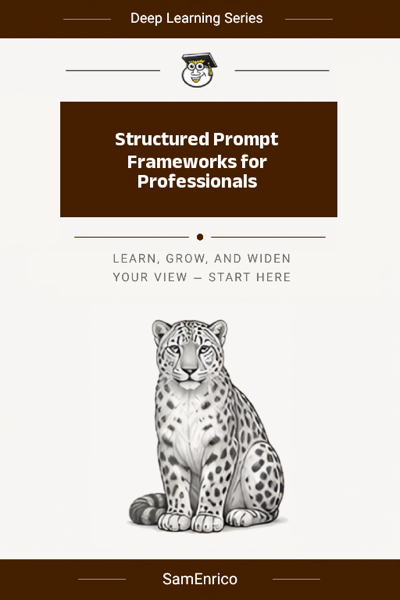
Structured Prompt Frameworks for Professionals eBook
A Coursebook on Structured Prompt Frameworks for P
A Coursebook on Structured Prompt Frameworks for Professionals
Formats
Free sample
Chapter 1: The Last Good Sentence...--Let me tell you about the most expensive sentence ever typed. It wasn't written on a trading floor during a flash crash. It wasn't scrawled on a napkin that launched a billion-dollar lawsuit. It was typed on a Tuesday morning by a mid-level marketing manager named Chloe, who needed a quick social media caption. Chloe typed: "Write a post about our new product." The AI generated something bland.
She tweaked it. The AI generated something else. She gave up and wrote it herself. The whole process took forty-five minutes.Across the office, her colleague Marcus typed: "You are a senior copywriter with ten years of experience in luxury beauty. Our new product is a vitamin C serum that reduces dark spots in fourteen days.
Our target audience is women aged thirty-five to fifty who have tried everything and are skeptical of claims. Write three Instagram caption options. Each caption must open with a surprising fact about vitamin C, include exactly one emoji, end with a question that drives comments, and stay under 220 characters. Format each option as Option 1, Option 2, Option 3 with a blank line between."The AI generated three excellent options in twelve seconds. Marcus picked one, posted it, and went back to his coffee.
Chloe and Marcus have the same AI tool. The same internet connection. The same deadline. The difference between forty-five minutes of frustration and twelve seconds of execution wasn't experience, intelligence, or creativity. It was the difference between typing a question and engineering a prompt.That difference is worth thousands of dollars per week.
Per employee. And right now, the vast majority of professionals are typing like Chloe.The High Cost of Vagueness Let's start with a provocation that might sting: if you cannot get a useful answer from an AI, the problem is almost never the AI. The problem is the question. We have been trained by a lifetime of human conversation to believe that clarity is optional—that if we say something vaguely, the other person will ask clarifying questions, fill in the gaps, or figure out what we meant. This works with humans because humans have shared context, theory of mind, and a deep well of assumptions about the world.
They know when you say "write a report" you probably mean a business report, not a police report or a school book report.Large language models have none of these things. They have no shared context with you. They have no theory of mind—they cannot guess what you meant but didn't say. They have a statistical map of language patterns, not a lived understanding of your industry, your company, your customers, or your deadline. When you type "write a project update," the AI scans its training data and produces the statistical average of every project update it has ever seen.
That average is generic, safe, and almost useless for any specific professional context.This is the High Cost of Vagueness, and it manifests in five predictable ways.First: Output Variability. Ask the same vague question twice and you will get two different answers. This is not creativity; it is statistical drift. The model has no clear target, so it samples from a wide distribution of possibilities. One time you get a bulleted list.
Next time you get a paragraph. Next time you get a question back asking what you meant. Professionals cannot build workflows around variability. You need consistency. Vagueness destroys it.Second: Hallucination.
When a model does not know the answer, it invents one. This is not malice; it is architecture. The model is designed to produce plausible continuations of text. If the prompt does not ground the model in reality, it will ground itself in probability, and probability is not truth. We will explore the four types of hallucination in detail later in this chapter—factual, authority, reasoning, and formatting—but for now, understand that vagueness is the single greatest predictor of hallucination.Third: Generic Output.
Vague prompts produce vague answers. "Write a marketing email" produces "Dear valued customer, we are excited to announce..." This is the language of no one, addressed to no one, saying nothing. Professionals who accept generic output are training their colleagues, clients, and bosses to ignore their communications. Generic is invisible. Invisible is worthless.Fourth: Rework Loops.
The vague prompt produces a bad answer. You correct it. The AI produces another bad answer. You correct it again. You find yourself in a long, frustrating loop where you are essentially writing the output yourself while pretending the AI is helping.
This is not collaboration; it is a time tax. Research suggests knowledge workers spend an average of four hours per week wrestling with AI outputs that should have been correct on the first or second attempt.Fifth: Erosion of Trust. The most insidious cost. After enough vague prompts produce bad answers, professionals conclude that "AI doesn't work." They stop using it. They tell their colleagues it is overhyped.
They fall behind competitors who invested the fifteen minutes required to learn structured prompting. The AI did not fail. The prompt failed. But the professional blames the tool and loses the competitive advantage.Chloe in our opening story suffered all five costs in forty-five minutes. Marcus suffered none.
The difference was not intelligence. It was structure.The Great Misconception: AI as Oracle Let me name the misconception that is costing professionals billions of hours: the Oracle Fallacy. The Oracle Fallacy is the belief that AI models are vast repositories of knowledge that you can simply "ask" like a genie, a wizard, or a very well-read colleague. This misconception is reinforced by every interface that puts a blinking cursor in a chat box and invites you to "Ask me anything."Here is the truth that changes everything: the model does not know anything. It does not have beliefs.
It does not have memories. It does not have access to a database of facts that it checks before responding. What it has is a mathematical function that predicts the next most probable token given the previous tokens. That is it. When you ask "What is the capital of France?" the model does not consult a mental map of Europe.
It calculates that after the sequence "What is the capital of France" the most probable next token is "Paris" followed by a period. This works for simple factual questions because the training data contains so many examples that the probability distribution is extremely narrow.But when you ask "Write a project update for our Q3 launch," the probability distribution is extremely wide. The model has seen project updates from software companies, construction firms, non-profits, government agencies, and middle school science fairs. It has seen good ones, bad ones, and ones written by people who hate their jobs. The statistical average of all these is not what you want.
It is what no one wants.The Oracle Fallacy leads professionals to treat the AI as a passive recipient of questions rather than an active engine that needs fuel. The fuel is structure. Stop thinking of the AI as something you ask. Start thinking of it as something you engineer. The shift from "asking" to "engineering" is the single…
This is the end of the free sample. Get the eBook to keep going. Buy now
About this book
Details
- Author
- Pannell Garret
- Publisher
- SamEnrico
- Language
- English
- Genre
- Non-Fiction, Informative, Educational
- Released
- 2026-05-07
- Pages (approx.)
- 146
- Available as
- eBook, Audiobook

Read better in the ZLOADR app
Your eBooks on your phone or tablet. Sign in with your SamEnrico account and start reading.
More by Pannell Garret
 MBSR Complete Home CoursePannell Garret$11.99
 Daily Doodle Habit GuidePannell Garret$11.99
 Michelle ObamaPannell Garret$11.99
 LinkedIn Profile Optimization GuidePannell Garret$11.99
 Chiropractic for SciaticaPannell Garret$11.99
 The EQ for Customer ServicePannell Garret$11.99
 Focus Mate Pairing GuidePannell Garret$11.99
 The Spiritual Awakening StepPannell Garret$11.99
 Forgiveness Trance WorkPannell Garret$11.99
 The Storm from the Steppe: Subutai's Unstoppable Campaigns (1236-1242)Pannell Garret$11.99
 Whispers in the Wild: The Octopus Who Outsmarted the LabPannell Garret$11.99
 The Dragon’s Apprentice: A Knight’s Forgotten MentorPannell Garret$11.99