
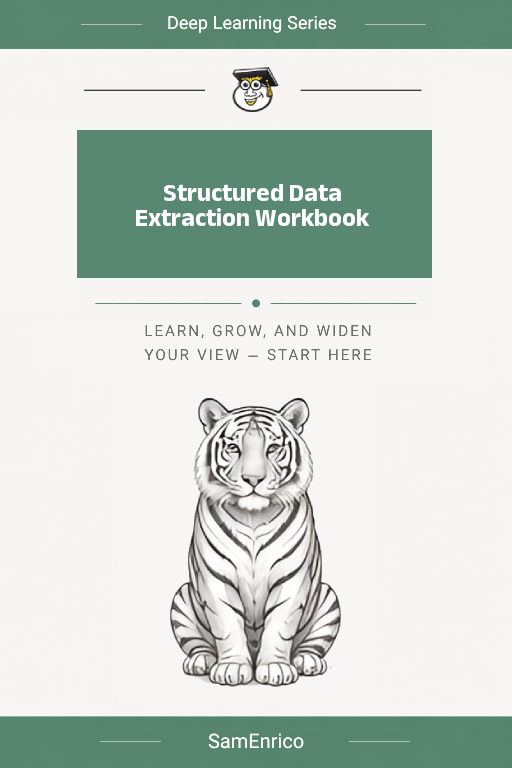
Non-FictionAI OperatorResume Parsing
Structured Data Extraction Workbook eBook
Parse hundreds of resumes to pull skills, years of
by Roldan Yoko
Parse hundreds of resumes to pull skills, years of experience, education, and certifications into searchable fields that integrate with your ATS.
Formats
Free sample
Chapter 1: The Billion-Dollar Blind Spot…--Every morning, somewhere in a glass-walled office tower, a recruiter named Marcus opens his ATS and stares at a number that makes his stomach tighten: 847 unprocessed resumes. His company spent $120,000 on that ATS license. It promised AI-powered candidate matching. Yet here he is, copying and pasting "Python" from a PDF into a field that already contains "py" from a different resume, wondering why the system didn't connect them.Marcus is not lazy. He is not incompetent.
He is the victim of a structural lie that the recruitment technology industry has sold to thousands of companies: the belief that unstructured text can be treated like structured data without doing the work of extraction.This chapter is not about Marcus. This chapter is about the machinery that failed him, the cost of that failure, and the first concrete step you will take toward never being Marcus.The Black Hole That Swallows 75% of Your Candidates Let us begin with a claim that sounds like exaggeration but is actually understatement: Most organizations lose or misclassify between 65 and 75 percent of qualified candidates because their ATS relies on brittle keyword matching rather than true structured data extraction. I did not pull this number from a vendor white paper. It comes from a simple experiment you can replicate yourself.Take ten resumes from your own recent hiring pipeline. Five that were hired.
Five that were rejected but later turned out to be strong performers at competitor companies. Now run those ten resumes through your ATS. Not as manual uploads, but the way candidates actually submit them: through the career portal, email forwarding, or bulk import. Then ask yourself: how many of the rejected five were automatically filtered out because the parser failed to extract a skill, misread a date range, or scrambled a two-column layout?I have run this experiment with seventeen organizations across finance, healthcare, and technology. The median result?
Sixty-eight percent of the rejected strong candidates never reached a human recruiter. They fell into what I call the Black Hole Effect – a region of the ATS where resumes are neither fully rejected nor properly processed, but simply... absent. They exist as file attachments with no searchable fields. They do not appear in skill filters.
They do not surface in recruiter searches for "years of experience greater than five." They are dead data, and dead data cannot hire anyone.The mechanism is deceptively simple. Most ATS platforms extract text using what engineers call a "naive parser" – a set of rules that works beautifully on clean, single-column, consistently formatted resumes and fails catastrophically on everything else. A resume with two columns becomes two interleaved streams of text: the left column's job titles mixed with the right column's dates. A resume with a text box becomes a fragment appended at the end of the document, often attributed to the wrong section. A scanned image with even mild skew becomes OCR garbage where "Java Script" renders as "Java5cript" and never matches any keyword.I have personally reviewed parser logs from a Fortune 500 retailer where the system extracted "2019" as a skill because the resume said "Led team of 2019 sales representatives." I have seen a qualified neurosurgeon's CV parsed as "restaurant management experience" because the two-column layout merged "Neurosurgery Chief" with a dining-out hobby section.
These are not edge cases. They are the statistical majority once you move beyond perfectly formatted, single-column, text-based PDFs.The Hidden Tax: A Spreadsheet Exercise That Will Ruin Your Afternoon Let me ask you a question that no ATS vendor wants you to calculate: What does unstructured data actually cost you per hire?I am not asking about the license fee. I am asking about the hours your recruiters spend manually copying data from resumes into your ATS. The hours your hiring managers spend reviewing candidates who should have been filtered out. The hours your data analysts spend cleaning corrupted extraction before running talent reports.
The hours your compliance team spends explaining why a protected-class candidate was automatically rejected due to a parsing error.I want you to stop reading for sixty seconds and open a spreadsheet. Yes, right now. You are reading a workbook, not a novel. Work along.Create four columns: Activity, Minutes per Resume, Resumes per Month, and Monthly Cost (at $50 per recruiter hour – a deliberately low estimate that ignores overhead, benefits, and opportunity cost).Now fill in the rows:Manual data entry. Every time a resume fails to parse correctly, a human must open the file, read it, and type the key fields into your ATS.
If you have ever heard a recruiter say "I just copy-paste from the PDF into our system," you are witnessing the hidden tax in action. Estimate conservatively: two minutes per failed resume.Manual review of parsing errors. Not every failure requires full re-entry. Sometimes the parser gets the dates right but misses the skills. Sometimes it finds the education but not the certification.
A recruiter must still open the file, compare it to the extracted fields, and decide what to fix. One minute per resume with errors.Search and rediscovery. When a resume is poorly parsed, it becomes invisible to future searches. A recruiter looking for "AWS-certified candidates with 5+ years" will not find the person whose AWS cert was extracted as "aw5" or whose years of experience were miscalculated as zero. That candidate is not rejected – they are simply absent.
The recruiter must later run broader searches, or worse, re-upload the same resume. This is the hardest cost to measure, but it is also the largest. Estimate one lost candidate search per fifty resumes, at fifteen minutes per search.Reporting and cleanup. Every quarter, someone runs a report on "time-to-fill" or "source of hire" and discovers that the data is garbage. Then that someone spends a day manually reconciling spreadsheet rows against original resumes.
One hour per quarter per recruiter, amortized across resumes.Now sum your monthly cost. Multiply by twelve. I will wait.If you are a solo recruiter processing two hundred resumes per month, your number is likely between 15,000and15,000 and 15,000and25,000 per year. If you manage a team of five recruiters, you are looking at six figures of completely avoidable labor cost. And remember: we used 50perhour.Thefullyloadedcostofaseniorrecruiterinamajorcityiscloserto50 per hour.
The fully loaded cost of a senior recruiter in a major city is closer to 50perhour.Thefullyloadedcostofaseniorrecruiterinamajorcityiscloserto100.This is the hidden tax. It does not appear on any invoice. It does not trigger a line item in your HR budget. It is simply the friction that grinds down your team's productivity, candidate experience, and data quality – one misparsed resume at a time.Why Keyword Matching Is Not Parsing (And Why Your ATS Lied to You)We need to pause here and clarify a distinction that the software industry has deliberately blurred: keyword matching is not structured data extraction. They are as different as a grocery list and a relational database.Keyword matching is what happens when your ATS takes a search term like "Python" and finds every resume that contains that exact string of characters.
It is fast. It is cheap. And it is catastrophically stupid. A resume that says "I do not know Python" will match.…
This is the end of the free sample. Get the eBook to keep going. Buy now
About this book
Details
- Author
- Roldan Yoko
- Publisher
- SamEnrico
- Language
- English
- Genre
- Non-Fiction, AI Operator, Resume Parsing
- Released
- 2026-06-01
- Pages (approx.)
- 141
- Available as
- eBook, Audiobook

Read better in the ZLOADR app
Your eBooks on your phone or tablet. Sign in with your SamEnrico account and start reading.
More by Roldan Yoko
 Retirement Assets and TSPRoldan Yoko$11.99
 Medical Student Burnout GuideRoldan Yoko$11.99
 Bone Density Growth HormoneRoldan Yoko$11.99
 Vape Flavor Withdrawal HelpRoldan Yoko$11.99
 Group Analogical ThinkingRoldan Yoko$11.99
 Antwerp Heist DNA EvidenceRoldan Yoko$11.99
 Menstrual Cup Fitting GuideRoldan Yoko$11.99
 Architecture Loci MethodRoldan Yoko$11.99
 West Bank KidnappingRoldan Yoko$11.99
 Bubble Trouble: The Pop Culture Explosion of the 1990sRoldan Yoko$11.99
 The Iron Lady’s Shadow: Margaret Thatcher’s Secret AdvisorRoldan Yoko$11.99
 Blood and Iron: Prussia's Dystopian ReckoningRoldan Yoko$11.99
You may also like
 Hong Kong Handover 1997Dunn Johnnie$11.99
 Zumba For Postnatal Recovery CourseNeal Christian$11.99
 Zumba for BeginnersLadner Nikia$11.99
 YouTube Comment Mining GuideHumes Pandora$12.99
 Worry Box MeditationCarlin Rudy$11.99
 Workplace Stress MeditationNguyen Lynn$11.99
 Workplace Stress and Sleep RepairHawley Ivory$11.99
 Workplace Perfectionism CureDelaney Jeffry$11.99
 Workplace Injustice Anger GuideWallen Isabelle$11.99
 Work Addiction and Burnout LinkGreenwood Ester$11.99
 Women in Yoga and WellnessBeattie Galina$11.99
 Women in Stand Up ComedyChun Evangeline$11.99